

Table of Contents
- Introduction to White-Label Trading Platforms
- How a White-Label Trading Platform Works
- Core Components of a White-Label Brokerage Solution
- Benefits of White-Label Trading Platforms for Brokers and Start-Ups
- Potential Drawbacks to Consider
- Why Choose EnterTrade’s White-Label Solution
- Final Thoughts
- Frequently Asked Questions (FAQs)
Launching a brokerage from the ground up can be expensive, slow, and technically demanding. For most start-ups and growing brokers, building everything internally simply does not make sense. A white-label trading platform offers a faster and more practical way to enter the market by giving businesses access to a fully developed trading infrastructure they can brand as their own.
In simple terms, a white-label brokerage solution is a ready-made trading platform created by a technology provider and licensed to another company. The technology stays the same, but the broker customizes the branding, user interface, and client experience. For fintech start-ups and brokers looking to launch quickly without developing proprietary software, this model has become the industry standard.
How a White-Label Trading Platform Works
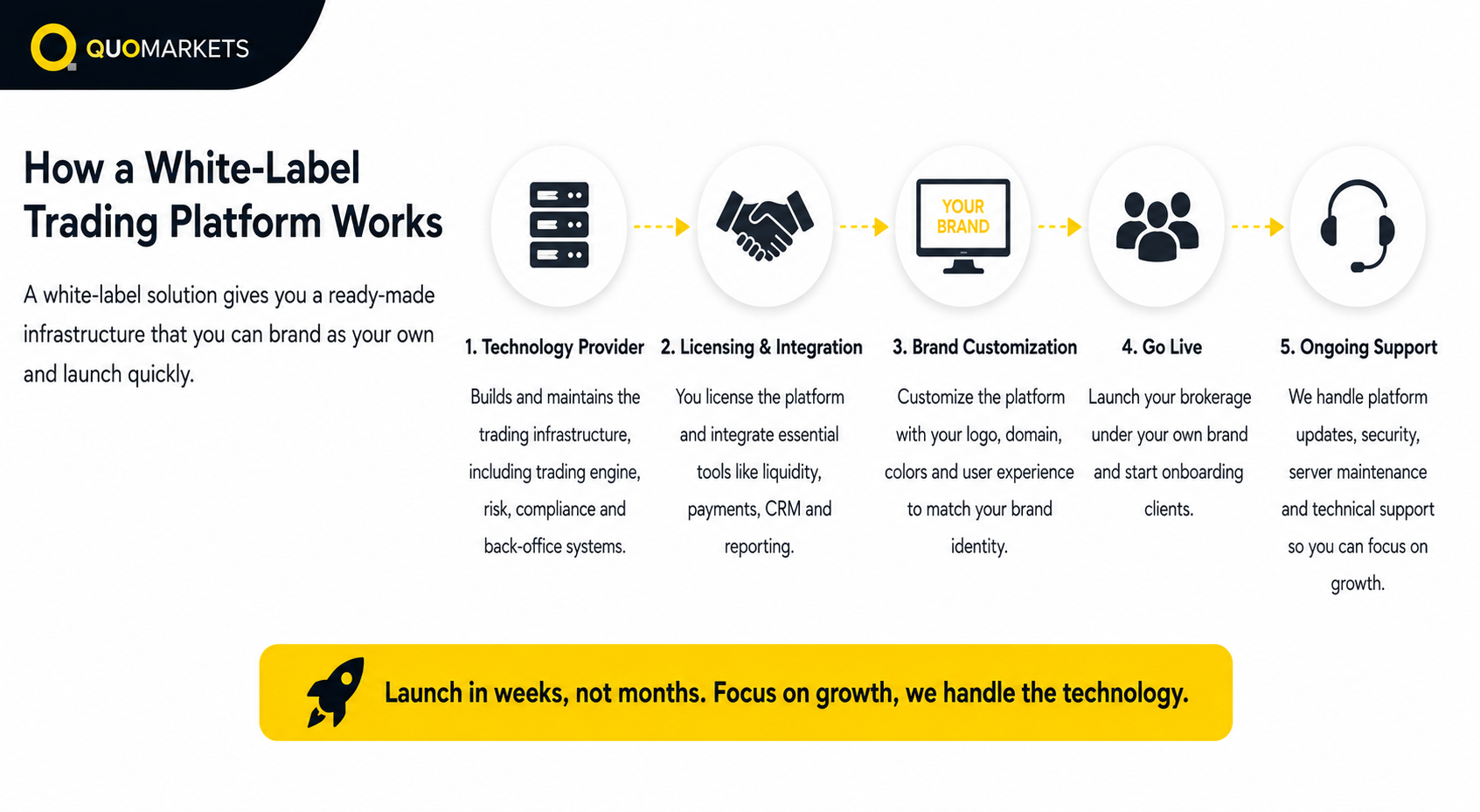
A white-label partnership is built around licensing, integration, and long-term support.
The technology provider develops and maintains the trading infrastructure, including the trading engine, execution systems, compliance tools, risk management features, and back-office operations. The partner company licenses access to this infrastructure and presents it to clients under its own brand.
From the client’s perspective, the platform appears fully owned by the broker. Logos, domains, mobile apps, dashboards, and platform colors are all customized to match the broker’s identity.
Most licensing agreements include platform access, software updates, technical support, and sometimes compliance assistance. Depending on the provider, pricing may involve a fixed monthly fee, revenue sharing, or a combination of both. Compared to building a proprietary platform, which can cost millions before launch, white-label trading software is far more affordable.
One of the biggest advantages is ongoing support. The provider handles server maintenance, platform upgrades, security updates, and infrastructure reliability, while the broker focuses on acquiring clients and growing the business. This is one of the main reasons why white-label forex platforms and white-label crypto trading platforms have become so widely adopted worldwide.
Many turnkey brokerage providers also help with onboarding, compliance setup, and integrations with payment gateways, CRM systems, and liquidity providers. In some cases, brokers can go live within a few weeks instead of spending 12 to 24 months building a custom solution.
Core Components of a White-Label Brokerage Solution
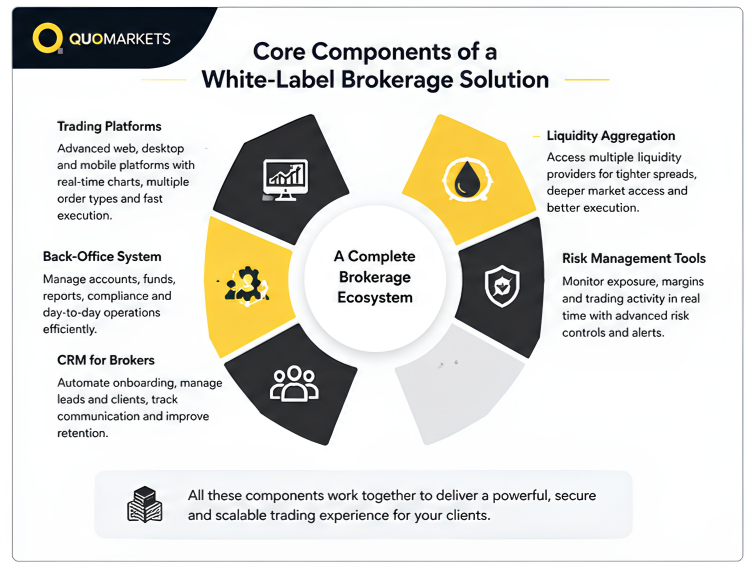
A professional white-label trading platform is made up of several integrated systems that together create a complete brokerage ecosystem.
Trading Platforms
The client-facing side usually includes desktop, web, and mobile trading terminals. These platforms support advanced charting, multiple order types, live pricing feeds, and fast execution. Many providers offer MT5 white-label integration because of MetaTrader 5’s strong reputation among global traders.
Back-Office System
The back-office manages operations such as account administration, deposits and withdrawals, reporting, and compliance documentation. A reliable back-office setup helps reduce manual work and operational risk.
CRM for Brokers
Broker-focused CRM systems automate onboarding, manage leads, store communication history, and organize client segmentation. For brokers, CRM software plays a central role in managing the entire customer lifecycle.
Liquidity Aggregation
Liquidity access directly affects spreads and execution quality. Strong white-label brokerage solutions connect brokers to multiple liquidity providers, helping deliver tighter spreads and deeper market access across forex, commodities, indices, and crypto assets.
Risk Management Tools
Integrated risk tools help brokers monitor exposure, margin levels, and trading activity in real time. Features such as automated alerts, hedging systems, and advanced execution controls protect both the broker and the client.
Together, these systems create a brokerage infrastructure that would otherwise require years of development and major financial investment.
Benefits of White-Label Trading Platforms for Brokers and Start-Ups
Lower Development Costs
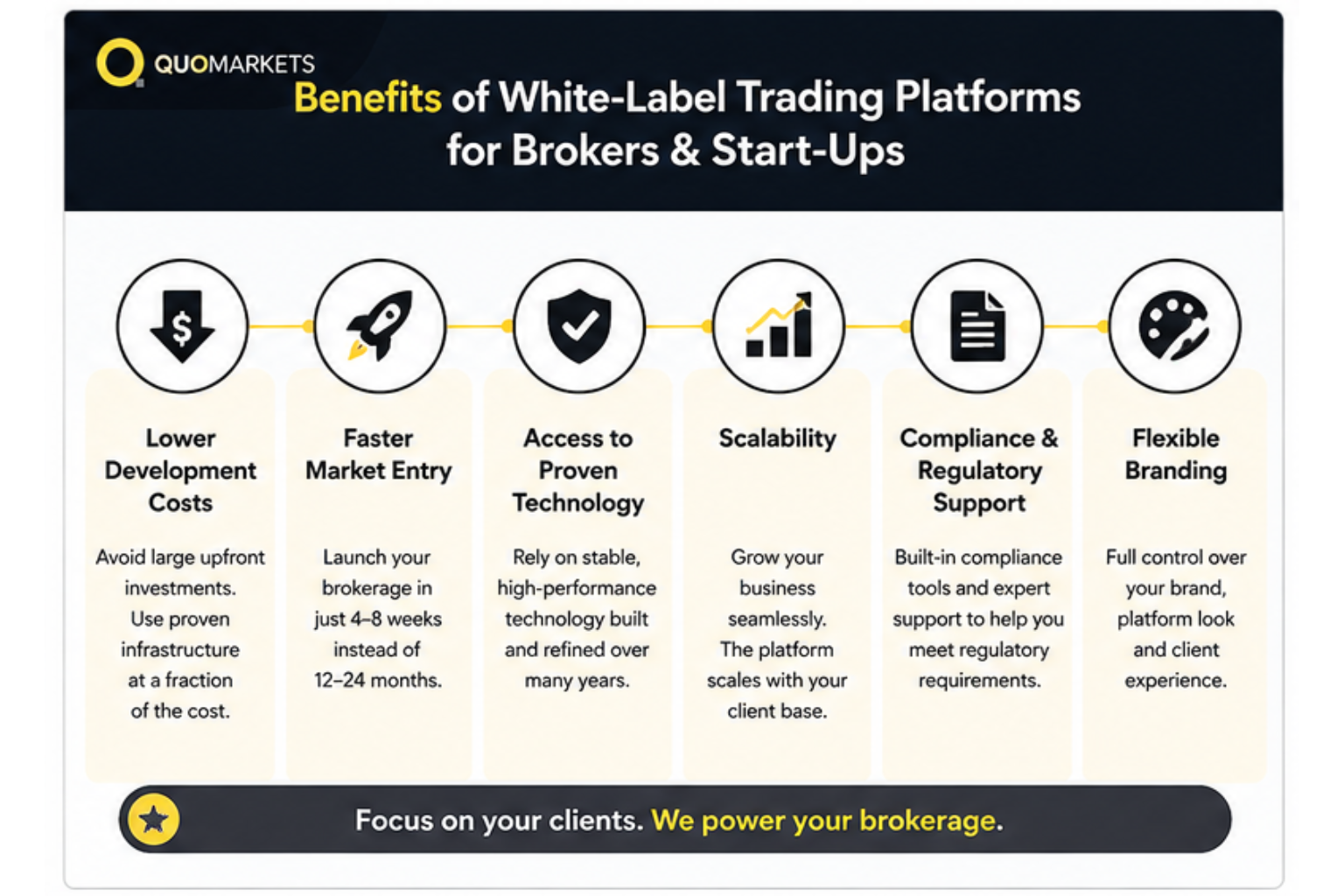
The cost of a white-label trading platform is significantly lower than building a custom solution. Instead of hiring developers, infrastructure engineers, and compliance specialists, brokers gain access to an already operational system through licensing. For many start-ups, this makes launching financially possible.
Faster Market Entry
For brokers wondering how to start a brokerage using white-label technology, speed is often the biggest advantage. A turnkey brokerage solution can shorten the launch process from more than a year to just four to eight weeks. In competitive markets, getting to market faster can create a major advantage.
Access to Proven Technology
The best white-label trading platforms are built on infrastructure refined over many years. Brokers benefit from mature technology, strong platform stability, and advanced functionality without developing it themselves. In trading, reliability plays a major role in building client trust.
Scalability
A strong white-label forex broker solution grows alongside the business. Whether a broker has 100 clients or 10,000, the infrastructure is designed to handle expansion. Brokers can also start with forex and later add crypto, commodities, or equities as the business evolves.
Compliance and Regulatory Support
Meeting regulatory requirements is one of the hardest parts of launching a brokerage. Many white-label providers include compliance tools within the platform and assist brokers with licensing and documentation requirements in different jurisdictions. For newer firms without an in-house legal team, this support can be extremely valuable.
Flexible Branding
Modern white-label solutions allow brokers to customize dashboards, onboarding flows, trading interfaces, and marketing materials to reflect their own identity. Clients interact entirely with the broker’s brand without seeing the underlying provider.
These advantages explain why white-label trading platform providers have become such an important part of the global brokerage industry.
Potential Drawbacks to Keep in Mind
Limited Control Over Technology
With a white-label solution, the provider controls the platform’s core development. If brokers need a feature that is not part of the provider’s roadmap, they may have to wait or compromise.
Dependence on the Provider
Platform uptime, security, and performance all depend on the provider’s infrastructure. If the provider experiences technical issues, the broker’s operations are affected too. This makes choosing a reliable white-label trading platform provider extremely important.
Revenue-Sharing Costs
Some white-label agreements involve revenue sharing, where part of the broker’s trading revenue goes to the provider. As the business grows, these costs can become substantial and should be carefully evaluated before signing long-term agreements.
Challenges With Differentiation
Although branding customization has improved significantly, brokers using the same provider may still share a similar user experience. Creating a truly unique product can sometimes be difficult within a shared infrastructure framework.
These limitations are manageable, especially when brokers work with providers offering flexible customization, strong support, and scalable commercial terms.
Why Choose EnterTrade’s White-Label Solution
EnterTrade provides a fully managed white-label brokerage infrastructure that enables partners to launch a regulated trading business under their own brand without building technology from scratch. It offers a complete ecosystem where everything operates under the broker’s brand, including:
- Branded trading platform (logo, domain, UI)
- Centralized Single Sign-On (SSO) hub for all modules
- Fully integrated trading execution environment
Clients experience a seamless branded environment while all backend systems remain unified.
EnterTrade’s infrastructure now includes a modular stack:
- TradingView Charting & Execution – professional-grade charting with direct order placement
- Liquidity & Execution Engine – supports A-Book, B-Book, and C-Book routing models
- KYC / KYB Compliance – automated onboarding and verification
- Funds Portal – deposits and withdrawals via cards, PSPs, and crypto (region dependent)
- Financial Reporting Tool – role-based reporting (Viewer, Explorer, Creator access)
- Client Portal & CRM (Pro package) – full lifecycle management, IB system, and promotions engine
- Support System (Pro package) – branded omnichannel ticketing system
- Social Trading (Pro package) – copy trading and trading competitions
- IB & Partner Management System – commission tracking and affiliate structures
- A/B/C-Book Risk Engine – institutional-grade execution control and risk routing
Instead of per-module licensing fees, EnterTrade operates on performance-based alignment:
Net PNL = Gross trading revenue − PSP fees − liquidity costs − IB commissions − operational costs ± B-book result
- EnterTrade earns only when brokers earn
- Tiered structure increases broker share as performance grows
- Incentives are aligned for long-term scalability
EnterTrade positions itself not just as a platform provider, but as a full brokerage infrastructure partner, combining trading technology, compliance, CRM, execution, and monetization systems into a single environment.
Final Thoughts
A white-label trading platform is not simply a shortcut to the market. It is a strategic business decision that allows brokers and fintech start-ups to launch faster, reduce costs, and access proven infrastructure from day one.
The right white-label partner can provide technology stability, compliance support, scalability, and branding flexibility that would take years to build independently. For businesses looking for that combination, EnterTrade’s white-label solution offers a strong starting point for building a competitive brokerage.
FAQs
What is a white-label trading platform?
A white-label trading platform is a ready-made brokerage system developed by a provider and rebranded by another company. It usually includes trading software, CRM tools, liquidity access, and risk management features.
How much does a white-label broker cost?
Costs vary depending on the provider and features included. Most setups involve an initial fee, monthly licensing costs, and sometimes revenue sharing. It remains far cheaper than building a custom platform.
How do white-label brokers work?
White-label brokers license existing trading technology, customize it with their own branding, and focus on client acquisition and operations while the provider manages the backend infrastructure.
Is white-label trading legal?
Yes. White-label trading is a widely used and legal business model, although brokers must still comply with licensing and regulatory requirements in their operating jurisdictions.