

Table of Contents
- Introduction
- Understanding Trading Rules and Account Requirements
- Choosing the Right Market to Trade
- Building Your Trading Setup
- Creating a Trading Strategy That Makes Sense
- Popular Day Trading Strategies
- Testing Your Strategy Before Going Live
- Risk Management and Protecting Your Capital
- Practicing and Reviewing Your Performance
- Frequently Asked Questions
Starting Day Trading in 2026: A Beginner’s Guide to Building the Right Foundation
Day trading continues to attract new investors because of the possibility of fast profits and the excitement of being actively involved in the financial markets. But understanding how to start day trading goes far beyond opening a platform and placing random trades. Successful traders rely on preparation, discipline, and a structured approach to managing risk.
Day traders buy and sell stocks or other financial assets within short periods of time, aiming to profit from small price movements during the same trading day. Unlike long-term investors who may hold positions for years, day traders usually close all trades before the market closes, avoiding overnight exposure and unexpected price changes while markets are inactive.
Starting day trading in 2026 requires a clear understanding of trading regulations, account requirements, market selection, technology, and strategy development. Traders also need emotional discipline and realistic expectations. With the right preparation, beginners can approach day trading with greater confidence and a stronger foundation.
Understanding Trading Rules And Account Requirements
Before entering the market, every new trader should understand the regulations that apply to trading accounts. These rules vary depending on the market and region, but they exist to protect investors and maintain fair market conditions.
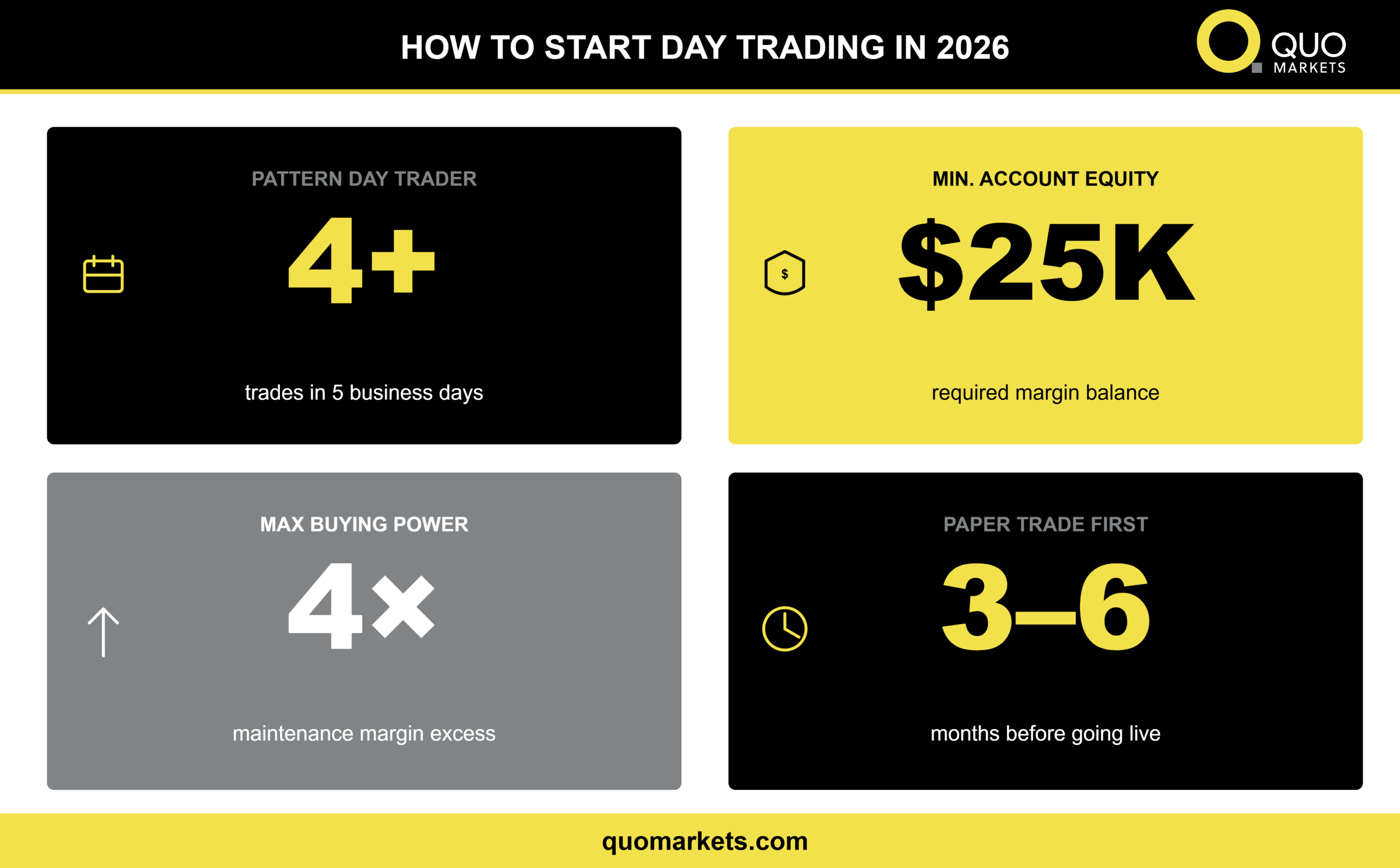
One of the most important regulations in the United States stock market is the Pattern Day Trader rule under FINRA regulations. A trader is classified as a pattern day trader when they complete four or more day trades within five business days, provided those trades account for more than 6% of their total activity during that period. Once an account receives this classification, it remains designated as a pattern day trading account even if trading activity later slows down.
Pattern day traders are required to maintain at least $25.000 in equity in their margin account on any day they actively trade. If the account balance drops below that level, day trading activity may be restricted until the required equity is restored. In addition, these traders can access the buying power of up to four times their maintenance margin excess, calculated using the previous trading day’s closing balance.
If a trader exceeds their allowed buying power, the broker may issue a margin call that usually needs to be resolved within five business days. During this period, trading restrictions may apply.
The structure of the trading account also matters. Cash accounts are often limiting for active day traders because securities must be fully paid for before being sold. As a result, most active traders prefer margin accounts, which provide access to borrowed capital and greater flexibility. However, leverage increases risk as much as it increases opportunity, making proper risk management essential.
In 2026, industry discussions have continued around replacing the fixed pattern day trader threshold with a more flexible risk-based intraday margin system. Even so, margin supervision and account regulation remain central parts of modern trading.
Most importantly, traders should always work with a regulated broker that offers transparent fees, reliable execution speeds, and strong client protection.
Choosing The Right Market To Trade
The next major step when starting day trading is deciding which market best matches your goals, experience level, and tolerance for risk. The most common markets for day traders include stocks, forex, cryptocurrency, and CFDs.
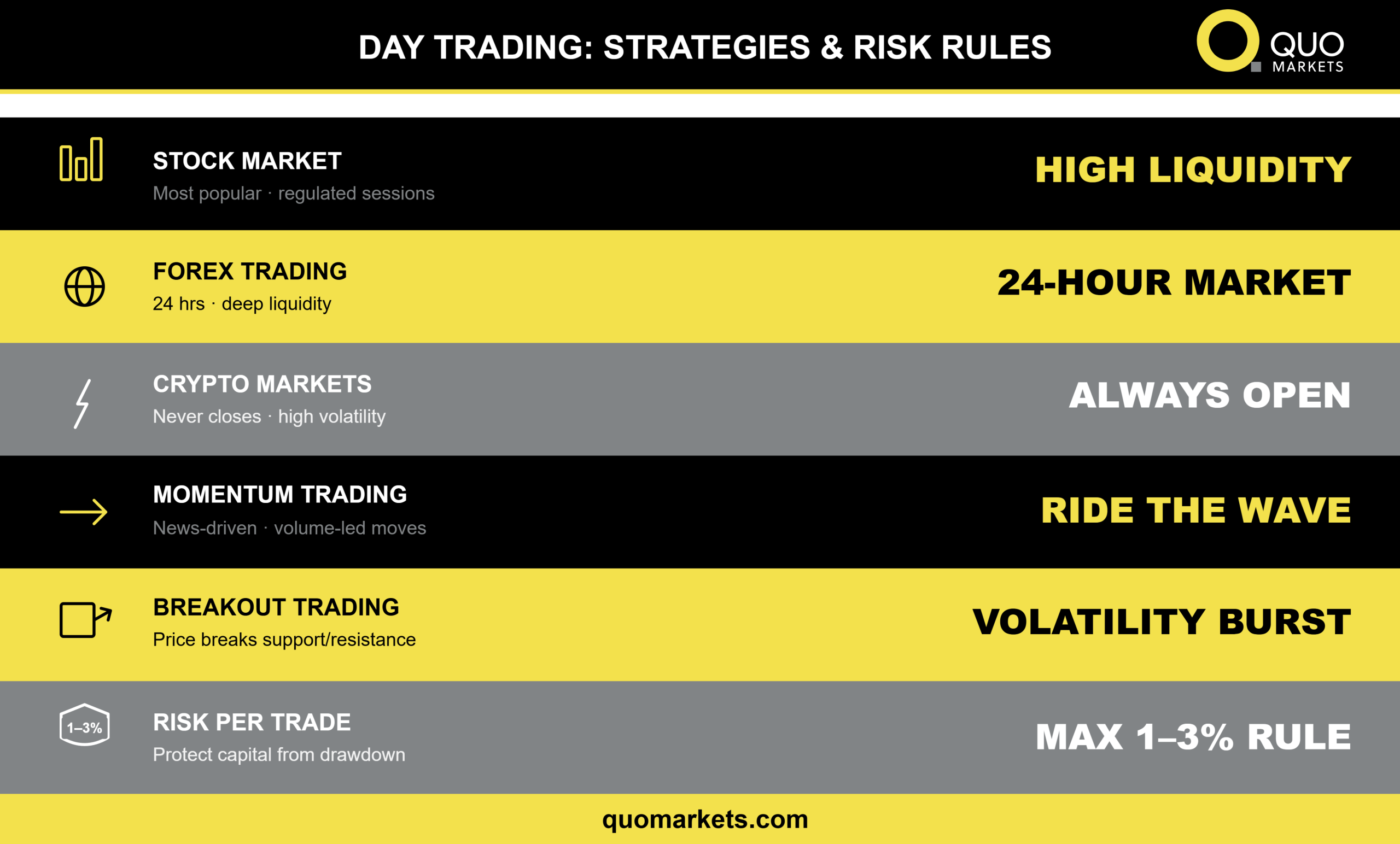
The stock market remains one of the most popular choices because it offers high liquidity, regulated trading environments, and predictable trading sessions. Many day trading stocks experience strong volatility and trading volume, creating opportunities around earnings reports, economic releases, and breaking news.
Forex trading attracts many active traders because currency markets operate almost twenty-four hours a day and provide deep liquidity. Exchange rates frequently move in response to economic indicators, interest rate decisions, and central bank announcements.
Cryptocurrency markets appeal to traders because they never close and often experience significant price swings. While this volatility can create opportunities, it can also expose inexperienced traders to substantial losses.
Contracts for difference, or CFDs, allow traders to speculate on price movements without owning the underlying asset itself. CFDs are commonly used in several regions, but they involve leverage, which increases both potential rewards and potential losses.
Beginners are usually better off focusing on a single highly liquid market instead of trying to trade multiple markets at once. Specializing in one environment helps traders understand price behavior, market reactions, and trading opportunities more deeply.
Building Your Trading Setup
Modern-day trading depends heavily on reliable technology. Fast execution, accurate market data, and strong analytical tools can significantly affect trading performance.
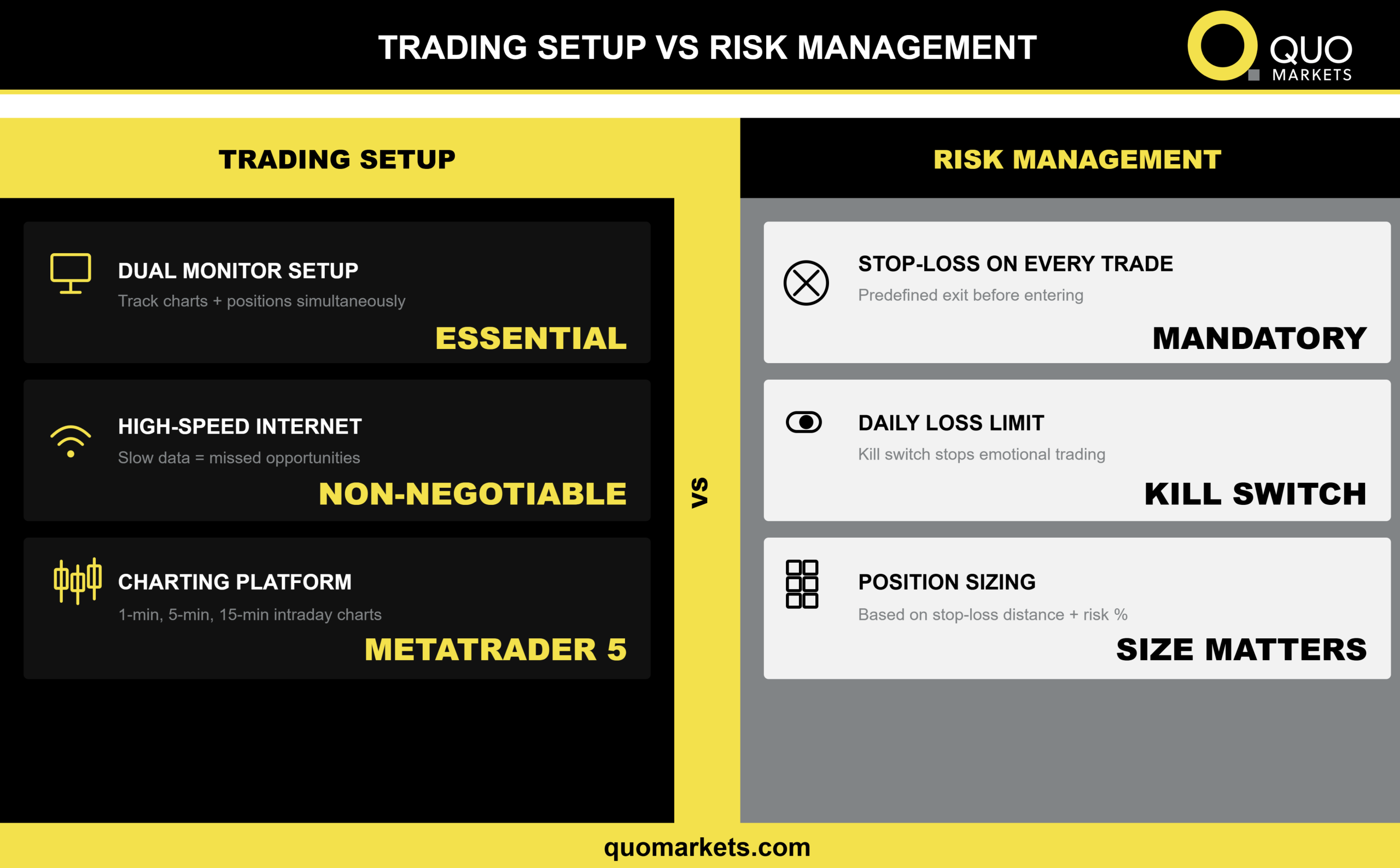
At the most basic level, traders need a dependable computer capable of running charting software and trading platforms smoothly at the same time. A stable high-speed internet connection is equally important because slow execution or delayed data can turn a profitable trade into a missed opportunity.
Many professional traders also rely on dual monitor setups. Multiple screens allow traders to track charts, monitor open positions, follow price action, and stay updated on market news simultaneously. More advanced setups may include additional monitors for technical indicators, news feeds, or order flow analysis.
The trading platform acts as the trader’s main workspace. Platforms like MetaTrader 5 provide real-time pricing, fast order execution, advanced charting tools, and customizable technical indicators. Many platforms also support automated trade management features.
Charting software helps traders identify trends, patterns, and potential entry or exit levels. Intraday traders commonly use one-minute, five-minute, and fifteen-minute charts to analyze short-term price action throughout the trading day.
Execution quality is another critical factor. Brokers that offer low commissions, direct market access, and fast execution speeds allow traders to respond quickly to short-term market movements. The rise of commission-free stock trading has also made financial markets more accessible for retail traders.
While strong technology alone cannot guarantee profitability, it allows traders to operate efficiently and make informed decisions.
Creating A Trading Strategy That Makes Sense
Simply being interested in financial markets does not qualify as having a trading strategy. A real strategy clearly defines when to enter a trade, where to place a stop-loss, how much capital to risk, and where to take profit. Without those rules, trading becomes little more than guessing.
Most day trading strategies are built around technical analysis rather than long-term fundamental analysis. Traders use charts, indicators, and market data to identify patterns and determine potential trade setups.
Popular Day Trading Strategies
Momentum trading is one of the most common approaches among active traders. This strategy focuses on assets experiencing strong price movement driven by news, earnings surprises, or unusually high trading volume. Traders aim to profit while momentum continues building.
Breakout trading focuses on moments when the price breaks above resistance or below support levels. These breakout points often lead to increased volatility and rapid price movement once the market escapes established ranges.
Scalping is another widely used day trading strategy. Scalpers place many trades throughout the trading day, targeting small profits that gradually accumulate over time.
Reversal trading attempts to identify moments when a market becomes overextended and is likely to reverse direction. Traders rely on technical indicators and price action signals to spot overbought or oversold conditions.
Testing Your Strategy Before Going Live
Before risking real money, traders should test their strategies using historical market data. Backtesting allows traders to evaluate how a strategy would have performed in previous market conditions. Although past performance never guarantees future success, it helps determine whether a strategy has logical consistency.
After backtesting, traders should spend at least three to six months paper trading through a simulated account that reflects real market conditions without exposing real capital to risk. This stage is not only about testing the strategy itself. It is also about developing discipline, patience, and emotional control before live trading begins.
Risk Management And Protecting Your Capital
Risk management is one of the most important aspects of day trading. Even experienced traders take losses regularly, which means survival depends on controlling risk effectively.
A common rule among traders is to risk no more than one to three percent of the account balance on a single trade. This approach helps protect trading capital from major drawdowns while allowing traders to continue participating in future opportunities.
Position sizing is equally important. Traders must determine how many shares or contracts to trade based on their stop-loss distance and acceptable level of risk. Poor position sizing can turn even small price movements into substantial losses.
Using leverage through margin accounts increases buying power, but it also magnifies losses. Traders using borrowed funds should remain fully aware of margin requirements and maintain enough capital to avoid forced liquidations.
Many traders also set daily loss limits. This type of trading “kill switch” automatically stops trading once losses reach a predetermined amount, helping prevent emotional decisions such as revenge trading.
Protecting capital through disciplined risk management should always remain the top priority.
Practicing And Reviewing Your Performance
One of the safest ways to begin day trading is by practicing through paper trading accounts. Most trading platforms offer demo environments that simulate real market conditions without risking real money.
Beginners should spend several months paper trading before transitioning to live markets. This allows them to test strategies, learn platform functionality, and become comfortable with the pace of the trading day.
During this stage, traders should keep a detailed trading journal. Recording entry points, exit points, position size, reasoning behind each trade, and final outcomes helps identify both strengths and recurring mistakes.
A trading journal also highlights emotional patterns. Many traders discover that impatience, fear, or frustration often lead to unnecessary trades or poorly timed exits. Recognizing these habits is essential for building emotional discipline.
Once traders achieve consistent results in a simulated environment, they can begin trading with small real-money positions. Starting small reduces psychological pressure while allowing traders to adapt to real market conditions.
Regular performance reviews are also critical. Weekly or monthly evaluations help traders identify which strategies perform consistently and which approaches lead to repeated losses. This habit transforms trading from random speculation into a disciplined process.
Final Remarks
Starting day trading in 2026 is not about chasing fast money or finding shortcuts to instant success. It is about developing a disciplined process built on education, regulation awareness, reliable technology, strategy development, and responsible risk management.
The traders who succeed long-term are usually the ones who respect the process. They learn the rules, focus on one market, manage their capital carefully, and evaluate their performance honestly.
Patience and consistency matter far more than any single winning trade. Markets will continue offering opportunities every day. The goal is to build the discipline and longevity needed to stay in the game.
FAQs
What Is The Pattern Day Trader Rule?
The Pattern Day Trader rule states that traders who execute four or more day trades within five business days in a margin account are classified as pattern day traders and must maintain at least twenty-five thousand dollars in account equity.
Should Beginners Start With Paper Trading?
Yes. Paper trading allows beginners to practice strategies, understand trading platforms, and gain experience without risking real capital. Many professionals recommend practicing for several months before transitioning to live trading.
Is Day Trading Profitable For Beginners?
Day trading can become profitable, but it is extremely challenging for beginners. Many new traders lose earnings early because markets move quickly and require strong discipline, emotional control, and effective risk management.
What Is Day Trading?
Day trading involves buying and selling financial instruments within the same trading day in order to profit from short-term price fluctuations. Most day traders close all positions before the market closes to avoid overnight exposure.