

Table of Contents
- How Much Do You Actually Need to Start Trading Forex in 2026?
- What Brokers Actually Require to Open an Account
- Leverage: The Part That Changes Everything
- Risk Management and Position Sizing: The Math Most Beginners Skip
- Realistic Starting Ranges for Different Types of Traders
- Start With the Right Foundation, Not Just the Fastest Entry
- FAQs
How Much Do You Actually Need to Start Trading Forex in 2026?
Spend five minutes in any trading forum, and you’ll see the same debate playing out. Someone claims they turned $10 into serious money. Someone else says you need tens of thousands just to open a chart. Both sides are wrong, and both sides are also a little bit right.
The truth is that the right starting capital for forex trading is personal. It depends on your goals, how much risk you can stomach, which broker you pick, and how seriously you’re treating this. A hobbyist dabbling on weekends has completely different needs than someone building a structured trading routine.
Below is a realistic breakdown of the actual numbers, what the risks look like, and what should be sitting in your account before you place your first live trade.
What Brokers Actually Require to Open an Account
Funding requirements vary more than most beginners expect, and the differences between account types matter.
Micro Accounts are where most new traders start. Many brokers market beginner accounts with low entry points, sometimes ranging from $10 to $100, though the exact figure depends on the broker and payment method. These accounts let you trade micro lots (0.01 lots), meaning smaller positions and more breathing room while you’re still learning. QuoMarkets, for example, has minimum deposits that vary by payment system and can start from $1, though payment-method floors may still apply.
Standard Accounts generally require more than entry-level accounts, with the exact figure varying by broker. You get access to standard lot sizes and usually tighter spreads. If you already have some experience and want more flexibility in how you size your positions, this type of account is worth considering.
ECN Accounts are built for more active or professional traders. Raw spread or ECN-style accounts tend to have higher deposit requirements and usually add a commission structure, though specifics differ across firms.
One thing worth keeping in mind: a broker’s stated minimum deposit and the amount you actually need to trade sensibly are two different figures. A broker letting you open an account with $50 doesn’t mean $50 is enough to manage risk the way you should be.

Leverage: The Part That Changes Everything
Leverage is probably the most misunderstood concept in forex, and it has a direct effect on how much capital you actually need to get started.
Leverage lets you control a position much larger than your deposit. A 1:100 ratio means $100 in your account can control a $10,000 position. A 1:500 ratio stretches that same $100 to control $50,000 worth of currency. That sounds like an incredible edge. In practice, it’s a tool that can wipe out an underfunded account in minutes.
Here’s a concrete example. Say you want to trade 0.1 lots on EUR/USD. One standard lot equals 100,000 units, so 0.1 lots is a $10,000 position.
Without leverage, you’d need $10,000 to control that position outright. With 1:100 leverage, you only need $100 in margin. With 1:500, that drops to $20.
So why not just use maximum leverage and trade on $20? Because a small move against your position can trigger a margin call before you’ve had a chance to react. At 1:500, a 0.2% adverse move in the pair is enough to wipe out your entire margin. People who make their initial investment decisions based purely on leverage ratios, without factoring in an account cushion, almost always blow their accounts.
Regulatory caps vary by region. EU retail brokers are limited to 1:30 leverage on major pairs under ESMA rules. In the US, the CFTC caps it at 1:50 for majors. Offshore brokers often offer much higher ratios, but those come with their own risks.
The practical point: lower leverage gives your account room to survive bad trades. The more capital you start with, the less leverage you need, and the more sustainable your trading becomes over time.
Risk Management and Position Sizing: The Math Most Beginners Skip

This is where most beginners cut corners, and where most beginners lose money. Getting risk management and position sizing right matters more than finding the perfect entry point on any given trade.
The rule you’ll hear from experienced traders over and over: never risk more than 1 to 2 percent of your trading capital on a single trade. That’s not just conventional wisdom. It’s what keeps traders in the game long enough to actually improve.
Here’s how it works. With a $1,000 starting balance and the 1% rule, you’re risking $10 per trade. If your stop loss sits 20 pips from your entry on EUR/USD (where each pip on a 0.1 lot trade is worth roughly $1), your maximum position size is 0.1 lots. Push that to 0.3 lots with the same stop loss, and you’re risking $30, or 3% of your account, which puts you outside responsible parameters.
Run the same calculation on a $500 account. At 1% risk, you can only lose $5 per trade. With a 20-pip stop loss, your maximum position size drops to 0.05 lots. That’s perfectly viable, but your flexibility is limited. Setups requiring wider stop losses become harder to take, and every losing streak hits proportionally harder.
A $500 account with proper risk management can absolutely survive and grow. It just requires a level of discipline that many beginners are still developing.
The formula worth keeping handy:
Position Size = (Account Balance × Risk Percentage) ÷ (Stop Loss in Pips × Pip Value)
Run this before every trade. No exceptions.
Risk management also means thinking about the overall drawdown. Losing streaks happen to every trader. At 1% risk per trade, five consecutive losses put your account down 5%. That’s recoverable. At 10% risk per trade, five losses leave you down nearly 41%. That kind of damage is both financially and psychologically hard to come back from.
Realistic Starting Ranges for Different Types of Traders
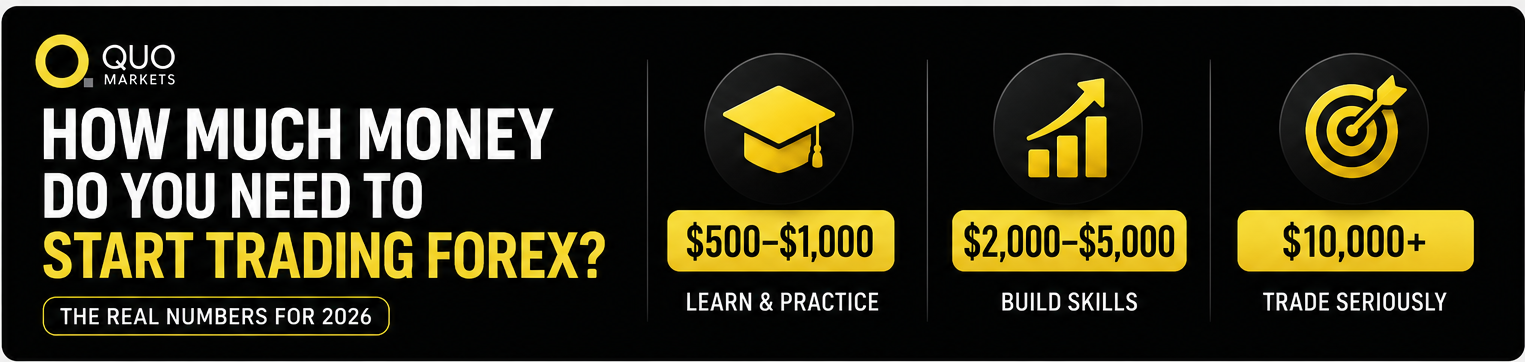
With the mechanics clear, here’s what the numbers actually look like for real situations.
Casual Traders and Complete Beginners: $500 to $1,000
If you’re learning how the market moves and getting comfortable with a platform, $500 to $1,000 is a workable range. You won’t be generating serious income at this level, but that’s not the point. The goal is learning without catastrophic losses.
Stick to micro lots, use conservative leverage, and treat every trade as a lesson. Starting with $100 is technically possible, but it leaves almost no room for error. Be honest with yourself about whether that kind of pressure serves your development.
Serious Beginners With a Plan: $2,000 to $5,000
This range starts to make practical sense for someone approaching forex as a skill worth developing over time. With $2,000 to $5,000, you can trade standard position sizes with proper risk management, absorb normal drawdowns without panicking, and build a track record worth actually analyzing.
The psychology also becomes more manageable here. Having a reasonable cushion reduces the urge to over-leverage or trade emotionally after a loss, both of which are fast ways to destroy an account.
Day Traders and Swing Traders: $10,000 and Above
For anyone treating forex as a serious income source or primary trading activity, $10,000 is a more realistic floor. At this level, you can run lower leverage ratios (1:10 or less), trade multiple pairs at once, and generate meaningful returns from percentage gains without taking on extreme risk.
Professional traders work with significantly larger accounts, and that’s precisely what allows them to be conservative with risk while still producing results. The connection between capital and long-term sustainability is direct.
Can you build your account with a small capital? Yes. Just accept that growth will be gradual, leverage should stay low, and skill development comes before income generation.
Start With the Right Foundation, Not Just the Fastest Entry
Everything above points to the same conclusion: the right amount to start trading forex is whatever lets you manage risk properly, absorb losses without panic, and stay in the market long enough to genuinely improve.
Starting small is fine. Starting underfunded and over-leveraged is where traders run into serious trouble. Whatever you deposit, make sure it’s money you can afford to lose entirely.
Before funding any live account, spend real time on a demo account. Every reputable broker offers one. Demo trading lets you test your approach, learn the platform, and work through position sizing in real conditions, without any financial consequences. It’s not exciting, but it’s how traders build the kind of foundation that actually holds up.
When you go live, start modest, trade small, follow your risk rules without shortcuts, and give yourself time. The market isn’t going anywhere.
FAQs
Can you start forex trading with $100?
Yes, many brokers allow micro accounts funded at $100 or less. At 1% risk per trade, you’re risking $1 per position, which severely limits your flexibility. It’s possible to learn at this level, but treat it as a training exercise rather than an income attempt.
Is $500 enough to trade forex?
$500 is a workable starting point if you trade micro lots and follow strict risk rules. Your returns in dollar terms will be modest, but you can develop solid habits and grow your account from there.
What is the minimum amount to start forex trading?
Some brokers and payment methods allow funding from as little as $1 to $10. Realistically, trading responsibly at that level is nearly impossible. $500 is a more sensible minimum for meaningful practice, with $1,000 or more giving beginners a reasonable margin for error.
How much do professional forex traders use?
Professional traders and institutional desks typically work with accounts ranging from tens of thousands to millions of dollars. The larger account size is what allows them to use lower leverage, take smaller percentage risks, and stay profitable without relying on high-risk strategies.
How much money can you lose in forex trading?
In a standard retail account without negative balance protection, you can lose your entire deposit. With negative balance protection (offered by many regulated brokers, including QuoMarkets), your maximum loss is capped at your account balance. Starting with an amount you can afford to lose entirely, and always using stop-loss orders, is the foundation of responsible forex trading for beginners.