

Table of Contents
- What You Should Actually Know Before You Download
- What Separates a Great Mobile Trading App from a Pretty-Looking One
- Top Mobile Trading Platforms in 2026
- How to Find the Right Mobile Trading App for You
- Final Thoughts
- FAQs
The Best Trading Apps for Mobile Trading in 2026: What You Should Actually Know Before You Download
There was a time when placing a trade meant sitting at a desk, staring at multiple screens, and working through some broker’s clunky web interface. That era is long gone. Today, the best trading apps for mobile put powerful, professional-grade tools right in your pocket, and traders are using them everywhere, on commuter trains, in coffee shops, wherever an opportunity shows up.
The growth has been hard to ignore. Smartphones now drive a meaningful share of retail trading volume worldwide, and brokers are pouring serious resources into mobile-first experiences that can compete with any full desktop terminal. But more competition also means more noise. There are dozens of platforms all pushing for your attention, and plenty of them don’t deserve it. Choosing the wrong app can cost you in fees, headaches, and trades you simply miss.
What Separates a Great Mobile Trading App from a Pretty-Looking One
Before you open an app store, it helps to know what actually matters in a mobile trading platform versus what just makes for a good screenshot. Here’s what to focus on.
Security and Regulation
This one’s a given. Any app that handles your money needs to be backed by a licensed, regulated broker. Look for oversight from credible bodies like the FCA, ASIC, FSA, or equivalent regulators in your part of the world. Two-factor authentication, data encryption, and clear privacy disclosures are baseline expectations in 2026 – they’re the floor, not a bonus.
Range of Markets
The top mobile platforms are increasingly merging stocks, forex, and crypto into one place. Whether you’re trading forex pairs, CFDs, indices, commodities, or cryptocurrency, having access to all of it from a single account is far more practical than juggling multiple apps.
Fees and Cost Structure
Mobile trading apps span the full spectrum, from commission-free platforms to ones that charge per trade or quietly widen spreads to generate revenue. Neither model is inherently worse, but you need to know exactly how your chosen platform makes its money. Low spreads, clear commissions, and no hidden charges are what you’d expect from a trustworthy broker.
Charting and Technical Tools
Active traders need real-time data, solid charting, and a decent library of technical indicators. If an app gives you only basic candlestick charts with no way to adjust timeframes or layer on indicators, it’s simply not built for serious trading.
User Interface
A cluttered interface is more than just annoying. When markets are moving fast, a confusing layout costs you real time and, potentially, real money. The best mobile trading apps manage to balance deep functionality with a clean, logical design, so you can move between your watchlist, charts, and order screen without thinking twice about it.
Customer Support
Things go wrong at the worst possible moments. A platform with fast, multilingual support, ideally around the clock, is worth a small premium. Quick withdrawal processing and accessible live chat are both strong signs that a broker actually cares about its clients.
Top Mobile Trading Platforms in 2026
QuoMarkets
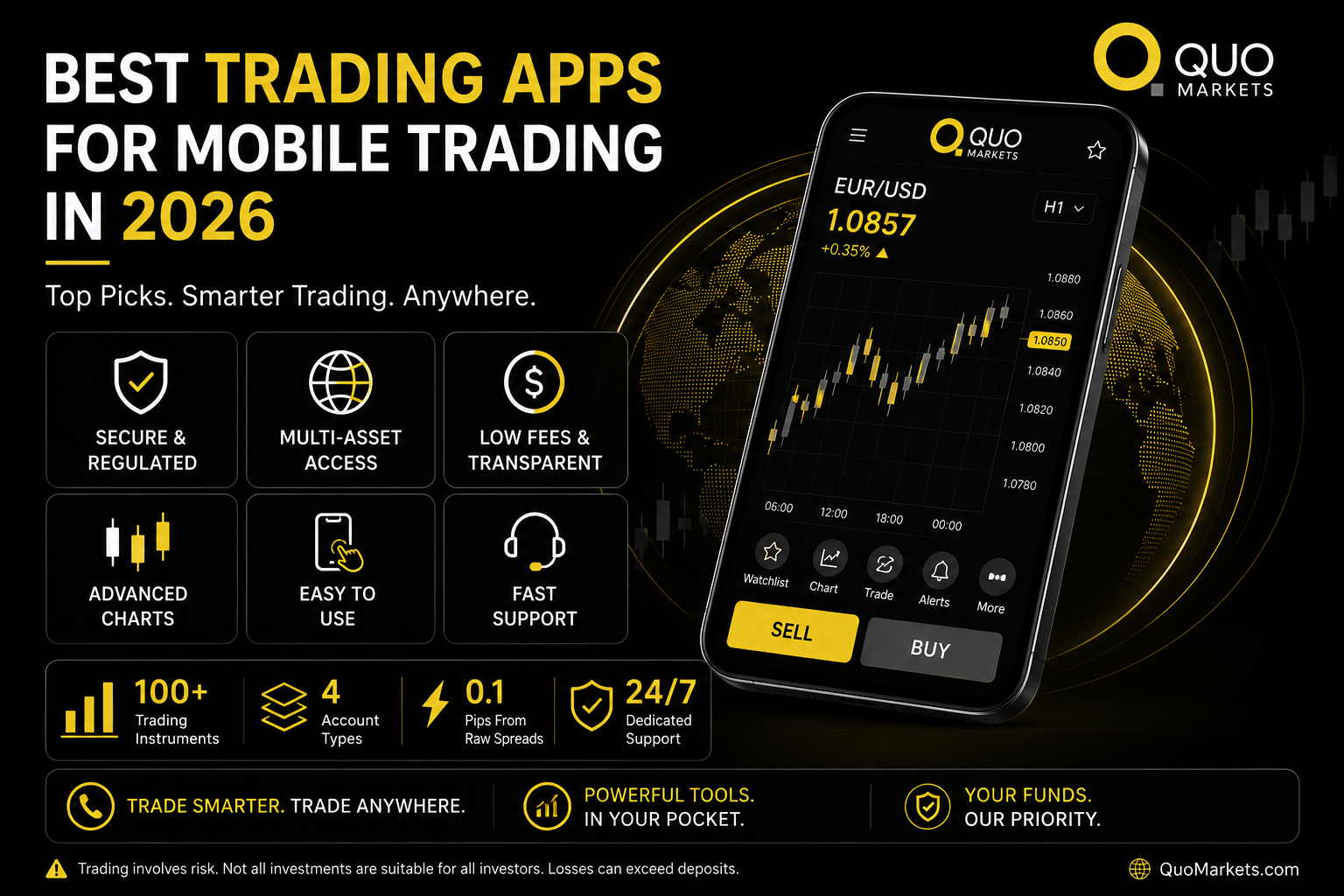
QuoMarkets has been quietly building its reputation since launching in 2020, and by 2026, it’s grown into a solid choice for traders who want a clean, multi-asset platform with genuinely competitive pricing.
The platform runs on MetaTrader 4 and MetaTrader 5, both available for Android and iOS, alongside a newer MT5 Supercharts interface that delivers a more modern, multi-window charting experience. Traders can stick with the familiar MT5 terminal or switch to Supercharts for richer visualization tools. The mobile apps are fast, stable, and responsive even during high-volatility sessions, based on consistent user feedback.
Instrument coverage is broad – hundreds of tradable assets across forex, metals, indices, cryptocurrencies, energies, and stocks – making it a strong pick for traders who move across asset classes. There are four account types: Standard, Raw, Zero, and Limitless. Spreads start from 0.1 pips on the Raw account, while the Zero account offers zero-spread pricing on a selected basket of instruments for the majority of the trading day. Commissions sit at $3 per side on Raw and $4 per side on Zero, with no commission on Standard or Limitless accounts.
Copy trading is built into the platform with strategy profiles and subscription tools that work well for newer traders who want to learn by following more experienced ones. Funding options include bank wire, cards, Skrill, Neteller, and multiple cryptocurrencies. Fast withdrawal processing is something user reviews bring up repeatedly.
eToro
eToro is probably the most recognizable name in social and copy trading apps, and for good reason. It has built a loyal global user base by combining standard brokerage functionality with a community-driven trading network that genuinely feels different from anything else on the market.
The CopyTrader feature lets you allocate funds to top-performing investors and mirror their trades automatically, which makes it a natural fit as one of the best trading apps for beginners. Smart Portfolios offer another layer of passive involvement, bundling assets around investment themes. The app is available on both Android and iPhone with a clean, accessible interface that prioritizes ease of use over deep technical capability.
Instrument coverage includes stocks, ETFs, cryptocurrencies, indices, commodities, and CFDs, all within a single account. Crypto fees run at around 1%, which is higher than dedicated exchanges, and eToro charges a $5 withdrawal fee. Advanced charting is more limited compared to MT5-based platforms, with 46 technical indicators available versus the 100-plus you would find on MetaTrader. eToro is regulated by the FCA, ASIC, and CySEC, making it one of the most tightly supervised options on this list.
Interactive Brokers (IBKR)
For traders who put precision, depth, and global market access above everything else, Interactive Brokers remains the standard to beat. The IBKR mobile app, available on iOS and Android, doesn’t trim features just because you’re trading from a phone. You get streaming real-time data, more than 150 technical indicators, and dozens of drawing tools.
The platform covers stocks, options, futures, forex, bonds, ETFs, and CFDs, making it one of the most complete options available for professional instruments. IBKR is regulated by top-tier authorities across multiple jurisdictions – the SEC, FCA, ASIC, and others – which gives it the strongest regulatory standing of any broker on this list.
The trade-off is the learning curve. The sheer density of features means newer traders can easily feel overwhelmed. The interface rewards familiarity, and the educational content assumes a baseline of financial knowledge that true beginners may not yet have.
Webull
Webull carved out its space as the platform for technically minded retail traders who wanted real-time charting, extended-hours trading, and no commissions on stocks and ETFs. In 2026, it continues delivering on that while steadily expanding what it offers.
The mobile app, available for Android and iPhone, has a polished design with advanced charting tools, a full range of technical indicators, paper trading for practice, and access to stocks, ETFs, options, futures, and cryptocurrencies. Webull has expanded its crypto trading capabilities and integrated them more tightly into the platform. The app also pays competitive interest on uninvested cash – a genuinely useful passive feature for traders who like to keep some cash on hand.
Webull is a regulated brokerage operating primarily in the United States. It’s less globally available than some alternatives, and social or copy trading features aren’t part of the package.
How to Find the Right Mobile Trading App for You
Choosing between the best mobile trading apps in 2026 comes down to matching the features to how you actually trade, rather than chasing the biggest brand name or the slickest marketing.
Start with the basics. If you’re new to trading, look for platforms with clear interfaces, built-in education, and demo accounts where you can practice before touching real money. Both eToro and QuoMarkets offer demo functionality, which is genuinely invaluable while you’re still working out your strategy.
If you’re an active day trader focused on equities, you want commission-free structures, strong charting, and fast execution. Webull and Interactive Brokers are worth serious consideration there.
If forex and multi-asset CFD trading are your focus, you want an MT5-based platform with competitive spreads and wide instrument coverage. That’s where QuoMarkets beats competitors.
Also, think about the practical side: Is the app stable on your device? Can you reach customer support quickly when something goes wrong? Are deposits and withdrawals handled smoothly? These day-to-day operational details matter more than most traders realize, and platforms like Trustpilot, Myfxbook, and BrokersView give you a useful ground-level view of what clients actually experience.
And always test on a demo account before putting in real money. A few hours of practice trading will tell you more about whether an app suits your style than any review article.
Final Thoughts
The mobile trading landscape in 2026 is more capable and more competitive than it’s ever been. Whether you’re after a strong stock trading app, a dedicated forex platform, or a full multi-asset CFD environment, genuinely good options exist across the board.
What matters is making a deliberate choice. Look at your trading style, understand the fee structure, check the regulatory status of any platform you’re considering, and always test before committing real capital.
If you’re curious about QuoMarkets specifically, the most straightforward advice is to start with a demo account. Get comfortable with the MT5 and Supercharts interfaces, test the order execution speed, explore the copy trading features, and see whether the platform fits how you actually trade. There’s no cost and no obligation. The right app is the one you trust, understand, and can execute your strategy on with confidence.
FAQs
What is the best trading app for beginners in 2026?
For beginners, eToro and QuoMarkets are both strong starting points. eToro’s social trading and CopyTrader features make learning easier by letting you observe and follow experienced traders. QuoMarkets offers a full demo account with access to its MT5 platform, so newer traders can practice forex and multi-asset trading without any financial risk.
Which mobile trading app has the lowest fees?
It depends on the asset class. For commission-free stock and ETF trading, Webull and eToro are consistently competitive. For forex and CFDs, QuoMarkets’ Raw account starts at spreads of 0.1 pips with a $3 per side commission, while its Zero account offers zero spreads on a selected basket of instruments.
Are trading apps safe to use?
Reputable trading apps from regulated brokers are generally safe, provided you take basic precautions. Use strong, unique passwords, enable two-factor authentication, and only download apps through official app stores or the broker’s own website.
Can you trade forex on a mobile app?
Yes. Forex trading on mobile is fully supported by platforms like QuoMarkets, Interactive Brokers, and eToro. QuoMarkets’ MT4 and MT5 mobile apps in particular are built around forex and multi-asset CFD trading, offering real-time quotes, advanced charting, and direct order execution from your phone or tablet.
What features should a good mobile trading app have?
At a minimum: real-time market data, a solid library of technical indicators, multiple order types, portfolio tracking, and price alerts. Security features like two-factor authentication are essential. For more advanced use, look for copy trading functionality, access to multiple asset classes, stable performance during volatile periods, and responsive customer support.