
Oil Price Today: What Really Moves WTI and Brent
Oil prices never sit still for long. A headline from the Middle East, a surprise inventory report from the United States, a shift in OPEC+ production policy – any one of these can send crude benchmarks swinging within hours. For retail CFD traders watching WTI and Brent, understanding what actually drives these moves is the foundation of every informed decision.
This article breaks down the mechanics behind crude oil pricing. You will learn what determines oil prices, why WTI and Brent trade at different levels, and which forces tend to push the market up or down. By the end, you will have a clearer framework for reading oil market headlines and spotting potential trading opportunities.
What Really Sets the Price of Oil?
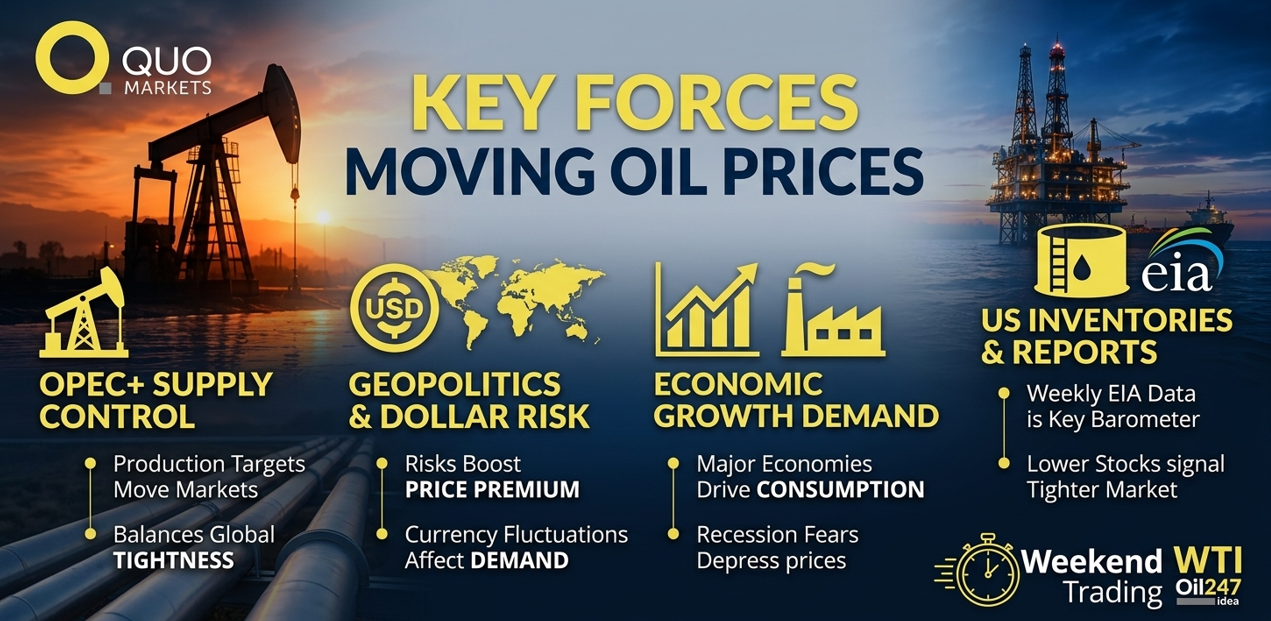
At its core, the price of oil reflects the balance between supply and demand. When global oil supply exceeds demand, prices tend to fall. When demand outpaces available supply, prices rise. That sounds simple, but the reality is messier.
Supply and demand for crude oil do not adjust quickly. Production capacity is relatively fixed in the short term. It takes years to develop new oil fields or build pipelines. On the demand side, factories, vehicles, and power plants cannot instantly switch to alternative fuels when prices spike. This means even small shifts in supply or demand can trigger large price movements.
Inventories act as the physical bridge between production and consumption. When production exceeds consumption, excess crude goes into storage. When consumption outpaces production, inventories are drawn down. Falling crude inventories often signal tighter supply conditions and can support higher prices. Regular inventory data releases, particularly from the U.S. Energy Information Administration, serve as key barometers for market tightness.
Market expectations matter just as much as physical barrels. Traders constantly assess future supply and demand conditions, and those perceptions get priced into oil futures contracts. A single report suggesting stronger economic growth can lift futures prices before any physical shortage materializes. This forward-looking behavior is why oil markets often seem to move on sentiment rather than current fundamentals alone.
Refinery activity matters too. When refineries increase crude processing to meet strong gasoline, diesel, or jet-fuel demand, crude demand can rise; maintenance or outages can have the opposite effect.
WTI vs Brent: Why Two Barrels, Two Prices?
Two crude oil benchmarks dominate global trading: West Texas Intermediate and Brent. Understanding the Brent vs WTI distinction is essential for anyone trading oil.
WTI is a light, sweet crude benchmark associated with U.S. production, particularly in Texas and southern Oklahoma. Its futures contract is physically settled at Cushing, Oklahoma. It trades on the New York Mercantile Exchange (NYMEX) and serves as the primary benchmark for U.S. oil. Its price reflects domestic supply and demand conditions, including crude inventory levels and U.S. shale oil production trends.
Brent is the leading international crude oil benchmark, based on a basket of waterborne North Sea crude grades. Up to two-thirds of the world’s oil is priced relative to the Brent complex, making it the key international benchmark, which trades on the Intercontinental Exchange (ICE) in London. Because Brent is waterborne and easier to export, it typically trades at a premium to WTI. The spread between the two benchmarks, known as the Brent-WTI spread, is influenced by transport logistics, regional supply conditions, and the relative cost of moving crude to refineries.
When you see headlines about global oil prices, they usually refer to Brent. When the focus is on U.S. production or domestic inventories, WTI takes center stage. Both matter, but they respond to different regional dynamics even as they move in broad sync.
OPEC+ and the Power to Move Markets
The Organization of the Petroleum Exporting Countries, along with its allies in the OPEC+ coalition, controls a substantial share of global oil production. Their decisions on output quotas directly influence market tightness and oil price levels.
OPEC+ production targets function as a supply management tool. When the group cuts production, it removes barrels from the market and typically supports higher prices. When it increases output, prices often face downward pressure. The cartel has historically acted as a stabilizing force, with Saudi Arabia frequently adjusting its own production to help balance the market.
That role has evolved. The rise of U.S. shale oil production over the past decade has diminished OPEC’s ability to single-handedly dictate prices. When OPEC cuts output to support prices, higher prices can encourage American producers to ramp up drilling, effectively capturing market share. This dynamic has led to periods where OPEC+ chose to defend market share rather than prices, contributing to significant price declines.
OPEC’s market power was particularly strong in the 1970s, when its share of global crude production was much higher than it is today. Its production decisions still move markets, but they do so within a broader context shaped by shale oil, renewable energy growth, and shifting demand patterns.
When Geopolitics Sends Oil Spiraling
Much of the world’s crude oil sits beneath regions prone to political instability. The Middle East, in particular, has a long history of conflicts and tensions that disrupt oil supply or create fear of disruption.
Geopolitical tensions affect oil prices through what analysts call a risk premium. Even when no actual supply loss occurs, the possibility of one gets priced into the market. Traders assess the size and duration of a potential disruption, the availability of spare production capacity, and the level of global oil inventories. When spare capacity is low and inventories are tight, the risk premium tends to be larger.
Historical examples illustrate this pattern. The Arab Oil Embargo in 1973, the Iranian revolution in 1979, the Persian Gulf War in 1990, and more recent conflicts have all triggered sharp oil price movements. When tensions escalate in the Middle East, oil prices often rise as markets price in the risk of supply disruptions, even if those disruptions never fully materialize.
The flip side is that geopolitical events can also weigh on demand. A major conflict can slow global economic growth, reducing oil consumption. This creates a tug-of-war between supply fears and demand concerns, and the net effect on prices depends on which force dominates at any given moment.
The Dollar Effect: Why Currency Moves Oil
Oil is priced globally in U.S. dollars. This convention has a direct impact on how oil prices respond to currency movements.
When the dollar strengthens, oil becomes more expensive for buyers using other currencies. That can dampen demand and put downward pressure on prices. When the dollar weakens, oil becomes relatively cheaper for foreign buyers, potentially supporting demand and prices.
The relationship is not mechanical. Oil prices and the dollar can move together during periods of geopolitical stress, when both assets attract safe-haven flows. A supply-disrupting conflict, for instance, might push oil prices higher while simultaneously strengthening the dollar as investors seek safety. For traders, this means currency markets and oil markets are worth watching in tandem, especially during periods of heightened uncertainty.
Global Growth and the Demand Engine
Oil demand is closely tied to economic activity. When major economies are growing, factories operate at higher capacity, more goods move through supply chains, and consumers drive and fly more. All of that translates into higher oil consumption.
Non-OECD countries, particularly in Asia, have driven most of the growth in global oil demand over the past two decades. Rapid industrialization and rising vehicle ownership in countries like China and India have made their economic performance a key factor affecting oil prices. When growth in these economies slows, oil demand expectations fall, and prices often follow.
The relationship runs in both directions. Changes in the economic outlook can move oil prices before any actual change in consumption occurs. If forecasts for global GDP growth improve, traders anticipate stronger future oil demand and bid up futures prices. If recession fears mount, oil prices often drop as markets price in weaker consumption ahead.
Longer-term trends also matter. The rise of electric vehicles, improvements in fuel efficiency, and the shift toward renewable energy sources are gradually reducing the world’s reliance on oil for transportation. These structural changes do not move prices day to day, but they shape the trajectory of oil demand over years and decades.
How Traders Play Oil Price Swings
Retail traders can access oil markets through CFDs and spread betting, which allow speculation on price movements without owning physical barrels. Oil futures contracts offer another route, though these are more commonly used by institutional participants.
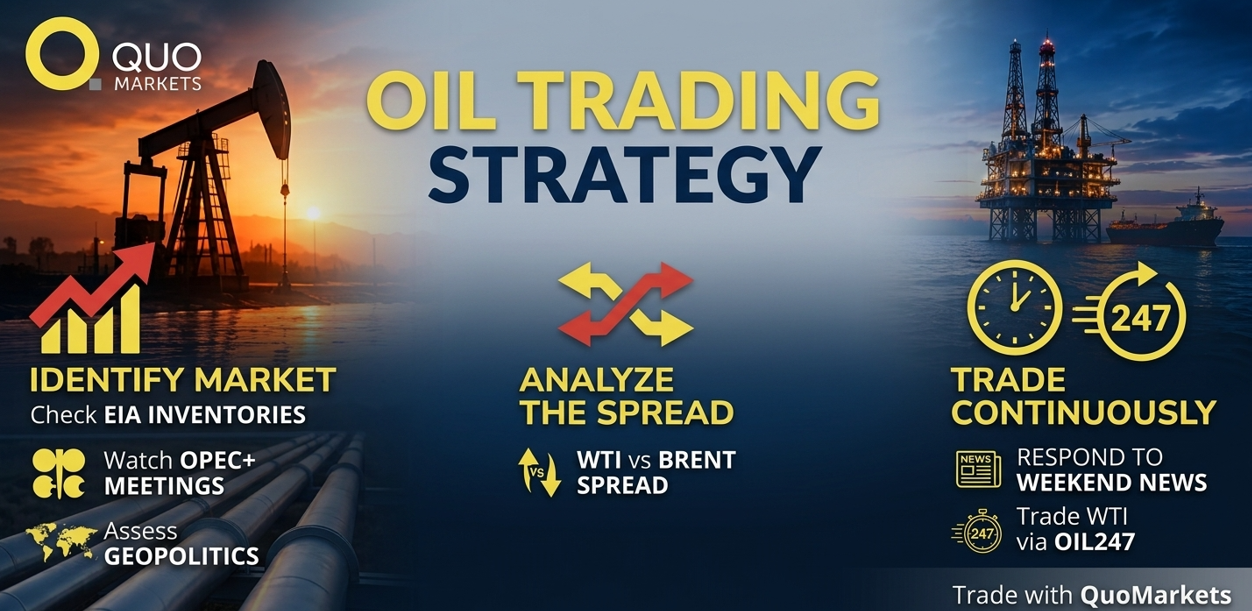
Successful oil trading requires attention to the calendar. Inventory reports, OPEC+ meetings, and economic data releases all create scheduled volatility. Geopolitical events are unpredictable, but their impact can be swift and significant. Risk management is essential given the high volatility inherent in crude oil markets.
Understanding the difference between WTI and Brent is also practical. The two benchmarks can diverge based on regional factors, creating spread trading opportunities. A trader might take a view on whether the Brent-WTI spread will widen or narrow based on logistics, inventories, or production trends.
Final Remarks
Oil prices reflect a constant negotiation between supply, demand, geopolitics, currency dynamics, and market psychology. No single factor tells the whole story. WTI and Brent each have their own personalities, shaped by their physical characteristics and the markets they serve.
For retail traders, staying informed means watching the data that matters: OPEC+ decisions, inventory reports, economic indicators, and geopolitical developments. It also means respecting the volatility that makes oil both challenging and opportunity-rich.
If you want to trade oil beyond traditional market hours, QuoMarkets offers weekend WTI trading through its Oil247 initiative. That means you can respond to weekend news and geopolitical developments without waiting for Monday’s open.
FAQ
What is the main difference between WTI and Brent?
WTI is a U.S. benchmark tied to domestic supply and demand conditions, with its physical delivery point in Cushing, Oklahoma. Brent is an international benchmark based on North Sea crude and is used to price roughly two-thirds of global oil trade. Brent typically trades at a premium to WTI due to export logistics and regional supply factors.
What causes oil prices to drop suddenly?
Sudden oil price drops usually stem from demand fears or supply increases. A weak economic outlook can reduce demand expectations. OPEC+ raising production can add barrels to an already well-supplied market. In 2020, the COVID-19 pandemic caused oil prices to fall to 20-year lows as demand collapsed.
How does OPEC+ influence oil prices?
OPEC+ accounts for a significant portion of global oil supply through coordinated production quotas. When it cuts output, prices typically rise. When it increases output, prices often fall. The group’s decisions are watched closely because they can shift the supply-demand balance substantially.
Why does the U.S. dollar affect oil prices?
Oil is bought and sold in dollars worldwide. A stronger dollar makes oil more expensive for buyers using other currencies, which can reduce demand and pressure prices lower. A weaker dollar has the opposite effect.
What data releases should oil traders watch?
Key releases include weekly U.S. crude inventory reports from the EIA, OPEC+ meeting outcomes, global GDP forecasts, and manufacturing data from major economies. Geopolitical developments in oil-producing regions also warrant close attention.