
Table of Contents
- CFD Trading vs Stock Investing: What Sets Them Apart?
- Ownership and Shareholder Benefits
- Leverage and Capital Requirements
- Trading Costs and Fees
- Short Selling and Trading Flexibility
- Regulation and Market Access
- Which Option Fits Your Goals?
- Final Remarks
- FAQs
CFD Trading vs Stock Investing: What Sets Them Apart?
Modern investors have more opportunities than ever to access the companies and markets they believe in. Some stick with traditional stock investing, purchasing company shares and becoming partial owners of the business itself. Others turn to CFD trading, a type of derivative trading that allows them to speculate on market price movements without owning the actual asset.
Understanding the difference between CFDs and stock trading matters because the two approaches function very differently. While both provide exposure to the stock market and global financial markets, the structure, risks, costs, and trading mechanics are far from identical. Ownership rights, leverage, accessibility, and investment horizons all vary considerably.
For certain traders, the speed and flexibility of CFDs make them attractive for short-term trading strategies and responding quickly to changing market sentiment. For others, traditional stock investing offers a more stable path toward long-term wealth creation and shareholder benefits. Knowing how each approach works can help traders choose the option that aligns best with their financial goals, trading preferences, and tolerance for risk.
Ownership And Shareholder Benefits
One of the clearest distinctions between CFDs and stocks comes down to ownership.
With traditional share trading, investors purchase actual company shares through a brokerage account. Those shares represent real ownership in the company. Even holding a small number of shares means investors own a portion of the business and may receive certain shareholder rights.
Because stock investors own shares directly, they may qualify for dividend payments when companies distribute profits to shareholders. They can also receive voting rights, allowing participation in important corporate matters such as board elections or major business decisions.
Traditional stock investing also allows investors to benefit directly from long-term price appreciation. If a company grows steadily, delivers strong earnings, and maintains positive investor confidence, its share price may increase over time. Many long-term investors rely on both dividends and rising stock values to build wealth gradually.
CFD trading works differently. Put simply, CFDs involve speculating on price movements rather than purchasing the asset itself. When traders open a CFD position, they enter into a contract with a broker to exchange the difference in an asset’s price between the opening and closing of the trade.
As a result, CFD traders do not own the underlying asset. They do not actually hold company shares and therefore do not receive shareholder privileges such as voting rights. Dividend payments are generally not paid directly either, although brokers may apply dividend-related adjustments to open positions.
Since CFDs are derivatives, traders are only predicting whether prices will move upward or downward. They may potentially profit from those movements, but they never become owners of the underlying company shares.
For investors seeking long-term ownership, dividend income, and participation in company decisions, traditional stock investing may feel more suitable. Traders who care primarily about short-term price action may find CFDs more flexible.
Leverage And Capital Requirements
Another major difference between CFD trading and stock investing involves leverage and the amount of capital required.
In standard stock trading, investors usually pay the full value of the shares they purchase. If someone wants to buy ten thousand dollars’ worth of stock, they typically need to provide the entire amount upfront.
This larger upfront commitment can limit position sizes for retail traders working with smaller budgets. On the positive side, the risk is generally capped at the invested amount. If a stock price collapses to zero, the investor cannot lose more than the amount originally paid for the shares.
CFD trading, however, is built around leverage. Instead of paying the full value of a position, traders deposit a smaller amount called margin to control a much larger trade. In many cases, traders only need a fraction of the full trade value to gain exposure to share CFDs. This makes it possible to access larger positions with less starting capital.
Leverage can significantly increase potential profits when markets move in the trader’s favor. At the same time, it also magnifies losses if prices move the wrong way. That is why proper risk management is essential when trading derivatives.
It is also important to understand that leveraged CFD trading can sometimes produce losses greater than the initial deposit if risk is not controlled carefully. Some brokers offer negative balance protection for retail clients to prevent accounts from falling below zero, but traders should always review the rules and protections offered by their chosen trading platform.
The ability to trade with leverage is one of the main reasons active traders are drawn to CFDs, especially those using short-term strategies designed to capture smaller price fluctuations in volatile markets.
Trading Costs And Fees
The fee structure is another important factor when comparing these two markets.
In traditional share trading, brokers often charge commissions whenever investors buy or sell shares on a stock exchange. Depending on the broker and market, additional transaction fees may also apply.
In certain countries, investors may need to pay stamp duty when purchasing shares. Taxes such as capital gains tax can apply when shares are sold for a profit, while dividend income may also be taxable depending on local laws. Because stock investors purchase the full value of shares upfront, the initial cost of entering a position can be relatively high.
CFD trading follows a different pricing structure. Rather than charging standard commissions in many cases, brokers typically earn through spreads – the difference between the buy and sell price displayed on the trading platform. CFDs can appear cheaper at first because traders only deposit a margin instead of the entire asset value. However, other expenses still exist.
One of the most important costs is overnight financing. Positions kept open overnight often accumulate financing charges tied to the leverage being used. The longer the trade stays active, the larger those costs may become. This is one reason why many CFD traders focus heavily on short-term trading approaches. Holding leveraged trades for long periods can become expensive.
There can also be tax differences between the two approaches. In some regions, CFDs may be exempt from stamp duty because the trader never actually purchases the underlying shares. Still, tax laws differ significantly across countries, so traders should always check local regulations before making investment decisions.
Short Selling And Trading Flexibility
One of the biggest differences between CFD trading and traditional stock investing involves short selling.
Most stock investors take long positions. They buy shares expecting prices to rise over time. If the stock increases in value, they can later sell those shares for a profit. While short-selling stocks is possible, it usually requires borrowing shares through a margin account. This process often includes additional requirements, collateral rules, and borrowing fees.
CFDs make short selling much simpler. Traders can open positions designed to profit from falling markets just as easily as positions targeting rising prices. This flexibility allows CFD traders to potentially benefit during both bullish and bearish market conditions. During periods of strong volatility or economic uncertainty, this feature can become especially attractive.
CFDs also provide access to a wide range of financial instruments beyond stocks. Traders can speculate on indices, commodities, forex pairs, and cryptocurrencies from a single trading platform. Traditional stock trading, by comparison, focuses mainly on company shares and exchange-traded funds.
This broader market access is one reason CFDs appeal to traders looking for exposure across multiple asset classes.
Regulation And Market Access
Regulation creates another major distinction between CFDs and traditional stock investing.
CFDs are traded over the counter, meaning transactions occur directly between the trader and the broker rather than through a centralized exchange. In this structure, the broker acts as the counterparty to the trade. Because CFDs involve leverage and higher risk, regulators in several countries have introduced strict limitations on their use. In the United States, for example, CFDs are not available to retail investors.
Traditional stock investing operates differently. Shares are traded on regulated exchanges such as the New York Stock Exchange and the London Stock Exchange. These exchanges provide transparency, standardized market hours, and regulatory oversight intended to protect investors.
When investors purchase shares on an exchange, ownership is officially recorded, and they become registered shareholders of the company. This system creates clearer ownership rights and establishes investor protections. CFD trading, by contrast, depends heavily on the credibility and financial stability of the broker because trades happen over the counter. For that reason, choosing a well-regulated broker with a strong reputation is extremely important.
Regardless of the market, both CFDs and stocks are influenced by factors such as economic data, company earnings, market sentiment, and global financial news. Understanding these drivers is essential for anyone participating in modern financial markets.
Which Option Fits Your Goals?
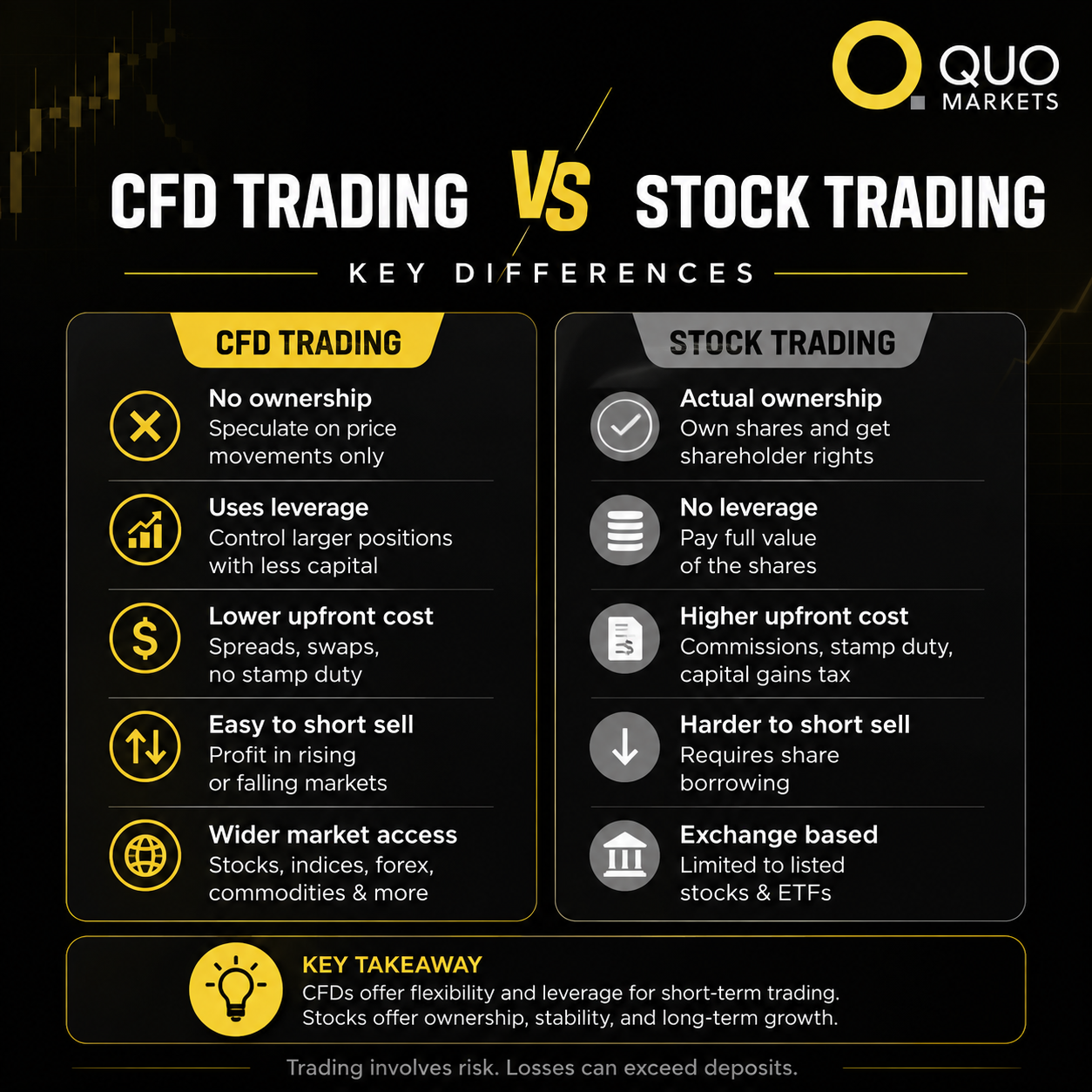
Choosing between CFD trading and stock investing ultimately depends on your goals, strategy, and appetite for risk.
Investors focused on long-term wealth accumulation often lean toward traditional stock investing. Buying and holding quality shares allows them to participate in business growth, collect dividends, and benefit from long-term appreciation. These strategies can work particularly well when investing in financially strong companies with solid fundamentals.
CFDs are typically favored by active traders who want to react quickly to short-term price movements and shifting market sentiment. The ability to use leverage and profit from falling prices makes CFDs especially attractive during volatile market periods.
At the same time, greater flexibility comes with greater risk. Since leverage increases both gains and losses, CFD traders must approach the market with disciplined risk management and a clear understanding of their financial objectives.
Available capital also matters. Investors who cannot easily commit the full value of stock purchases may see CFDs as a more accessible way to gain market exposure with a smaller initial deposit. Even so, the risks associated with leverage should never be underestimated.
Final Remarks
Both stock investing and CFD trading offer their own advantages and disadvantages. Traditional stock trading provides ownership rights, shareholder benefits, and long-term investment opportunities. CFD trading offers flexibility, leverage, and the ability to potentially profit in both rising and falling markets. Understanding how these approaches differ can help traders choose the path that best suits their financial goals and preferred trading style.
FAQs
What Is The Biggest Difference Between CFDs And Stocks?
The main difference is ownership. Stock investors purchase actual company shares and receive shareholder rights such as dividends and voting privileges. CFD traders only speculate on price movements and do not own the underlying asset.
Can Traders Make Money From Falling Markets With CFDs?
Yes. CFDs allow traders to open short positions that can potentially profit when market prices decline. This makes CFDs useful during bearish market conditions when traditional investors may struggle to generate returns.
Do CFD Traders Need To Pay The Full Trade Value?
No. CFD trading uses margin, meaning traders only deposit a smaller percentage of the full trade value to gain exposure to a larger position.