

Table of Contents
- Introduction: Why Crypto Copy Trading Is Gaining Attention
- How Crypto Copy Trading Actually Works
- How to Choose the Right Traders and Coins to Copy
- The Benefits of Crypto Copy Trading
- The Challenges and Risks You Need to Know
- Risk Management in Crypto Copy Trading
- Is Crypto Copy Trading the Right Choice for You?
- Conclusion: A More Structured Way to Participate in Crypto Markets
- Frequently Asked Questions (FAQs)
Crypto Copy Trading: A Smarter Way to Follow Experienced Traders in a Fast-Moving Market
Crypto markets move at a speed few other financial markets can match. Prices can rise sharply, crash within hours, and react instantly to news, sentiment, or large trades. New tokens appear constantly, trends shift overnight, and volatility is part of everyday trading life.
For people who want exposure to digital assets without spending years learning technical analysis and market structure, crypto copy trading has become an attractive option. It allows users to automatically mirror the trades of experienced investors in real time. It is not a guaranteed path to profits, but it can offer a more structured way to enter the crypto market.
How Crypto Copy Trading Actually Works
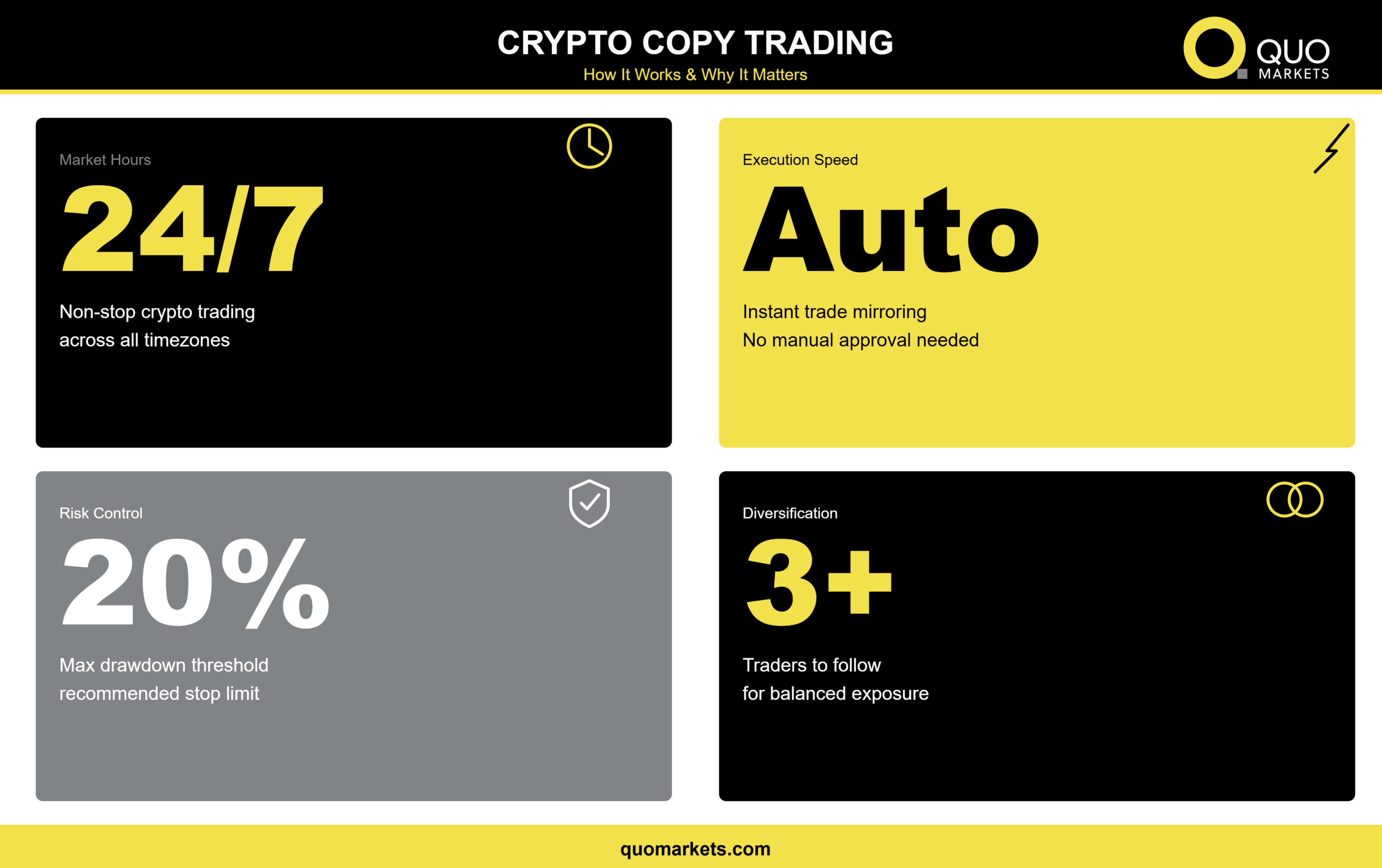
Crypto copy trading is built around automation. After opening an account on a copy trading platform, you choose an experienced trader to follow. Once connected, your account automatically mirrors that trader’s positions.
If the trader buys Bitcoin, Ethereum, Solana, or another cryptocurrency, your account enters the same trade proportionally based on the amount you allocated.
For example, if you invest $500 into copy trading and the trader places 10% of their portfolio into ETH, your account will automatically open a $50 ETH position as well. The process happens instantly without requiring manual approval for every trade.
This is what separates copy trading from traditional trading signals. With signals, you still need to manually place trades yourself. With crypto copy trading, execution becomes automatic after your initial setup.
Usually, the setup process includes:
- Choosing which trader to follow
- Deciding how much capital to allocate
- Setting personal risk controls and limits
Most crypto copy trading platforms support a wide range of assets, including:
- Bitcoin (BTC)
- Ethereum (ETH)
- Major altcoins like Solana, BNB, and Cardano
- Smaller emerging tokens depending on market trends
The available assets vary from platform to platform, so checking supported trading pairs before depositing funds is always important.
One major difference between crypto copy trading and traditional financial markets is that crypto never closes. Trading continues 24 hours a day, seven days a week across every timezone. There are no overnight shutdowns or scheduled pauses during volatility. That creates opportunities, but it also means copied trades can open during sudden overnight market crashes while you are asleep.
How to Choose the Right Traders and Coins to Copy
Many beginners make the same mistake at the start: they sort traders by recent profits and copy whoever made the biggest gains in the last month.
That approach often ends badly.
Crypto markets are highly volatile, and large short-term returns sometimes come from extremely risky positions. A trader may show massive profits simply because they placed most of their portfolio into one speculative altcoin at the perfect time.
The return looks impressive. The risk behind it can be dangerous.
What Matters Most When Evaluating Traders
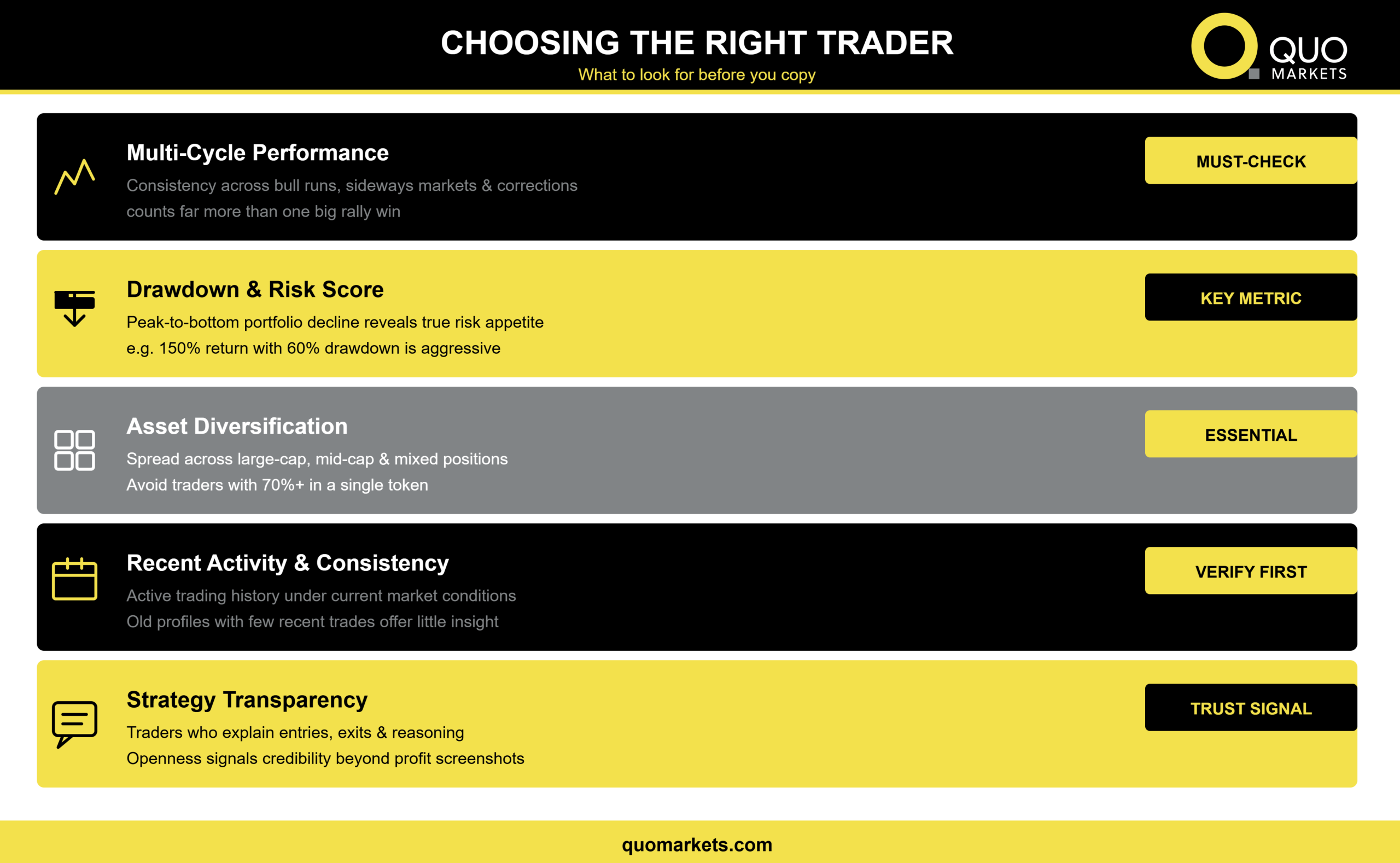
Performance Across Different Market Conditions
Crypto markets move through clear phases:
- Bull runs
- Sideways consolidation
- Sharp corrections
A trader who performs consistently across multiple market cycles is usually more reliable than someone who only succeeded during one strong rally.
Risk Score and Drawdown
Most reputable platforms display risk scores and maximum drawdown statistics.
Maximum drawdown measures the largest portfolio decline from peak to bottom. For example, a trader may have delivered 150% returns while suffering a 60% drawdown along the way. That reveals how aggressively they manage risk during difficult conditions.
Diversification
Experienced traders rarely place everything into one coin. Look for traders who:
- Spread exposure across several assets
- Balance large-cap and mid-cap coins
- Use long and short positions when appropriate
- Avoid chasing every trending token
Diversification cannot remove risk entirely, but it can reduce the damage caused by one collapsing asset.
Consistency
Check whether the trader is actively trading regularly.
A profile showing only a few trades years ago provides little value. Ongoing activity with a visible trading history gives a clearer picture of how the trader operates in current market conditions.
Transparency
Reliable traders are usually open about their strategy, risk approach, and market reasoning.
If a trader explains why they enter or exit positions, it becomes easier to understand how they react to changing market conditions. Transparency often says more about credibility than profit screenshots alone.
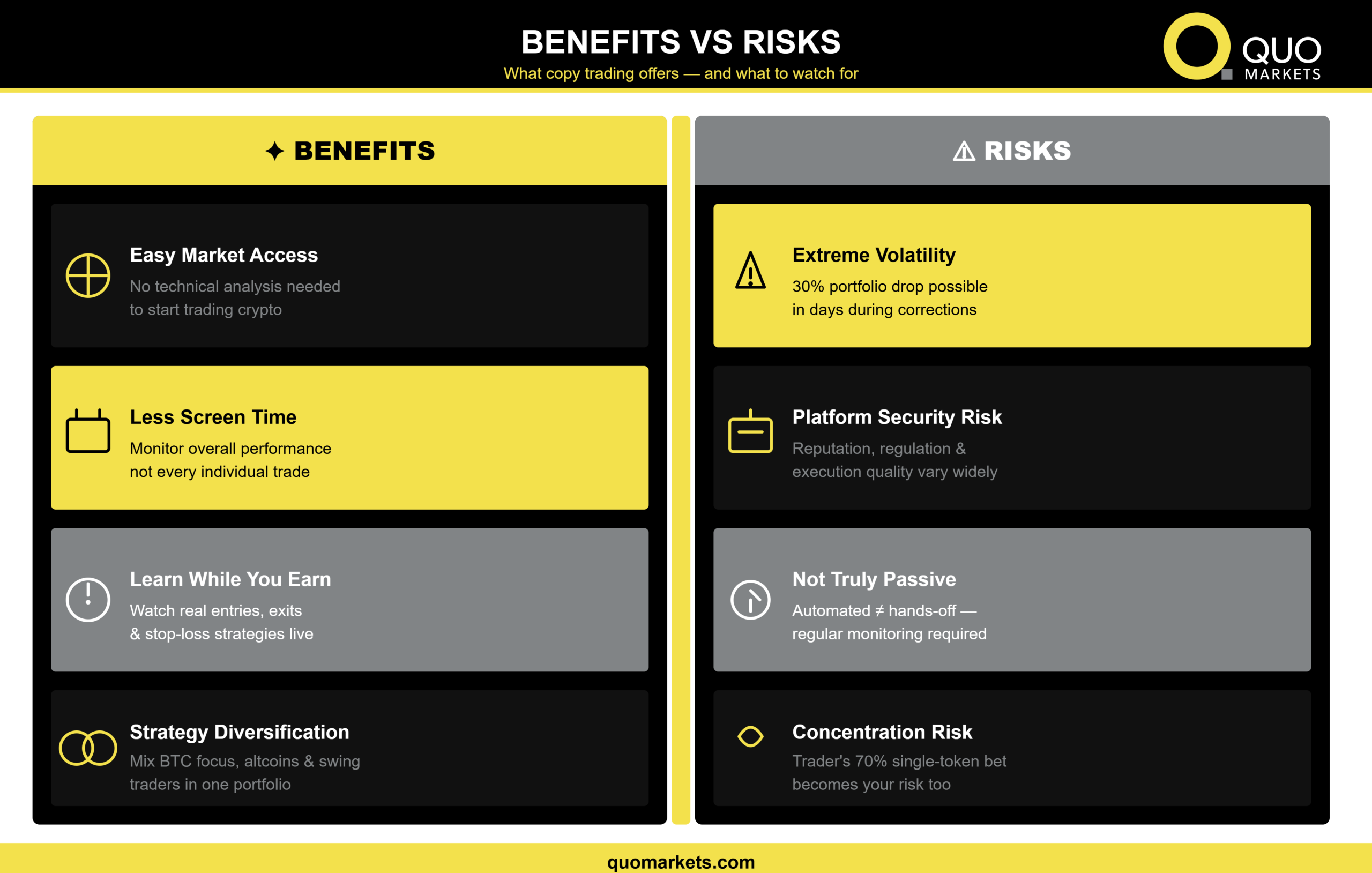
Concentration also matters when reviewing copied portfolios. If one trader places 70% of their portfolio into a single microcap token, that concentration risk becomes your risk too.
QuoMarkets provides transparent trading metrics that help users evaluate traders using real performance data instead of assumptions.
The Benefits of Crypto Copy Trading
Easier Access to the Crypto Market
One of the biggest advantages of crypto copy trading for beginners is accessibility.
New traders do not need advanced knowledge of: Order books, Liquidity analysis, Technical indicators, or On-chain analytics. Instead, they can focus on selecting traders carefully, managing risk properly, and monitoring performance over time.
Less Screen Time
Manual crypto trading often requires constant monitoring across multiple charts and assets.
Copy trading simplifies that process. Rather than analyzing every market move yourself, you monitor the overall performance of the traders you follow. For many people, that makes crypto investing far more manageable.
Learning While You Participate
Copy trading also acts as a practical learning experience. Watching how experienced traders manage entries, exits, stop-losses, and position sizes helps beginners understand how professional strategies work in live market conditions. Over time, users often develop a better understanding of:
- Market timing
- Risk management
- Portfolio structure
- Trade execution
Strategy Diversification
Copy trading makes it possible to spread capital across different trading styles. For example:
- One trader may focus mainly on BTC and ETH
- Another may specialize in high-risk altcoins
- A third may use short-term swing trading strategies
This allows users to build a portfolio aligned with their own risk tolerance without manually managing every position themselves.
The Challenges and Risks You Need to Know
Crypto Volatility
Volatility remains the biggest challenge in crypto markets. Even highly experienced traders experience losing periods and sharp drawdowns. A portfolio decline of 30% can happen in days during strong market corrections.
Anyone entering crypto copy trading must accept that volatility is part of the environment.
Platform Security
Security is another critical factor. Not every platform offers the same level of protection, execution quality, or regulatory oversight. Before depositing funds, users should evaluate:
- Platform reputation
- Regulatory status
- Security infrastructure
- Trade execution reliability during volatility
Regulations for crypto trading platforms still vary significantly between countries.
Copy Trading Is Not Fully Passive
The automation involved in copy trading can create a false sense of safety. Even automated trading requires active monitoring.
Markets evolve, traders adjust strategies, and conditions that once produced strong results may stop working during different market cycles. Users still need to stay involved and review performance regularly.
The difference between copy trading and manual trading often comes down to engagement. Manual traders stay focused because every decision is personal. Copy traders sometimes become too passive, which can create its own risks.
Risk Management in Crypto Copy Trading
Risk management is essential in crypto copy trading. Without it, a single market correction can severely damage an account.
Set Drawdown Limits
Most serious platforms allow users to set maximum drawdown thresholds. For example, you may decide to automatically stop copying a trader if losses exceed 20%. This creates a safety layer during unusually poor trading periods.
Diversify Across Multiple Traders
Following only one trader increases concentration risk. A stronger approach is to spread capital across several traders with different strategies, asset preferences, and risk profiles. One trader may focus on large-cap assets while another specializes in mid-cap opportunities.
Diversification can help smooth overall performance.
Start Small
A common question is how much money someone needs for crypto copy trading. The safest starting point is simple: begin with money you can afford to lose completely.
Crypto markets have a long history of sudden corrections, so starting with smaller capital while learning the platform and evaluating traders is a sensible approach.
Use Security Features
Reputable platforms typically offer: Two-factor authentication, Withdrawal whitelists, and Encryption protection. Using every available security feature helps reduce avoidable risks.
Review Trader Performance Regularly
Review your copied traders consistently. Comparing their:
- Current drawdown
- Win rate
- Trading frequency
- Strategy consistency
against earlier performance helps identify whether their approach is still working under current market conditions. Markets change constantly, and traders change with them.
Is Crypto Copy Trading the Right Choice for You?
Crypto copy trading sits somewhere between passive investing and active trading. It offers more flexibility than simply holding assets long term, while requiring less daily involvement than manual trading.
For beginners, it can provide a more approachable way to gain exposure to digital assets. For experienced investors, it can serve as a way to diversify strategies and gain access to trading styles outside their own expertise.
Still, no strategy guarantees profits. Crypto remains highly volatile, regulations continue to evolve, and even skilled traders go through losing periods.
What copy trading can offer is a more structured way to participate in one of the world’s fastest-moving financial markets. Quomarkets gives users access to transparent trader performance data before committing capital.
The best starting point is simple: Study the data carefully, choose traders thoughtfully, manage risk properly, and begin with capital you are comfortable putting into the market.
FAQs
What is crypto copy trading?
Crypto copy trading is an automated system where your account mirrors the trades of an experienced trader in real time. When they buy or sell a cryptocurrency, your account executes the same trade proportionally according to your allocated funds.
What are the risks of copy trading crypto?
The main risks include market volatility, platform security concerns, underperforming traders, and changing regulations. Proper risk management can reduce these risks, though it cannot remove them entirely.
How do you choose the best trader to copy?
Look at long-term performance, drawdown levels, diversification, consistency, and overall risk management. Avoid traders relying heavily on a single high-risk position, even if recent returns appear extremely strong.
Is crypto copy trading safe for beginners?
Crypto copy trading still involves risk, but it can provide a more structured starting point for beginners. Using drawdown limits, diversification, and smaller starting capital can help reduce unnecessary risk.
Can you make money with crypto copy trading?
Yes, it is possible to make money with crypto copy trading, but profits are never guaranteed. Results depend on market conditions, the traders you follow, and your overall risk management approach.