Table of Contents
- Why Choosing a Regulated Forex Broker Matters So Much
- How Forex Regulation Helps Protect Traders
- How to Verify That a Forex Broker Is Regulated
- The Dangers of Trading With Unregulated Brokers
- Common Red Flags Traders Should Notice
- Best Practices for Staying Safe as a Trader
- QuoMarkets’ Focus on Client Protection
- Final Thoughts
- Frequently Asked Questions
Why Choosing a Regulated Forex Broker Matters So Much
Every trader knows that markets can move in either direction. Profits and losses are a natural part of trading, and successful traders understand how to manage both. What traders should never have to worry about, however, is losing access to their funds because a broker disappears, blocks withdrawals, or operates without proper regulatory oversight.
That is why choosing a regulated forex broker is far more than a simple checklist item. It is one of the most important decisions you will make before placing your first trade. Regulation exists to keep brokers accountable, protect client funds, and give traders a clear path for resolving disputes when problems occur.
If you are asking whether forex trading is safe, the answer depends largely on the broker you choose.
How Forex Regulation Helps Protect Traders
The Regulators Behind the Industry
Forex regulation is enforced by government-backed or statutory authorities responsible for creating rules, monitoring brokers, and taking action when firms fail to comply. Understanding how these regulators operate is key to understanding forex regulation in real-world terms.
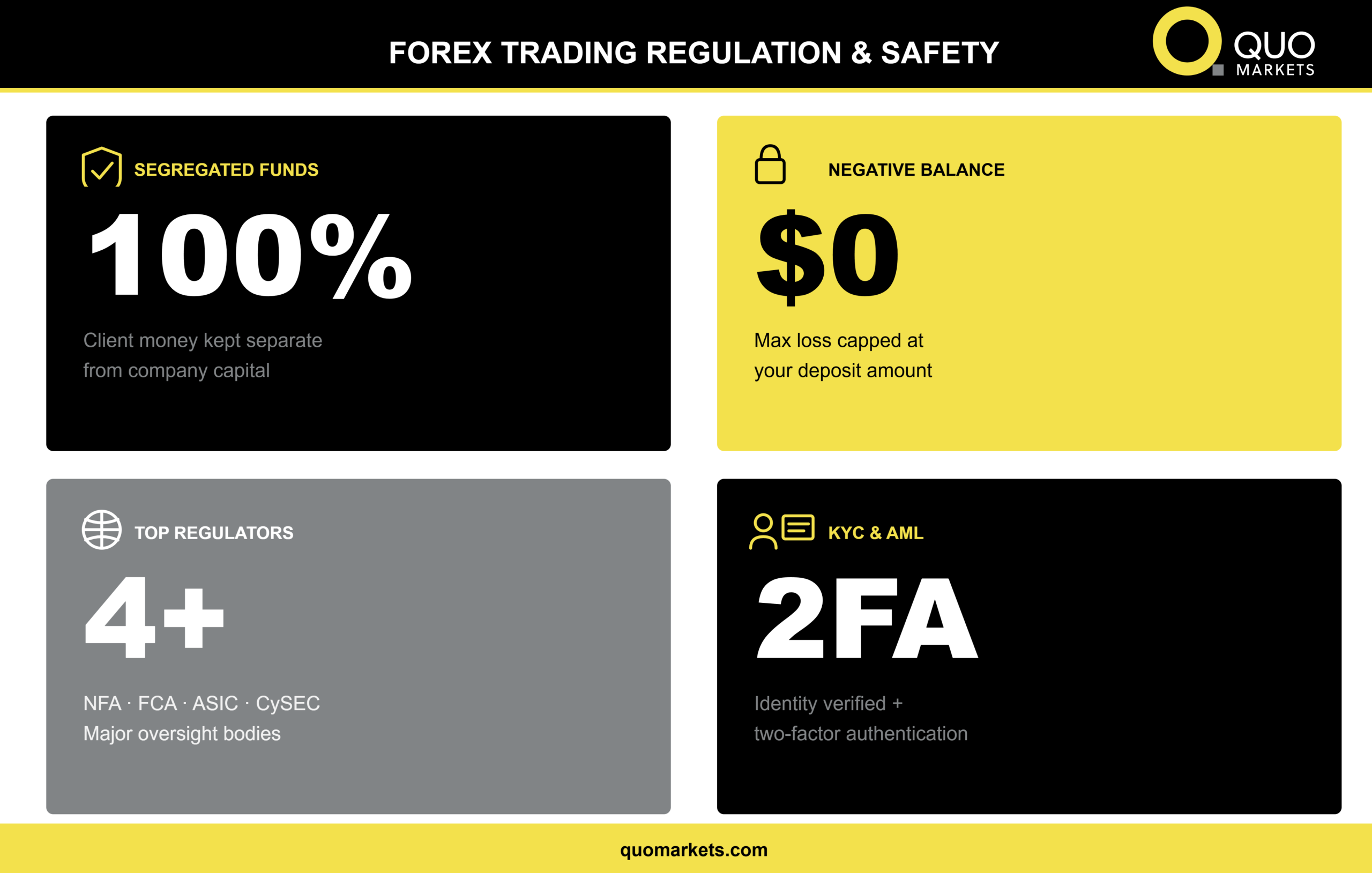
In the United States, retail forex trading is supervised by the Commodity Futures Trading Commission and the National Futures Association. Their requirements are considered some of the strictest globally. Brokers registered with the NFA must meet minimum capital requirements, undergo regular audits, and follow leverage restrictions designed to reduce excessive risk exposure.
In the United Kingdom, the Financial Conduct Authority oversees brokers under a system focused on investor protection and market integrity. FCA-regulated brokers are required to keep client money in segregated accounts, meaning trader funds remain separate from the company’s operational funds. This becomes especially important if the broker faces insolvency.
Across Europe, the Markets in Financial Instruments Directive II establishes the broader regulatory framework, while the Cyprus Securities and Exchange Commission has become one of the best-known licensing bodies for brokers serving European traders.
In the Asia-Pacific region, the Australian Securities and Investments Commission applies strict licensing and compliance standards that are widely respected within the trading industry.
What Regulated Brokers Are Required to Do
Top-tier regulators impose clear and enforceable obligations on brokers. These requirements are designed to protect traders and improve market stability.
Brokers must maintain enough capital reserves to meet client obligations and reduce the risk of financial collapse. They are also required to follow KYC and AML procedures, verifying customer identities and monitoring suspicious activity.
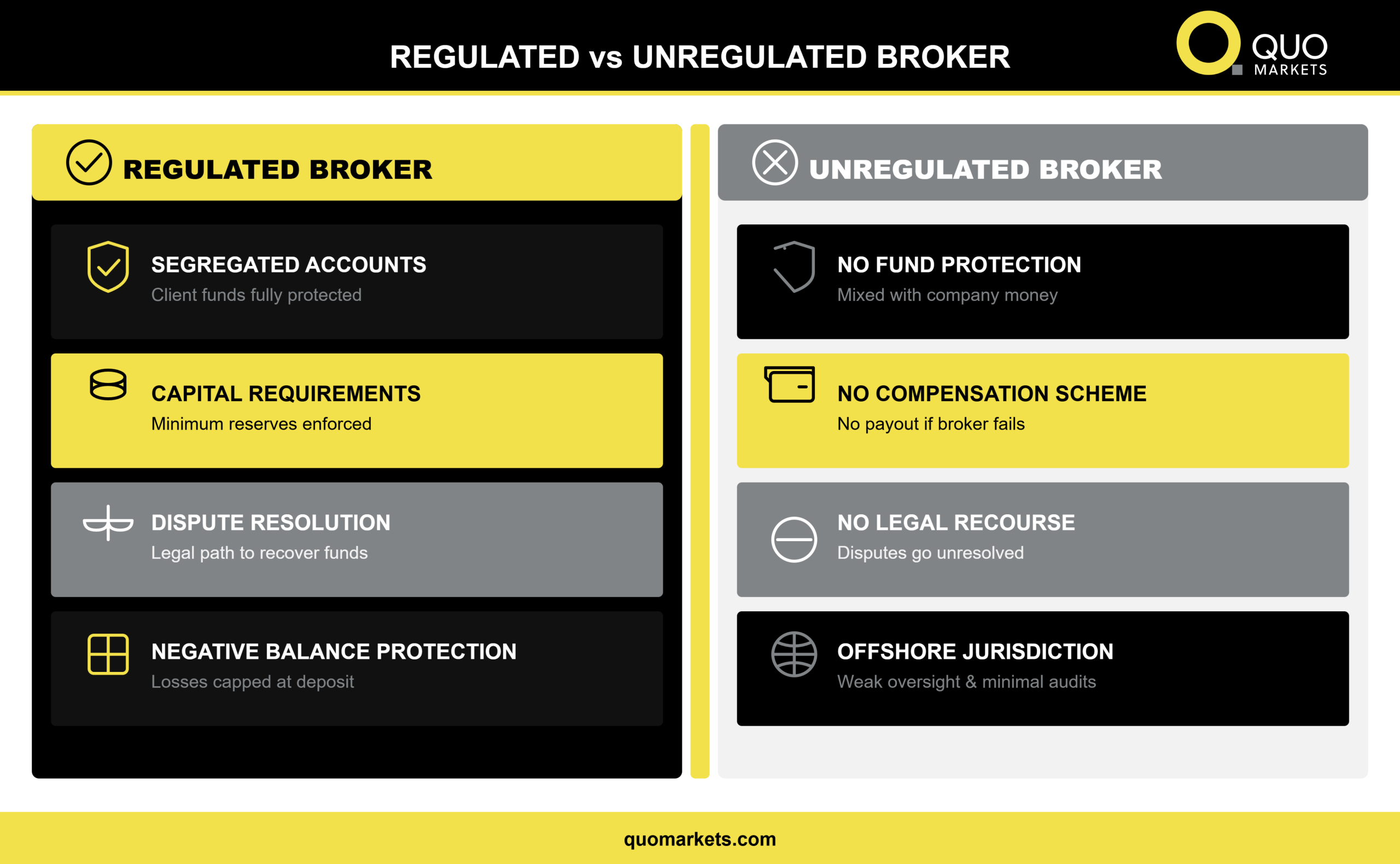
In many retail jurisdictions, brokers must provide negative balance protection, ensuring traders cannot lose more money than they deposit. Some regions, including the UK and parts of Europe, also provide compensation schemes for eligible clients if a licensed broker fails.
How to Verify That a Forex Broker Is Regulated
Use Official Regulatory Registers
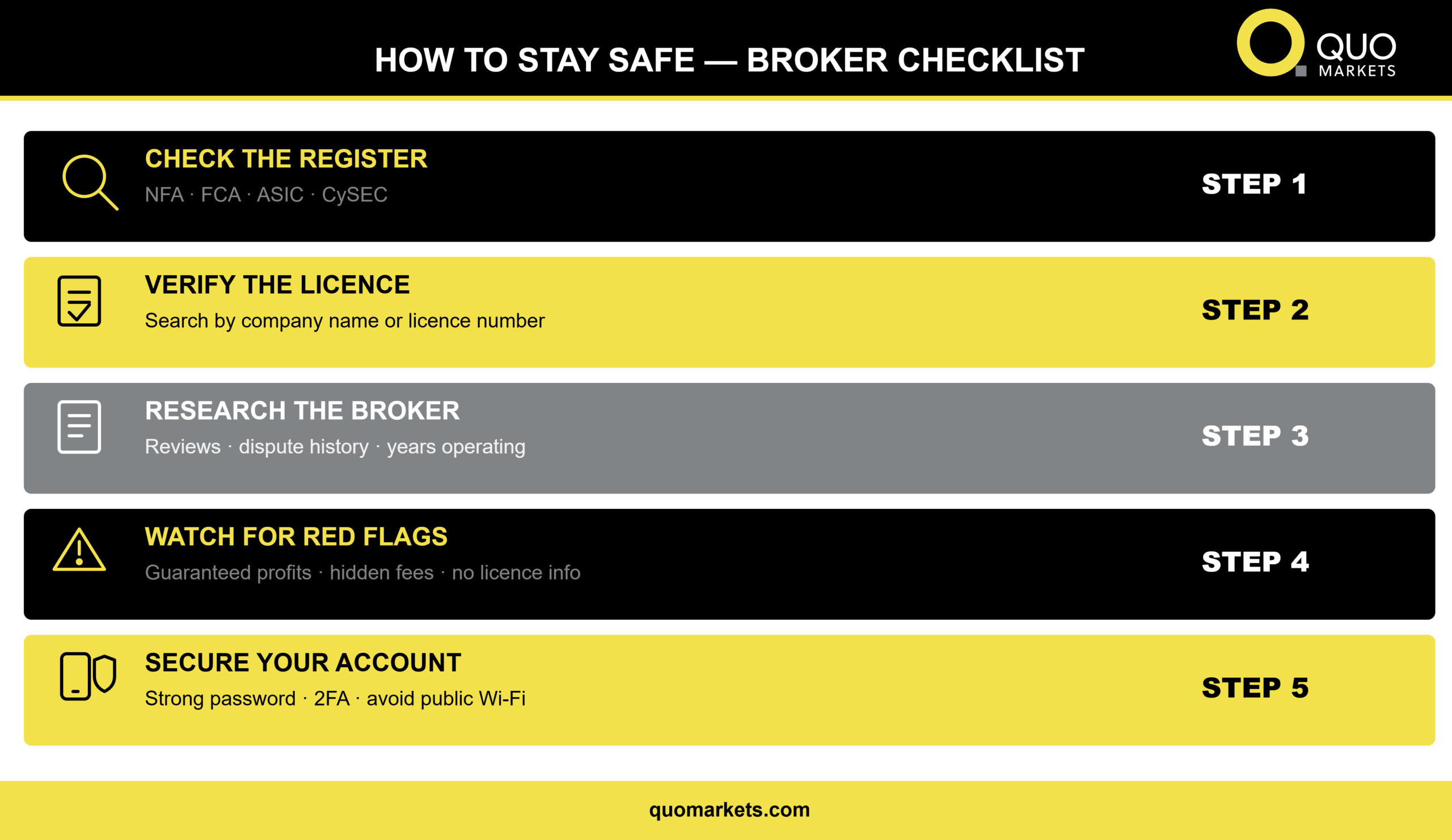
One of the safest habits any trader can develop is checking a broker’s licence before depositing funds. Legitimate regulators maintain public databases where brokers can be searched by company name, registration number, or licence ID.
In the US, the NFA’s BASIC database allows traders to review a broker’s registration status, disciplinary history, and any enforcement actions. A clean record can increase confidence, while repeated fines or suspensions deserve careful attention.
For brokers regulated in the UK, the FCA Financial Services Register allows traders to confirm whether a company is fully authorised. In Australia, traders can search ASIC’s professional registers, while CySEC licence information is available directly through its website.
Research the Broker’s Reputation
Checking the licence is only the first step. It is equally important to look into the broker’s background and overall reputation.
Read independent reviews on respected trading forums, search for reports of legal disputes, and check how long the company has been operating. A broker with several years of stable regulatory history offers a very different level of confidence compared to a newly created offshore company.
Transparency also matters. Reliable brokers clearly display their licence information on their website, legal documents, and client agreements. If regulatory details are difficult to find, that should raise concerns immediately.
The Dangers of Trading With Unregulated Brokers
Many traders underestimate the risks involved with unregulated brokers, treating the lack of regulation as a minor issue. In reality, it affects every part of the relationship between trader and broker.
Without regulation, there is usually no requirement to separate client funds from company money. Your deposit could be mixed with operational funds and become inaccessible if the company experiences financial problems.
There may also be no compensation scheme, no independent authority to handle complaints, and no legal framework capable of forcing the broker to return client funds.
Many unregulated brokers operate from offshore jurisdictions with very limited oversight. These regions may have weak investor protection laws, minimal capital requirements, and no mandatory external audits.
Common Red Flags Traders Should Notice
Forex scam warning signs are often visible before an account is even opened.
Be cautious of brokers promising guaranteed profits or risk-free trading. No legitimate broker can guarantee trading results. High-pressure sales tactics, unsolicited calls, and promotional bonuses tied to difficult withdrawal conditions should also raise concerns.
Another warning sign is poor transparency around fees, spreads, or execution policies. Offshore broker concerns become even more serious when the company cannot clearly explain where client funds are stored, how withdrawals work, or what protections are in place.
Best Practices for Staying Safe as a Trader
Securing Your Trading Account
Even when trading with a fully regulated broker, account security remains your responsibility.
Use a strong and unique password for your trading account, and avoid reusing passwords across different platforms. Password managers can help keep credentials secure without relying on memory alone.
It is also important to enable two-factor authentication whenever possible. This adds an extra verification step that helps prevent unauthorised access, even if your password becomes compromised.
Keep your operating system, browser, and trading software updated. Security updates often fix vulnerabilities that cybercriminals actively target. Public Wi-Fi networks should also be avoided unless you are using a VPN.
Be cautious with emails, phone calls, or messages claiming to come from your broker. Fraudulent phishing attempts remain one of the most common ways traders lose access to accounts.
Protecting Your Personal Information
Protecting your trading account goes beyond passwords.
Pay attention to which third-party services you connect to your account, and regularly review login activity for anything suspicious. If your broker offers IP whitelisting or login alerts, enable those features.
Risk management also plays a major role in trading safety. Use sensible position sizes, apply stop-loss orders consistently, and avoid excessive leverage. Safe trading habits and strong account security work together to reduce unnecessary risk.
QuoMarkets’ Focus on Client Protection
For traders looking for a broker that places strong emphasis on regulation and client protection, QuoMarkets operates under regulatory licences that require compliance with capital adequacy standards, fair dealing practices, and transparent pricing policies.
Client funds are held in segregated accounts separate from company operating capital, helping ensure that trader funds remain protected regardless of the company’s financial position. An added layer of security is proof of funds verified through independent audits, not by an internal certificate issued by the company itself.
QuoMarkets also follows full KYC and AML procedures as part of its onboarding process, in line with regulatory expectations.
Transparency remains a key part of the company’s approach. Regulatory information is clearly displayed, withdrawal procedures are straightforward, and support teams are available to answer questions related to account protection and security.
Final Thoughts
Financial trading always carries market risk. Prices can move unexpectedly, strategies may fail, and losses are part of the process. What traders can control is the broker they choose to work with.
A regulated broker removes many unnecessary risks unrelated to trading itself, including fraud, misuse of client funds, and the absence of legal protection if problems arise.
Before opening any trading account, verify the broker’s licence, review the regulator’s database, and research the company’s background carefully. Then focus on trading with confidence, knowing you have built your trading journey on a safer foundation.
FAQs
How can I check whether a forex broker is regulated?
You can verify a broker through official regulatory databases such as the NFA, FCA, ASIC, or CySEC registers. Search using the broker’s legal company name or licence number and confirm the licence is active.
What are the risks of using an unregulated forex broker?
Unregulated brokers may not follow basic fund protection rules, may offer no compensation scheme, and often provide very limited legal protection if disputes occur.
Are offshore forex brokers always unsafe?
Not necessarily. Some offshore brokers operate legitimately, but the level of protection depends on the regulator involved, the licensed entity handling your account, and the rules that apply in that jurisdiction.
Is forex trading regulated everywhere?
No. Forex regulation differs from country to country. Regions such as the US, UK, EU, and Australia have strict oversight, while some jurisdictions have limited or no meaningful regulation. Always verify the broker’s licence before opening an account.