

Table of Contents
- What Is an Introducing Broker in Forex?
- How IBs Get Paid: Commission Structures Explained
- What Can You Realistically Earn?
- IB Program vs. Affiliate Program: What’s the Difference?
- How to Become an Introducing Broker: Step by Step
- What Actually Makes IBs Successful?
- QuoMarkets’ IB Program: A Closer Look
- Do You Need a Licence?
- Common Challenges and How to Handle Them
- Where the IB Model Is Heading
- Is It Worth Doing?
- FAQs
What Is an Introducing Broker Forex? Complete IB Guide for 2026
If you’ve spent any time in the forex world – as a trader, educator, or just someone paying attention – you’ve probably heard the term “introducing broker” thrown around. But what is an introducing broker in real life, and is it a true business opportunity or just another buzzword?
This guide breaks down everything: how the IB model works, how commissions are structured, what you can realistically earn, and how to get started.
What Exactly Is a Forex Introducing Broker?
Think of an introducing broker (IB) as a connector. Your job is to bring traders to a brokerage firm. In return, you earn commissions based on how much those traders trade. That’s the core of it.
What you don’t do is equally important: you never hold client funds, execute trades, or handle any clearing. All of that stays with the broker. You focus on finding, educating, and supporting traders; the broker handles everything behind the scenes.
Most IBs operate independently, though some run small teams. Every client you refer gets linked to your profile through a unique referral code, so the broker can track activity and pay you accurately.
One thing worth noting for anyone based in the US: the CFTC and NFA may require you to register before operating. Rules differ by country, so check your local regulations early.
How the Whole Thing Actually Works
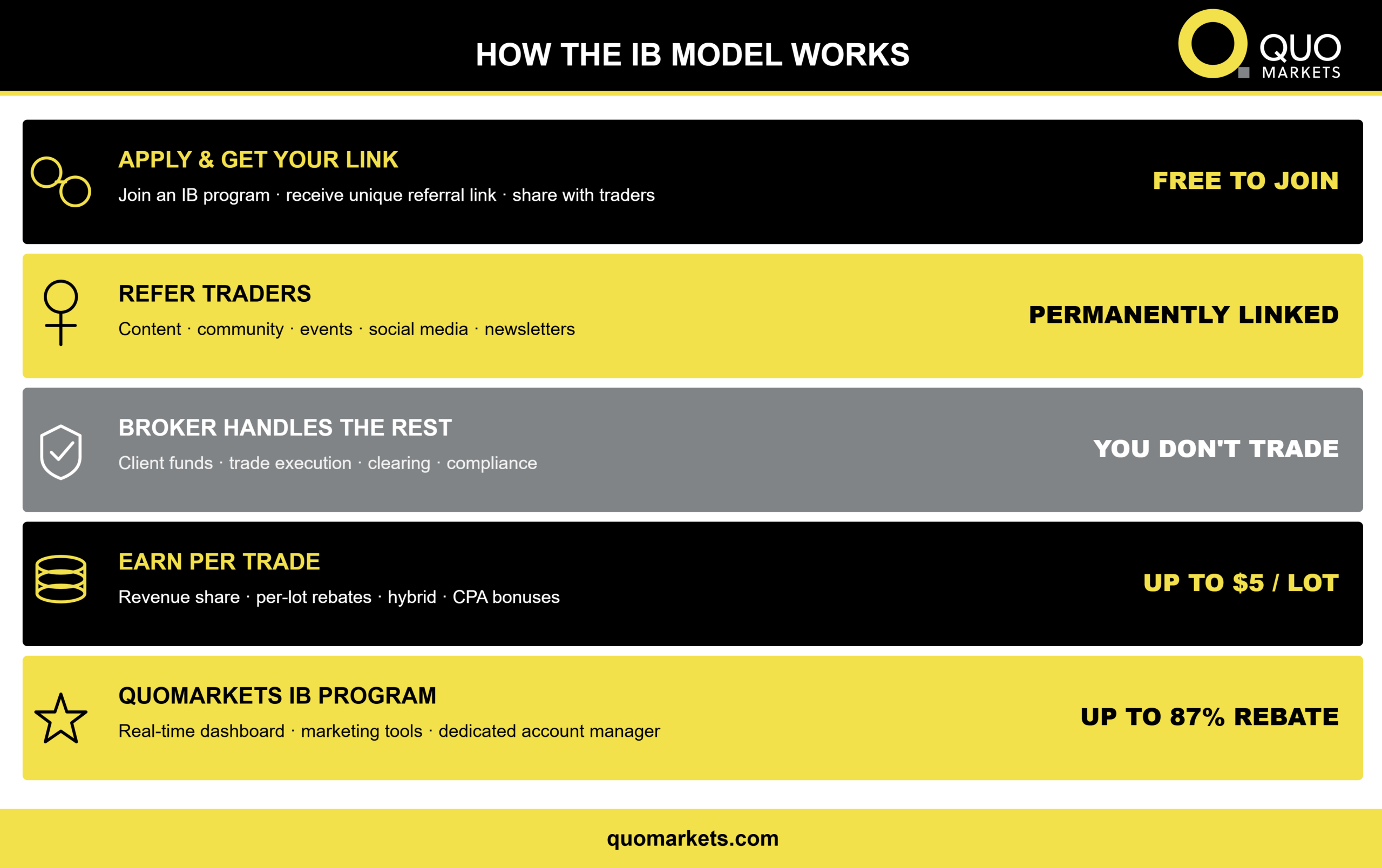
Joining an IB program is straightforward. Here’s the typical flow:
- Apply to a broker’s IB program
- Get your unique referral link
- Start referring traders through your content, community, or personal network.
- Those traders open accounts using your link
- You earn commissions every time they trade
Once someone signs up through your link, they’re permanently tied to your account. The broker tracks all trading activity automatically and calculates your earnings accordingly. You never touch the money – not theirs, not yours until the broker pays you.
How IBs Get Paid: Introducing Broker Commission Structure
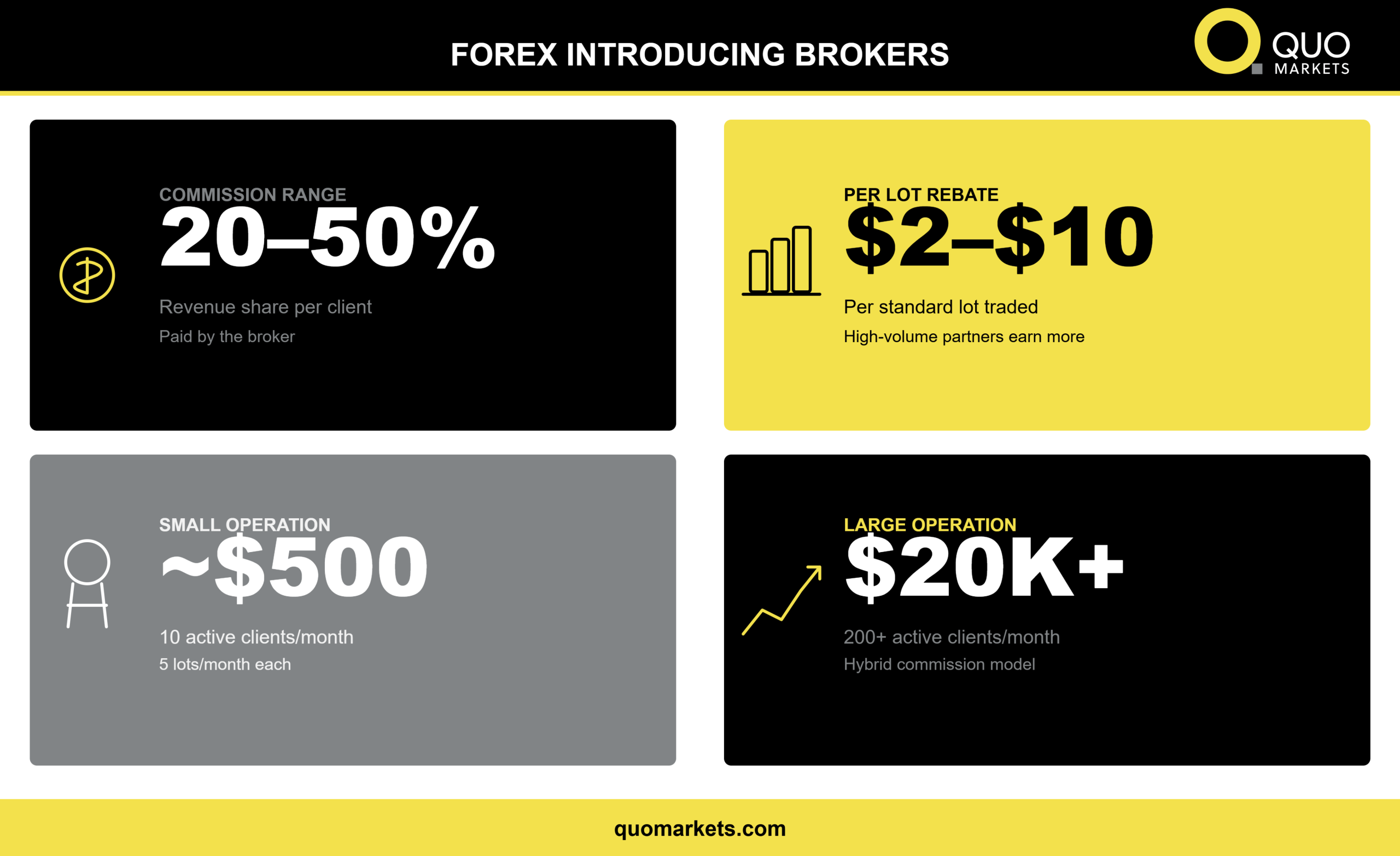
There are three main ways introducing brokers earn money.
Revenue Share
You receive a percentage of the revenue your referred clients generate, typically somewhere between 20% and 50%, depending on the broker and your agreement. The longer your clients stay active, the more you make. This model rewards loyalty and relationship-building.
Per Lot Rebate
You earn a fixed amount for every standard lot traded, usually $2 to $10 per lot, sometimes more for high-volume partners. It’s predictable and easy to forecast.
Hybrid
A combination of both: a fixed per-lot rebate plus a revenue share percentage. Many experienced IBs prefer this because it creates multiple income streams at once.
When choosing a structure, think about your client base. Active, high-volume traders tend to generate more under per-lot arrangements. Long-term, steady traders often perform better under revenue share.
And to be clear, commissions come from the broker, not from the trader’s account.
What Can You Realistically Earn?
Let’s be straight about this: earnings vary a lot, and they depend almost entirely on how much your clients actually trade.
- Small operation (~10 active clients, 5 lots/month each): a few hundred dollars monthly
- Mid-sized operation (~50 active clients, 35% revenue share): roughly $2,000–$3,000/month
- Larger operation (200+ active clients, hybrid model): $20,000+/month
The keyword is “active”. Ten traders who trade regularly will almost always outperform fifty who signed up and disappeared. This isn’t passive income; you’ll need to stay engaged, keep clients informed, and give them reasons to keep trading.
Forex IB Program vs. Affiliate Program: What’s the Difference?
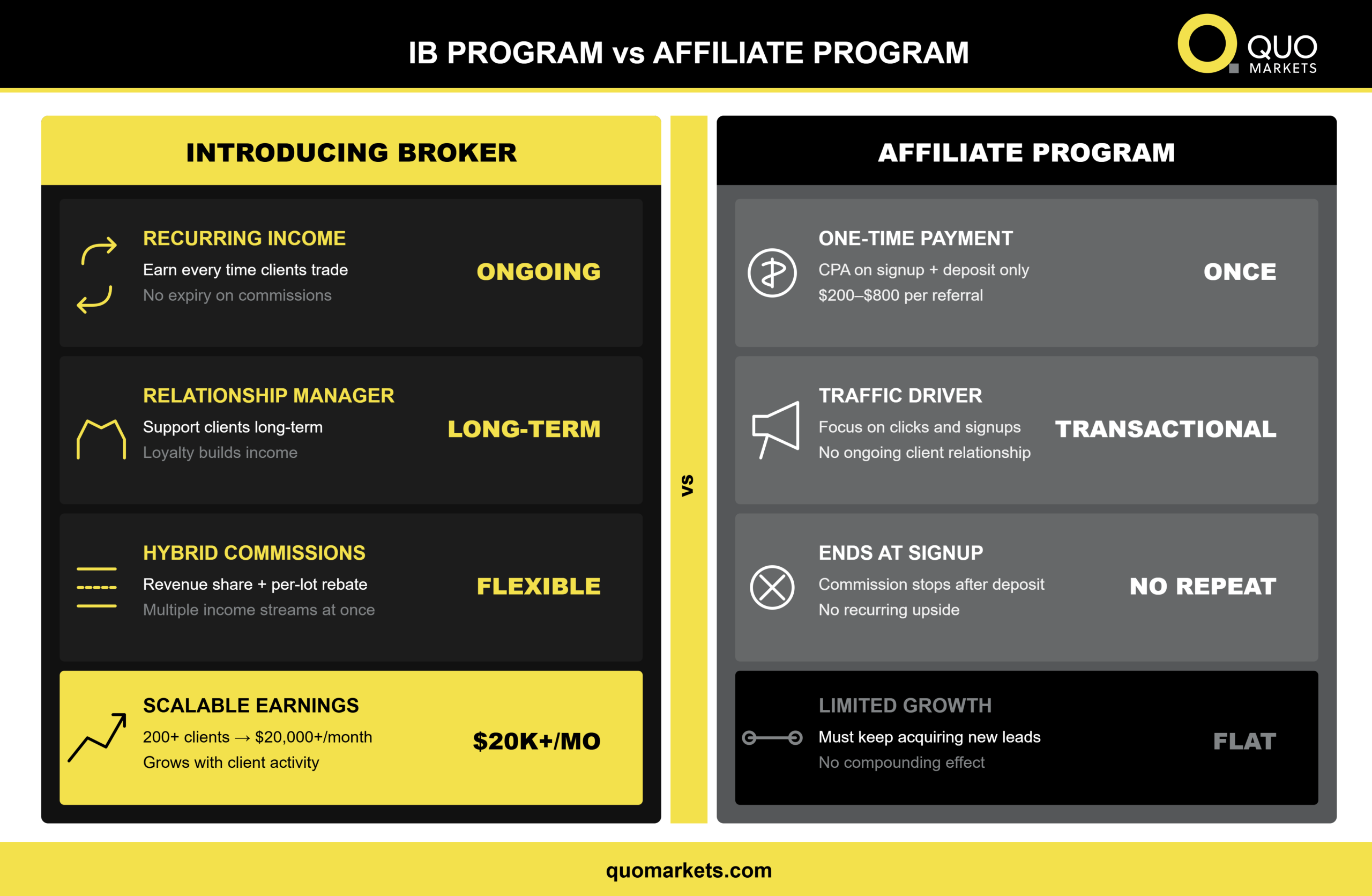
Brokers often offer both, and people mix them up constantly.
An affiliate earns a one-time payment when a referred client meets certain conditions, usually a registration and deposit. These CPA (cost per acquisition) payments typically range from $200 to $800. After that, the relationship is basically over.
An IB earns recurring commissions for as long as their referred clients keep trading. Instead of chasing the next signup, you’re building a book of clients whose long-term activity pays you month after month.
Affiliates are mainly traffic drivers. IBs are relationship managers. That distinction also means IBs tend to carry more responsibility around compliance and client communication.
How to Become an Introducing Broker: Step by Step
Step 1 – Pick a regulated broker
Regulation matters. A well-regulated broker means more security for your clients and more reliability for your payments. Look at platform quality, execution, and how transparent they are about commissions.
Step 2 – Complete registration
Fill out the application, submit your ID and KYC documents, and complete any required compliance forms.
Step 3 – Read the terms carefully
Understand the commission structure, payment schedule, any restrictions, and compliance requirements before you sign anything.
Step 4 – Build your outreach strategy
This is where your background matters. Content, webinars, social channels, newsletters, local events, trading communities, whatever suits your audience. Focus on attracting people who are genuinely interested in trading.
Step 5 – Track, analyze, and improve
Use the broker’s dashboard to monitor referrals, deposits, trading activity, and commissions. See what’s working and adjust accordingly.
What Actually Makes IBs Successful?
Three things, consistently: access to an audience, a working knowledge of forex, and regular, useful communication. Trust is the currency here – without it, conversions are shallow, and retention is poor.
Your clients also need to have a good experience with the broker itself. If execution is poor or support is non-existent, clients leave, and so does your income.
QuoMarkets’ IB Program: A Closer Look
QuoMarkets’ IB program is built for content creators, educators, marketers, community managers, and business owners who want to monetize their audience without trading themselves.
Partners earn ongoing commissions based on client trading activity – rebates of up to 87%, up to $5 per lot traded, and commission models that can include CPA rewards on top. Monthly performance bonuses are available for partners who hit referral targets.
The program includes a real-time dashboard for tracking referrals, conversions, and commissions, plus access to marketing materials and dedicated account management. QuoMarkets serves retail and institutional clients globally, with multilingual support and multiple account types.
Full details are available on QuoMarkets’ Introducing Brokers page.
Do You Need a Licence?
It depends on where you are. In the US, IBs soliciting retail forex clients typically need to register with the NFA and comply with CFTC rules. In many other countries, the broker holds the primary licence, and partners operate under that compliance framework.
Wherever you operate, you’ll generally be expected to:
- Complete KYC procedures
- Follow local marketing regulations
- Disclose risks accurately
- Avoid making misleading performance claims
- Comply with local advertising rules
Working with a regulated broker reduces your exposure significantly, for both you and your clients.
Common Challenges and How to Handle Them
Clients going inactive: Market conditions change, and traders take breaks. Build a large enough base that slow periods don’t wipe out your income, and re-engage dormant clients through events or fresh educational content.
Building trust takes time: There’s no shortcut here. Consistent, genuinely helpful content will outperform aggressive promotion every time.
Heavy competition: Many IBs are promoting the same platforms. Your differentiation comes from the quality of your content, the depth of your relationships, and the specific audience you serve.
Marketing compliance: You can’t make performance guarantees or misleading claims. Focus on education and transparency, and you’ll stay on the right side of the rules.
Where the IB Model Is Heading
A few trends worth watching:
Copy trading and social trading platforms are opening up new partnership structures. AI tools are helping IBs handle reporting, client communication, and day-to-day operations more efficiently. Multi-tier programs, where experienced IBs recruit and earn from sub-IBs, are becoming more common. And the growing availability of crypto pairs is broadening what brokers can offer, which makes the model more appealing to a wider audience.
The fundamentals of the IB business haven’t changed much, but the tools and opportunities around it keep expanding.
Is It Worth Doing?
For the right person – yes. If you have an audience of traders, a community, or a content platform with genuine reach, the IB model gives you a way to generate recurring income without managing money or executing trades.
It takes real work to build, and your earnings will always depend on how active your clients are. But for someone who already understands the forex space and knows how to communicate with traders, it’s one of the more accessible business models in the industry.
FAQs
What does an introducing broker actually do?
Refers traders to a broker, supports them, and earns commissions from their trading activity. The broker manages everything else.
How does an IB earn money?
Through revenue share, per-lot rebates, or a hybrid of both – all paid by the broker based on client trading activity.
Do you need a licence?
Depends on your country. Some require registration; others let you operate under the broker’s framework. Always check local rules.
What’s the difference between an IB and an affiliate?
Affiliates earn once per referral. IBs earn recurring commissions for as long as their clients trade.
How much can an IB earn per month?
Anywhere from a few hundred to tens of thousands of dollars, depending on client activity and commission structure.
What makes a good IB program?
Transparent commissions, real-time tracking, solid support, and a regulated broker with reliable trading conditions.