

Table of Contents
- Why Choosing the Right Traders to Copy Matters
- Define Your Copy Trading Goals Before You Start
- How to Evaluate Traders to Copy: The Key Performance Metrics
- Beyond the Numbers: Qualities Every Good Copy Trader Should Have
- Build a Diversified Copy Trading Portfolio
- How QuoMarkets Helps You Choose Traders to Copy
- Final Thoughts
- Frequently Asked Questions
Choosing who to copy is the most consequential thing you’ll do as a copy trader. The whole draw of copy trading is simple: someone experienced does the work, and you share in the results. But that simplicity cuts both ways. Follow the wrong trader, and you absorb their losses just as automatically as their wins.
Clicking “follow” on whoever sits at the top of the leaderboard with the biggest return figure isn’t a strategy; it’s a bet. The people who actually do well with copy trading treat provider selection the way you’d approach any serious financial decision: they dig into the data, understand the approach behind the numbers, and make sure what they’re looking at actually fits their own situation.
Get Clear on What You Want Before You Look at Anyone
Before you open a single trader profile, be honest about what you’re actually trying to accomplish. Copy trading can serve very different goals, and the trader who’s perfect for one objective can be completely wrong for another. Skipping this step is one of the most common mistakes new copy traders make.
Ask yourself: do you want aggressive growth, or something steadier? A trader chasing high monthly returns is probably using more leverage, taking on more risk, and riding wider swings in portfolio value. That can work well in a strong market and get painful fast when things turn choppy. A more conservative provider might post smaller but more reliable gains across different market conditions, and that might suit a longer time horizon or a lower tolerance for volatility far better.
Your drawdown tolerance matters just as much. Drawdown is how much a trading account falls from its peak before recovering. Some people can sit comfortably through a 20% dip, trusting the strategy will come back. Others find anything beyond 10% genuinely hard to stomach. Neither is wrong, but you need to know your own threshold before you start evaluating anyone, not partway through a losing streak when the pressure is already on.
Time horizon matters too. Are you planning to copy someone for three months or three years? Traders who scalp the market dozens of times a day can put up impressive short-term numbers that don’t hold over time. Swing traders who hold positions for days or weeks tend to build track records that actually mean something. Getting clear on your timeframe, your risk appetite, and your return expectations gives you a lens that filters out the noise and points you toward providers who actually fit.
The Numbers That Matter
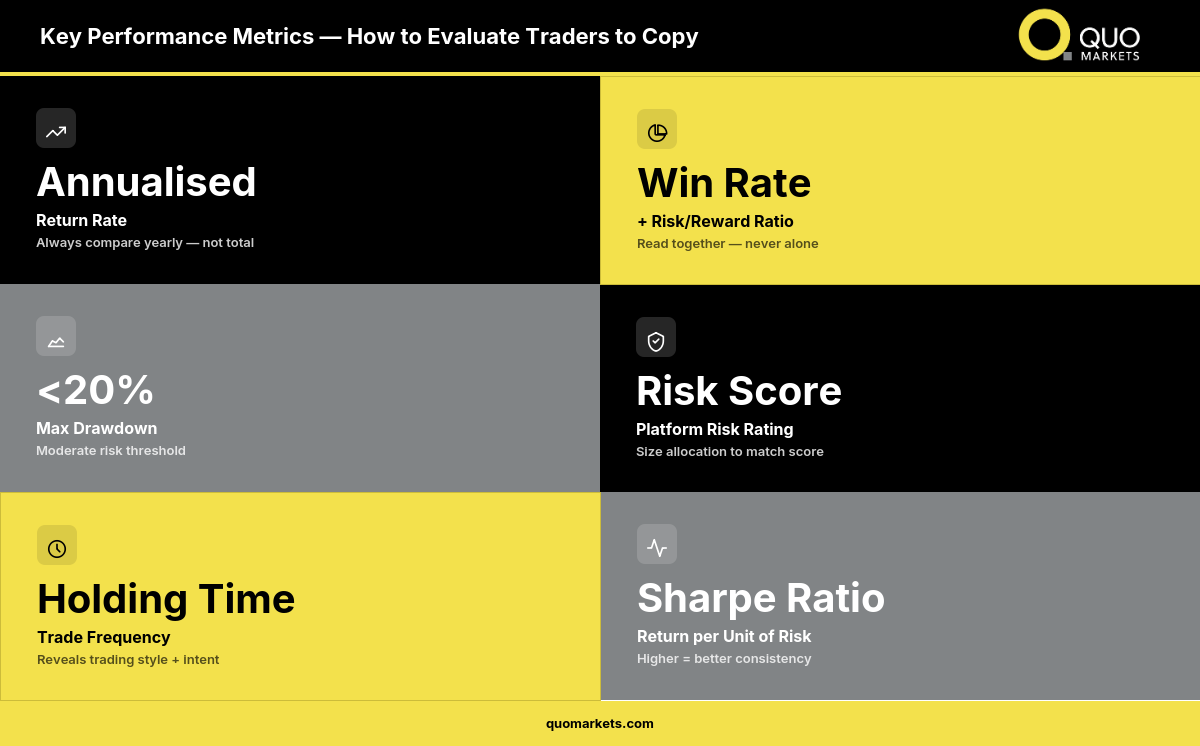
Performance metrics are the most objective starting point, but they only mean something in context. Here’s how to read the ones that count.
Total Return vs. Annualised Return
Total return shows how much a trader has made across their entire history on a platform. Annualised return converts that into a yearly rate, which makes comparisons fair. A trader showing 120% total return sounds compelling, until you find out it took four years, which works out to about 30% annually. Another trader showing 80% over two years is actually running at 40% annually and outperforming. Always compare annualised figures.
Win Rate and Win/Loss Ratio
Win rate is the percentage of trades closed in profit. What makes a good win rate? It depends almost entirely on how big the wins are compared to the losses. A trader closing only 40% of trades profitably can still be quite profitable if each winning trade is three times larger than each loser. Meanwhile, a 75% win rate can actually produce losses if gains are cut short and losers are left to run. Win rate should always be read alongside the profit factor or risk-reward ratio; on its own, it tells you very little.
Maximum Drawdown
This is arguably the most important thing to understand when evaluating any provider. Maximum drawdown measures the largest percentage fall from a peak balance to a trough before a recovery. It gives you a direct read on worst-case risk. As a rough guide, drawdowns below 20% indicate moderate risk; 30–40% and above point to an aggressive style that can produce serious capital erosion during rough patches. Before copying anyone, ask yourself: if this drawdown happened again starting tomorrow, could you handle it financially and mentally?
Risk Score
Many platforms assign each provider a composite risk score based on their historical volatility, leverage use, and drawdown patterns. A higher score doesn’t make a trader bad, but it means you should expect more turbulence and size your allocation accordingly. A common mistake is chasing the highest-return profiles without looking at the risk score attached to those returns.
Trade Frequency and Average Holding Time
These two figures reveal a lot about how a trader actually operates. A scalper opening and closing dozens of positions daily is a completely different animal from a position trader holding for weeks. High-frequency approaches can generate attractive short-term stats, but they’re also more sensitive to spreads, slippage, and platform conditions. Longer holding times often point to more deliberate, strategic decision-making. Neither style is inherently better, but they carry different risks and should match what you’re expecting to see in your account.
Sharpe Ratio and Consistency
Where the platform shows it, the Sharpe ratio is worth paying attention to. It measures how much return a trader earns per unit of risk – the higher, the better. Consistency matters enormously here: a trader generating 3% every month is far more useful than one swinging between 15% gains and 10% losses, even if the average ends up similar. Volatile returns create stress and make it much harder to plan around your own financial goals.
What the Numbers Won’t Show You
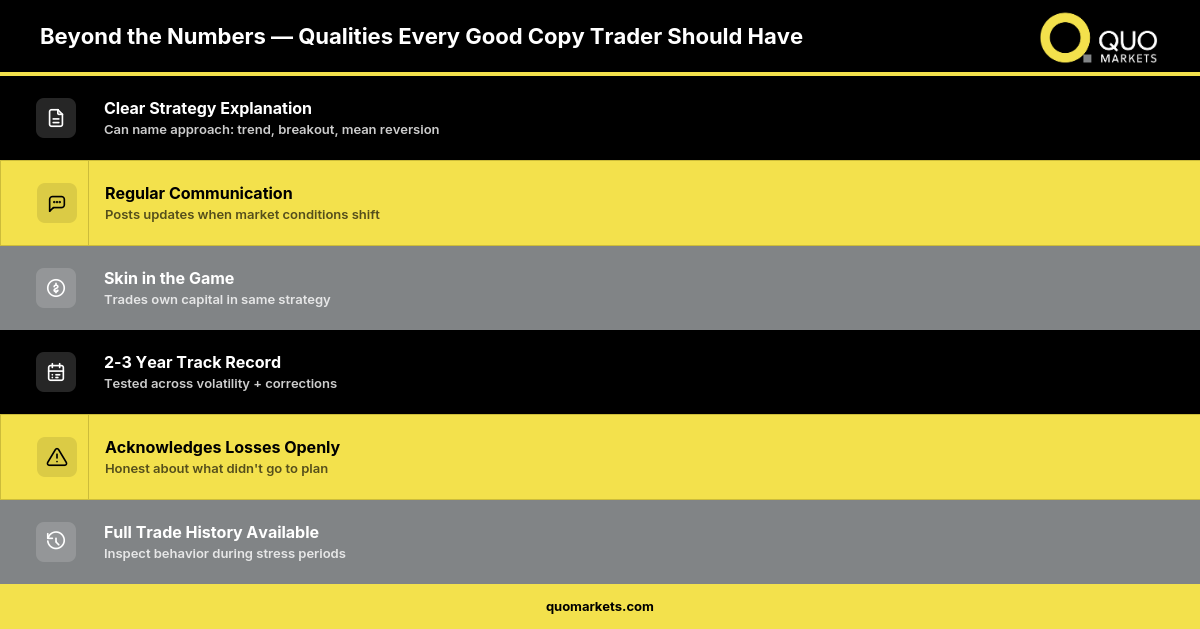
Data is essential, but it only captures part of the picture. The qualitative side of evaluating a provider is where you start separating traders with a genuine edge from those who got lucky during a favorable stretch.
Start with how a trader describes their approach. Can they explain what they actually do in plain terms? A serious provider should be able to say whether they trade trends, mean reversion, breakouts, or news events. They should mention which assets and instruments they focus on and give some sense of how they manage risk. Vague phrases like “proprietary system” with nothing more to explain them are worth treating with skepticism. If someone can’t or won’t explain their edge, that’s worth noting.
How often and how openly a trader communicates is equally telling. Do they post updates when market conditions shift? Do they acknowledge when something didn’t go as planned? The best providers treat their followers as people worth keeping informed, not just as passive capital. Regular, honest communication helps you distinguish a known drawdown phase from something more worrying.
One of the clearest signals is whether a trader has their own money in the same strategy. When a provider has real skin in the game, your interests align. They’re not taking risks with your capital while their own sits somewhere safe. Platforms that confirm whether a provider trades their own funds offer a layer of verification that goes well beyond statistics.
Track record length and context also matter. Six months of results from a strong bull market tell you almost nothing about what a trader does when things get difficult. A two to three-year history that spans volatility, corrections, and different market conditions is far more informative. Look for evidence that a strategy has actually been tested, not just optimized for one favorable window.
Treat Your Followed Traders Like a Portfolio
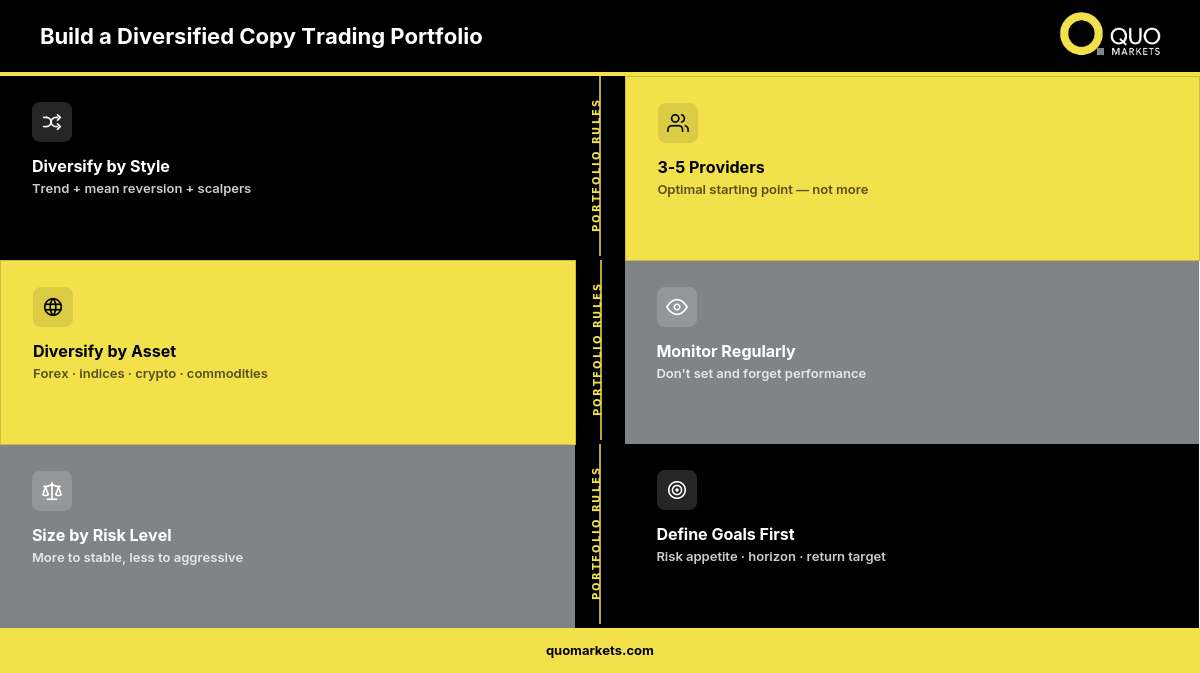
One of the most overlooked principles in copy trading is that the traders you follow should function as a portfolio, not a collection of separate bets. Putting all your copy trading capital with one provider, regardless of how good their track record looks, means you take the full force of any drawdown they experience. Diversifying thoughtfully across multiple providers cuts that risk significantly.
First, diversify by style. Follow traders who operate on different timeframes and use different approaches. If all your providers are momentum traders who thrive in trending markets, they’ll all struggle at the same time when markets consolidate or reverse. Mixing trend followers with mean-reversion traders, or short-term scalpers with longer-term swing traders, builds natural resilience into your overall position.
Second, diversify by asset focus. Forex, indices, commodities, and crypto often respond differently to the same macro events. A crypto-focused trader might do well during risk-on periods; an index trader with defensive positioning might hold up better during a selloff. Having providers across different asset classes means your portfolio is less correlated and more likely to have something performing well regardless of broader conditions.
Third, size your allocations to match risk. Higher-risk providers, those with elevated risk scores or larger historical drawdowns, should get smaller allocations than lower-risk, more consistent traders. A reasonable structure puts the bulk of your capital with two or three stable performers and smaller amounts with higher-upside, higher-risk providers. That way, if an aggressive position struggles, it doesn’t undermine the rest of your portfolio.
Three to five providers is a sensible starting point. Too few creates a concentration risk. Too many makes it hard to actually monitor anyone meaningfully and can result in positions that cancel each other out.
How QuoMarkets’ Tools Support This Process
QuoMarkets’ social trading platform is built around giving followers enough information to make decisions they’re actually confident in, rather than surfacing only headline return figures.
The filter system lets you narrow candidates by specific criteria: performance windows, risk score thresholds, asset class, minimum trading history – so you’re only looking at providers who already meet your baseline requirements. That cuts out a lot of manual screening.
Once you have a shortlist, the comparison tools let you view multiple providers side by side across key metrics: annualised return, maximum drawdown, win rate, risk score, and trade frequency. Seeing those figures together makes the differences much easier to spot. A trader showing stronger returns but a dramatically higher drawdown is telling you something important about the tradeoff involved, and the side-by-side layout makes that relationship immediately clear.
QuoMarkets also gives access to individual trade histories, so you can see how a provider actually behaved during past periods of market stress. Looking at what trades were made during high-volatility stretches tells you far more about a trader’s real behavior than any summary statistic. Combined with the platform’s transparency features around communication and strategy descriptions, the tools give you a complete picture to work from.
Final Remarks
Good copy trading isn’t about finding the biggest return and pressing follow. It’s about building a considered relationship with providers whose strategies, risk profiles, and communication styles genuinely align with your financial goals. That starts with knowing what you want, moves through careful analysis of both the numbers and the qualitative signals, and holds up over time through smart diversification.
No evaluation process removes risk entirely. Copy trading, like any form of market participation, involves uncertainty. But traders who approach provider selection with discipline, asking the right questions and actually stress-testing a track record before committing capital, consistently put themselves in a better position. Take your time, work through the framework, and let the data lead you.
FAQs
Is copy trading profitable in 2026?
It can be, but results depend on who you copy and how you manage risk. Selecting traders carefully and spreading your capital across several providers improves your odds considerably.
What is a good drawdown in copy trading?
Below 20% is generally a moderate risk. Between 20–30% is more aggressive. Above 30–40% signals high risk and the potential for significant losses.
What should I look for when copy trading?
Focus on annualised return, drawdown, risk score, and consistency. Also, check whether the trader explains their strategy clearly, communicates regularly, and trades with their own capital. Match their risk level to your goals before following anyone.
How do you reduce risk in copy trading?
Follow three to five traders with different styles and asset focuses. Put more capital behind stable, consistent performers and less behind higher-risk ones. Check in on performance regularly rather than setting it and forgetting it.