How to Trade Silver (XAGUSD): Strategies, Drivers, Risks, and CFDs Explained
Silver has a reputation for making big moves when markets get interesting. It can rally when investors seek protection from uncertainty, react sharply to changes in the US dollar, and move with global manufacturing, electronics, and solar demand. That combination makes silver appealing to active traders, but it also means the metal can punish oversized positions.
If you want to learn how to trade silver, the first step is understanding what actually moves its price. From there, you can choose an appropriate silver trading strategy, decide whether CFDs, futures, ETFs, physical silver, or mining stocks fit your objectives, and build a risk plan around the metal’s volatility.
What Is XAG/USD?
XAG/USD is the market symbol used to represent silver priced in US dollars. In simple terms, it shows how many US dollars are required to buy one troy ounce of silver.
The first part, XAG, represents silver, while USD represents the US dollar. Therefore, if XAG/USD rises, the price of silver in US dollars is increasing. If it falls, silver is becoming cheaper relative to the dollar.
Silver is unusual among precious metals because it has both monetary and industrial characteristics. It has traditionally been viewed as a store of value and a potential hedge during periods of uncertainty, while its industrial applications make it sensitive to economic activity.
That combination can create substantial price movements. The World Gold Council found that silver’s volatility was roughly twice that of gold over the period it studied, while silver also trades in a smaller and less liquid market than gold.
What Moves Silver Prices?
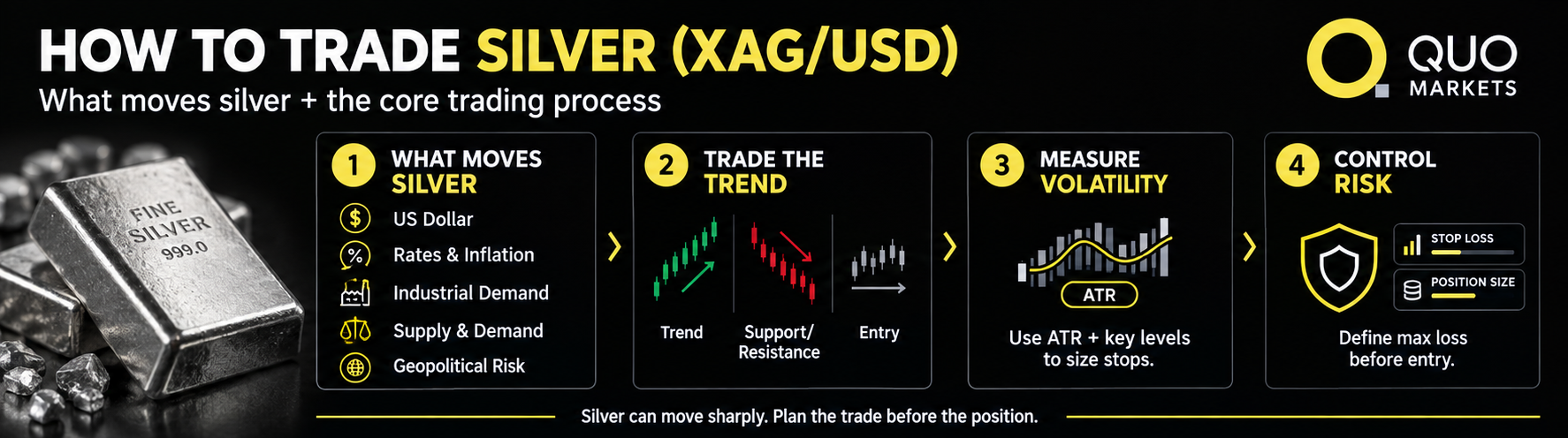
Understanding the forces behind silver prices is more useful than memorising a single indicator. Several factors can push XAG/USD in the same direction or pull it in opposite directions.
The US Dollar
Silver is quoted in US dollars, so movements in the dollar can have a major influence on its price. A stronger dollar can put pressure on dollar-priced commodities because they become more expensive for buyers using other currencies.
For silver traders, this makes the US Dollar Index and major US currency movements worth monitoring alongside the XAG/USD chart.
Interest Rates And Inflation
Interest rates matter because they affect the opportunity cost of holding assets that do not pay interest.
When markets expect US interest rates to remain high, precious metals can face pressure. Expectations of lower rates can have the opposite effect, particularly when investors also become concerned about inflation or economic uncertainty.
Inflation is another important part of the picture. Silver has historically attracted interest as a tangible asset when investors worry about declining purchasing power, although inflation alone does not determine the price.
Industrial Demand
This is where silver differs significantly from gold.
Silver is widely used in electronics, electrical equipment, photovoltaic applications, vehicles, power infrastructure, and other industrial products. The Silver Institute reported that industrial silver demand reached a record 680.5 million ounces in 2024, up 4% from the previous year. Growth was supported by applications linked to the green economy, including photovoltaics, vehicle electrification and grid infrastructure, as well as electronics and AI-related applications.
That industrial exposure means the health of the global economy can influence silver demand. Strong manufacturing and investment can support consumption, while a major economic slowdown can weaken some industrial uses.
Supply And Demand
Silver supply also matters. Mine production, recycling, and changes in industrial consumption can affect the balance between available metal and demand.
The Silver Institute reported that global silver demand exceeded supply for the fourth consecutive year in 2024, producing a structural deficit of 148.9 million ounces.
Traders do not need to forecast every ounce of supply. However, major changes in production, industrial consumption or investment demand can alter the broader market backdrop.
Market Sentiment And Geopolitical Risk
Silver can react quickly when investor sentiment changes.
Geopolitical tensions, financial-market stress and fears about economic stability can increase interest in precious metals. At the same time, silver’s industrial exposure means it can also respond to expectations for global growth.
This creates an important difference from gold. Silver can behave like a precious metal during periods of fear while simultaneously behaving like an industrial commodity when economic expectations change.
Ways To Trade Silver
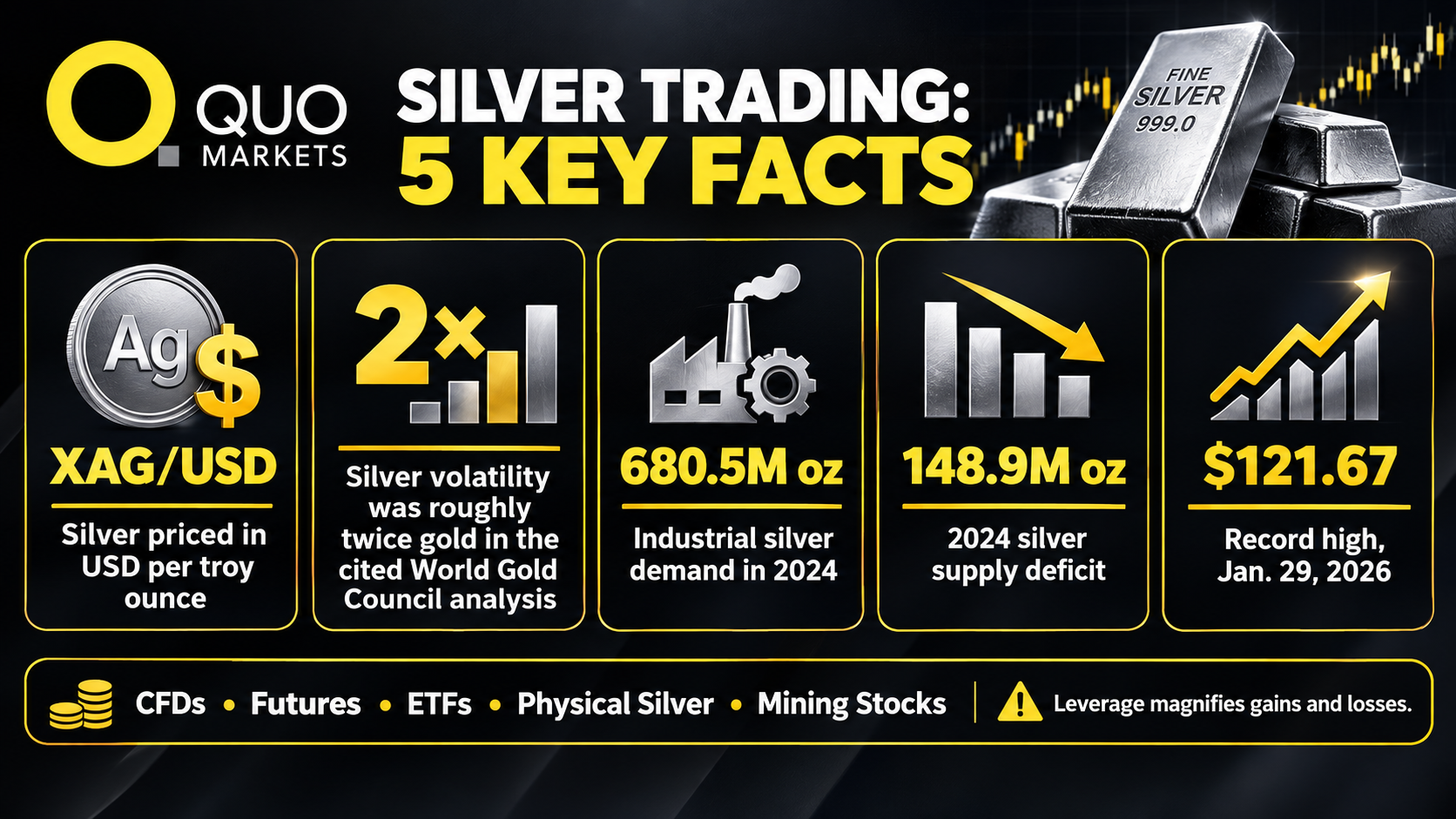
There are several ways to gain exposure to silver, and each works differently.
Physical Silver
Buying physical silver is the most direct way to own the metal. Investors can purchase coins, bars, and other physical products, although storage, insurance, dealer spreads, and transaction costs need to be considered.
Physical silver is generally more suitable for someone seeking long-term ownership than for a trader who wants to open and close positions frequently.
Silver ETFs
Silver exchange-traded products can provide exposure to silver without requiring investors to store the metal themselves. For example, the iShares Silver Trust seeks to track the price performance of silver bullion and provides exposure without directly purchasing physical silver.
The structure, fees, and underlying holdings vary between products, so investors should examine the specific fund before trading.
Silver Mining Stocks
Shares of companies involved in silver mining offer another route into the sector. Their performance can be influenced by silver prices, production costs, company-specific decisions, financing and broader equity-market conditions.
As a result, a mining stock is not the same thing as owning silver itself.
Silver Futures
Silver futures are derivatives that allow traders to take positions on future silver prices. CME Group’s standard silver futures contract represents 5,000 troy ounces, with prices quoted in US dollars and cents per troy ounce.
Futures can offer substantial market exposure, but contract size and margin requirements make them more complex than smaller retail trading positions.
Silver CFDs
A silver CFD allows traders to speculate on movements in silver without owning the physical metal. Traders can open either long or short positions, depending on whether they expect XAG/USD to rise or fall.
CFDs can also provide leveraged exposure, meaning a relatively small amount of capital can control a larger position. That can increase potential returns, but it also magnifies losses, making position sizing and risk controls essential.
How To Trade Silver With A Practical Strategy
There is no single strategy that works in every market. A good silver trading strategy should match the trader’s time frame, risk tolerance, and ability to follow a plan.
1. Start With The Bigger Picture
Before opening a position, check the factors that are currently driving silver. Look at the US dollar, interest-rate expectations, inflation data, economic growth indicators, industrial-demand developments, and major geopolitical news.
The objective is to understand the environment before relying on a chart pattern.
2. Identify The Market Trend
Use a daily or four-hour chart to establish whether XAG/USD is trending upward, trending downward, or moving sideways. Moving averages can help identify the broader direction. Support and resistance levels can then provide potential areas where price has previously reacted.
A trader looking for long positions may prefer an established upward trend, while a short-selling strategy may focus on lower highs and lower lows.
3. Choose An Entry Signal
Once the broader trend is clear, move to a shorter time frame if your strategy requires more precise entries.
Possible signals include:
- A breakout above established resistance
- A pullback toward support in an existing uptrend
- A rejection from resistance during a downtrend
- A momentum confirmation after a consolidation range
No indicator should be treated as a guarantee. The strongest setups usually combine price action with market context.
4. Measure Volatility
Silver can move quickly, so volatility should influence your trade size and stop-loss distance.
The Average True Range, or ATR, is useful for estimating recent price volatility. Rather than placing every stop at an arbitrary distance, traders can use ATR alongside support and resistance to determine whether a proposed trade gives enough room for normal price fluctuations.
5. Set Your Risk Before Entering
Decide how much you are prepared to lose before opening the position. A stop-loss can automatically close a trade when price reaches a predetermined level. The position size should then be calculated around that risk.
This matters especially with leveraged CFDs. Higher leverage can amplify both gains and losses, so using the maximum available leverage does not mean it is appropriate to do so.
How To Trade Silver CFDs On QuoMarkets
On QuoMarkets, XAGUSD is listed with a 5,000-unit contract size, 1% margin, and zero commission on the Standard account, with an average spread of 26 points. The Raw account offers XAGUSD with a $3-per-side commission and a 29-point average spread, while the Zero account lists XAGUSD with a $5-per-side commission and a 26-point average spread. The LIMITLESS account delivers XAGUSD with zero commission and LIMITLESS margin conditions.
For leverage, QuoMarkets offers Dynamic, Fixed, and LIMITLESS structures. Fixed Leverage for metals excluding gold is 1:200, while LIMITLESS can apply to silver under its specified volume tiers. Leverage can be temporarily reduced around certain events, and suitability checks may affect LIMITLESS conditions.
Before opening a position, check the live XAG/USD specification in the trading platform because spreads, trading conditions, and leverage can change with market conditions.
Silver Trading Risk Management
Silver’s relatively high volatility means a position that looks modest on paper can become significant during a sharp move. The January 2026 price action provides a useful example. Silver reached a record high of $121.67 per ounce on January 29, 2026, according to Kitco, before experiencing an exceptionally sharp reversal. Reuters reported that silver reached about $121.6 before falling more than 25% the following day.
That kind of movement shows why traders should avoid treating historical support levels, indicators, or bullish trends as guarantees. A sensible risk framework should include a defined maximum loss per trade, an appropriate position size, a stop-loss where suitable, and enough account margin to withstand ordinary market fluctuations.
A Simple Silver Trading Checklist
Before entering a silver trade, ask:
- What is driving silver today?
- Is XAG/USD trending or ranging?
- Where are the key support and resistance levels?
- What does the US dollar look like?
- Are important economic releases approaching?
- How volatile has silver been recently?
- Where will the trade be invalidated?
- How much could I lose if the stop is reached?
- Is the position size appropriate for my account?
- Does the potential reward justify the risk?
This process can help prevent emotional decisions when silver starts moving quickly.
Gold-Silver Ratio: Another Useful Indicator
The gold-silver ratio measures how many ounces of silver are required to buy one ounce of gold. For example, a ratio of 80 means that 80 ounces of silver have the same nominal value as one ounce of gold.
Traders and investors sometimes use the ratio to compare relative movements between the two precious metals. It should be treated as additional market information rather than a standalone buy or sell signal.
Gold and silver can move together, but their underlying demand profiles are different. Silver’s stronger industrial component and smaller market depth contribute to greater volatility.
Bottom Line
Learning how to trade silver starts with understanding why the metal moves. XAG/USD is influenced by the US dollar, interest rates, inflation, industrial demand, supply conditions, economic growth, geopolitical risk, and market sentiment.
Silver also deserves respect from traders because its volatility can be substantially higher than gold’s. The record move in January 2026 was a powerful reminder that large gains can be followed by equally dramatic reversals.
Whether you choose CFDs, futures, ETFs, mining stocks or physical silver, the same principle applies: understand the instrument, define the trade before entering it, and keep risk under control.
FAQs
What Is XAG/USD?
XAG/USD is the market symbol for silver priced in US dollars. The quote represents the US dollar price of one troy ounce of silver.
Is Silver More Volatile Than Gold?
Yes. Silver generally experiences larger price swings than gold. The World Gold Council found that silver’s volatility was roughly twice that of gold in its analysis, alongside lower market depth and wider spreads.
Can You Trade Silver With CFDs?
Yes. Silver CFDs allow traders to speculate on changes in the price of silver without owning physical metal. CFDs can also provide leveraged exposure, which increases both potential gains and potential losses.
What Is A Good Silver Trading Strategy?
A practical strategy can combine the broader trend, support and resistance, price action, volatility measurements such as ATR, and disciplined risk management. The best approach depends on the trader’s time frame, objectives, and risk tolerance.
What Is The Highest Silver Price Ever Recorded?
Silver reached an all-time high of $121.6 per ounce on January 29, 2026.