
Table of Contents
- What Actually Moves the XAUUSD Market
- How You Can Actually Trade XAUUSD
- Reading the XAUUSD Market: Technical and Fundamental Analysis
- XAUUSD Risk Management
- Trade XAUUSD With Confidence
- FAQs
Gold vs. Dollar: The XAUUSD Trading Guide You’ll Actually Use
Have you seen the ticker XAUUSD pop up and wondered what it stands for? It’s simply the price of one troy ounce of gold measured in U.S. dollars. XAU is gold’s ISO currency code, pulled from its Latin name aurum, and USD is, well, the dollar. Put them together, and you get one of the most actively traded instruments in global financial markets.
What makes XAUUSD interesting is that it lives at the crossroads of two very different worlds: the commodity market, where gold has held value for thousands of years, and the forex market, where currency dynamics shift by the minute. Neither side of this pair ever really goes quiet. Gold responds to geopolitical shocks, inflation prints, central bank moves, and shifting investor mood. The dollar moves on rate expectations, economic data, and global appetite for risk. Getting a feel for both is where any serious XAUUSD strategy begins.
What Actually Moves the XAUUSD Market
The Gold Side of the Equation
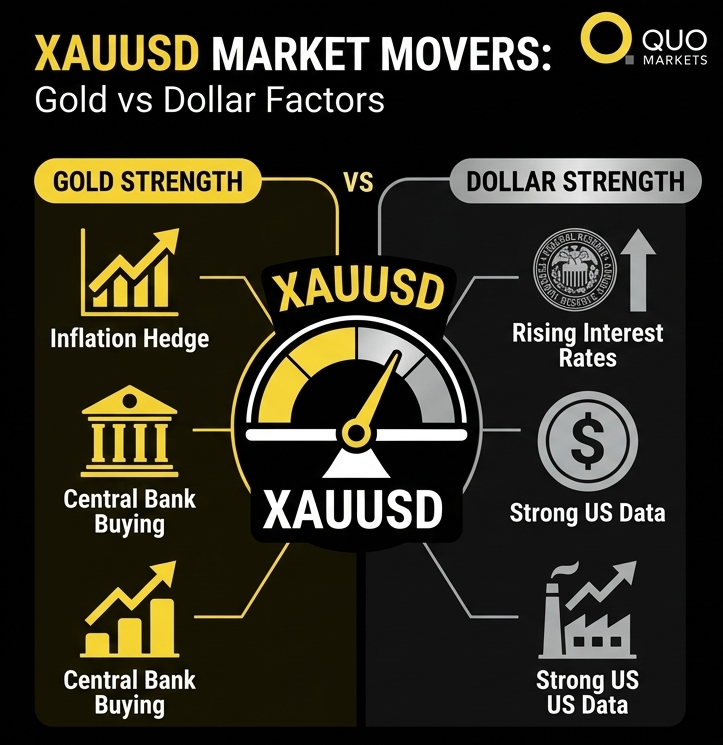
Gold doesn’t pay dividends or generate cash flow, so its price is almost entirely driven by perception and demand. Three forces tend to dominate.
Inflation gets the most airtime, and for good reason. When paper currencies lose purchasing power, investors historically park money in gold. This is why rising consumer prices often come with bullish momentum in gold – the relationship isn’t perfect, but it’s consistent enough that many traders keep a close eye on CPI and PCE releases as potential trading signals.
Central bank activity is another big one. Institutions like the People’s Bank of China, the Reserve Bank of India, and European central banks regularly adjust their gold reserves. Net buying from central banks creates a structural floor under prices; net selling can push prices down. Keeping tabs on reserve reports gives you useful context for longer-term positioning.
Physical demand from jewelry and industrial use also plays a role, especially from large consumer markets. Seasonal buying tied to cultural occasions and festivals can create modest, somewhat predictable upticks in demand that support the broader market.
The Dollar Side of the Equation
Since XAUUSD is priced in dollars, whatever the dollar does directly affects what traders pay per ounce.
U.S. interest rates are the biggest dollar driver. When the Federal Reserve raises rates, dollar-denominated assets become more attractive compared to gold, which yields nothing. This inverse relationship between real interest rates and gold is one of the most reliable dynamics in the XAUUSD market.
Economic data, non-farm payrolls, GDP, and retail sales shape expectations about future Fed policy, which flows through to dollar strength. Risk sentiment matters too. During periods of genuine market stress or geopolitical tension, both the dollar and gold can attract safe-haven flows at the same time, which confuses the usual inverse relationship.
How You Can Actually Trade XAUUSD
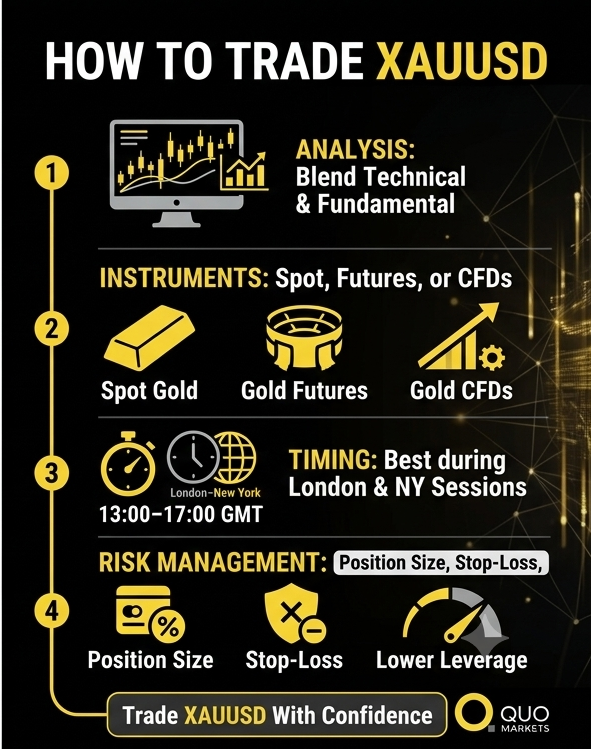
There’s more than one way to get exposure to XAUUSD, and your choice of instrument shapes everything from costs to capital requirements.
Spot Gold
Spot XAUUSD is the most direct route. You’re buying or selling gold at the current market price, with settlement typically within two business days. Most retail forex brokers operate in the spot market, and it runs around the clock from Sunday evening through Friday evening across major financial centers. Liquidity peaks during the London and New York sessions, but traders across time zones can access it throughout the week.
Gold Futures
Futures contracts, primarily traded on the COMEX exchange, are standardized agreements to buy or sell a set quantity of gold at a fixed price on a future date. A standard COMEX contract covers 100 troy ounces, which demands substantial capital even with margin. Futures tend to suit institutional traders and those hedging for price certainty. For most retail traders, the capital requirements and contract structure make futures harder to access than spot or CFD products.
Gold CFDs
Contracts for Difference let you speculate on XAUUSD price moves without owning physical gold or dealing with futures delivery. CFD trading is popular with retail traders because of flexible position sizing and leverage; you can control a larger position with a smaller initial deposit. QuoMarkets offers XAUUSD as a CFD, where you can go long or short depending on your read of the market. Just keep in mind that leverage cuts both ways, which makes risk management essential, not optional.
Timing matters too. The best windows for XAUUSD trading are the London session (8:00–17:00 GMT) and the London-New York overlap (13:00–17:00 GMT). These hours typically offer the tightest spreads and the most reliable price discovery. Asian session trading is possible, but volume is lower, and moves tend to lack conviction.
Reading the XAUUSD Market: Technical and Fundamental Analysis
Strong XAUUSD analysis usually blends both technical and fundamental approaches. Leaning entirely on one leaves real gaps in your understanding of why the price is moving and where it might head next.
Technical Analysis for XAUUSD
Gold chart analysis starts with mapping out key support and resistance levels. Because gold has been traded electronically for decades, major price levels – round numbers, historic swing highs and lows – draw attention from both algorithmic and discretionary traders. These zones regularly act as decision points where price either reverses or pushes through with momentum.
Trendlines are equally worth your attention. XAUUSD tends to develop clean trends during sustained macro moves, prolonged dollar weakness, or extended inflationary cycles, for example. A common approach is to draw trendlines on higher timeframes, such as the daily or weekly chart, then drop to lower timeframes to find specific entries.
Among technical indicators, moving averages are especially reliable for filtering noise and reading trend direction. Institutional traders closely watch the 50-day and 200-day moving averages. A crossover between the two – the so-called golden cross or death cross – can signal meaningful momentum shifts. The Relative Strength Index helps flag overbought and oversold conditions, while the Average True Range gives you a live read on volatility, which is useful when you’re figuring out where to place your stop.
Breakout trading also works well with XAUUSD. When price tightens into a range after a significant move, a breakout above or below that range, especially with rising volume, often kicks off a new directional push. QuoMarkets’ charting tools let you monitor these consolidation patterns and set alerts when the price approaches key levels.
Fundamental Analysis for XAUUSD
On the fundamental side, three things deserve your consistent attention: the U.S. Dollar Index, Treasury yields, and geopolitical developments.
The U.S. Dollar Index, which measures the dollar against a basket of major currencies, has a historically inverse relationship with XAUUSD. When the index climbs, gold tends to come under pressure, and vice versa. Watching both simultaneously tells you whether dollar moves are behind any given XAUUSD swing.
Real interest rates, nominal Treasury yields adjusted for inflation, are arguably the single most important macro variable for gold. When real rates turn negative, gold becomes comparatively attractive because the opportunity cost of holding a non-yielding asset disappears. When real rates rise sharply, gold historically feels the weight, even when nominal inflation remains elevated.
Geopolitical risk has a well-documented relationship with gold prices. Armed conflicts, trade wars, political instability in major economies, and unexpected global events push investors toward assets they consider safe. Gold often catches those flows, sometimes quickly and in size. Keeping geopolitical awareness in your analysis is part of managing risk like a professional.
XAUUSD Risk Management
XAUUSD volatility is both the appeal and the danger. The pair can move several dollars per ounce within minutes around major data releases, which means real P&L swings even on modest position sizes. Without a clear framework for managing risk, that volatility will work against you far more often than it works for you.
Position Sizing
Know how much of your account you’re willing to risk on any single trade before you enter. Most experienced traders cap this at one to two percent of total account equity per position. It might feel overly cautious when a setup looks clean, but this discipline is exactly what keeps you in the game through losing streaks. Piling into a single position because you’re confident is one of the most common and costly mistakes in gold trading.
Stop-Loss Placement
Every XAUUSD trade should have a defined stop-loss set before you execute. Placing stops based on technical structure, just beyond a key support or resistance level, generally works better than picking an arbitrary dollar figure. Given XAUUSD’s volatility, stops set too tight often get clipped by normal price movement before the trade has room to develop. Using the ATR indicator to calibrate your stop distance relative to current conditions is a practical way around this.
Using Leverage
Leverage in gold CFD trading can reach 1:100 or higher on some platforms, but having access to it and using it are two different things. High leverage shrinks your margin for error. Even a well-reasoned setup can get stopped out by a brief volatility spike if you’re stretched to the limit. Many professional traders run at much lower effective leverage, often 1:5 to 1:20, treating it as a tool for capital efficiency rather than a shortcut to bigger gains.
Also, be especially careful around high-impact events. Non-farm payrolls, Fed rate decisions, and CPI releases can spark fast, unpredictable moves. Some traders cut or close positions ahead of these releases rather than absorb the uncertainty. Others stick around with wider stops and a smaller size. Either works, as long as it’s deliberate and fits your broader plan.
Trade XAUUSD With Confidence
XAUUSD is not a simple instrument. Trading it well means thinking about commodity dynamics and macro forces at the same time – inflation expectations alongside chart structure, central bank policy alongside real-world events unfolding on the other side of the globe.
The traders who do this consistently well aren’t necessarily those with the sharpest instincts. They’re the ones with a structured process, steady risk management, and the right tools in front of them. QuoMarkets’ platform is designed to support exactly that kind of approach: advanced charting, real-time data, and the execution infrastructure that XAUUSD demands. If you’re ready to put what you’ve learned to work, start by exploring QuoMarkets’ gold trading tools and testing your analysis in live market conditions.
FAQs
Is XAUUSD Good for Day Trading?
Yes, particularly during the London and New York sessions when liquidity is highest and spreads are tightest. The volatility creates real intraday opportunities, though that same volatility demands careful position sizing and stop discipline. Beginners are better off starting on a demo account before going live.
What Drives the XAUUSD Price?
U.S. real interest rates, Federal Reserve policy expectations, the U.S. Dollar Index, inflation data, central bank reserve changes, geopolitical events, and broader risk sentiment in global markets all play a role. No single factor dominates consistently, which is why tracking multiple inputs at once matters.
Can Beginners Trade XAUUSD?
Yes, though it asks more of you than lower-volatility instruments. Understanding how gold and the dollar interact, learning to read a price chart, and building solid risk management habits before committing serious capital are all steps worth taking before diving in.
What Is XAUUSD?
XAUUSD is the market symbol for the price of one troy ounce of gold expressed in U.S. dollars. It’s traded across forex brokers, futures exchanges, and CFD platforms, making it one of the most accessible commodities available to individual traders.
Why Is XAUUSD Popular Among Traders?
It combines the deep liquidity of the forex market with gold’s long-standing role as a safe-haven asset. It responds meaningfully to inflation, interest rate shifts, and geopolitical events, which creates consistent trading opportunities and portfolio diversification value across different trading styles.