

Table of Contents
- What Is Leverage Trading? Understanding the Risks and Rewards
- How Leverage Trading Works
- Advantages of Leverage Trading
- Disadvantages of Leverage Trading
- Regulation and Leverage Limits
- How to Trade with Leverage
- Final Remarks
- FAQs
What Is Leverage Trading? Understanding the Risks and Rewards
Leverage trading is one of the most widely discussed concepts in the financial markets, and it’s easy to see why. It gives traders the ability to control positions much larger than the money they actually have in their account. That sounds exciting until the market turns the other way. In simple terms, leverage trading involves using funds provided by a broker to increase market exposure. A trader with $1,000 in capital could potentially control a $30,000 position, which can be incredibly useful when managed properly and extremely risky when it is not.
Before putting real money into leveraged positions, it’s important to understand how leverage works, what advantages it offers, and how quickly things can go wrong.
How Leverage Trading Works
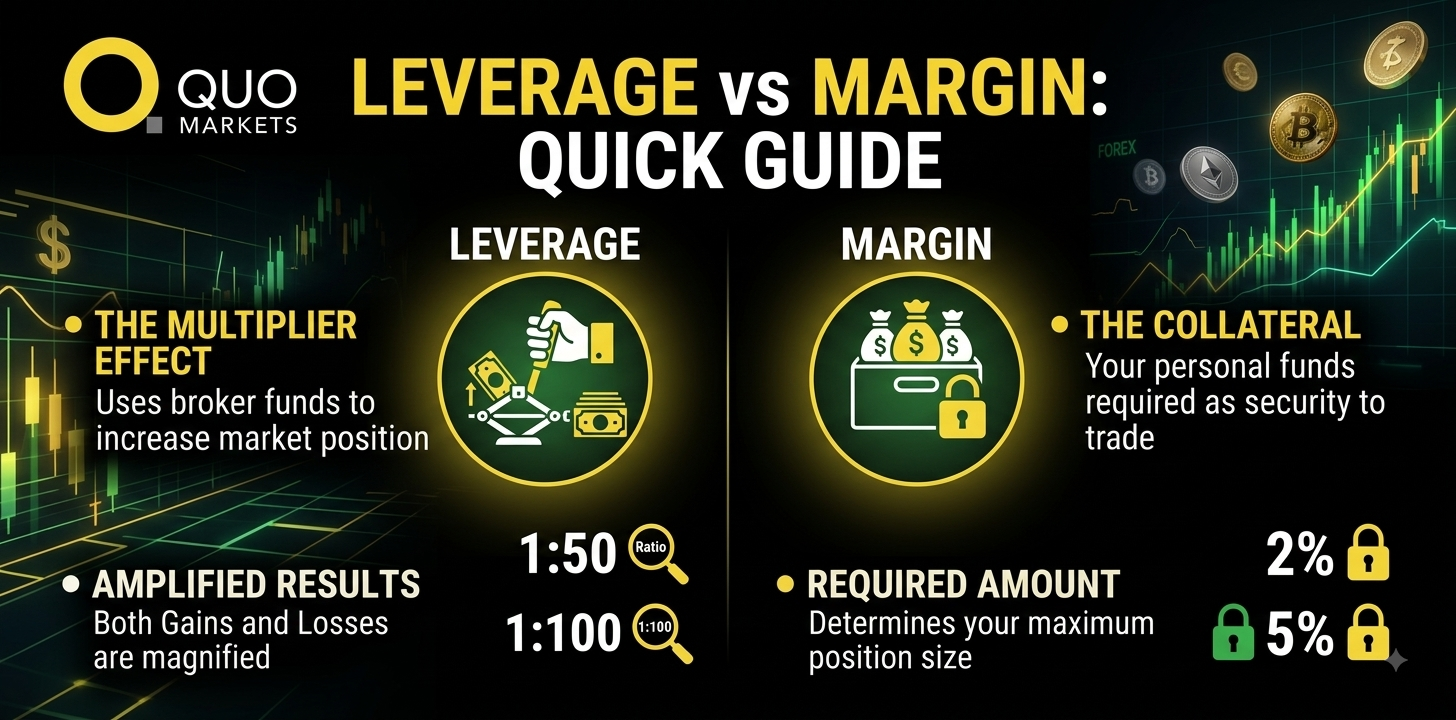
To understand leverage trading, you first need to know the connection between margin and leverage. Margin is the amount of your own money required as collateral to open a leveraged trade. Leverage is shown as a ratio, such as 1:10, 1:50, or 1:100, and it represents how much buying power in trading you receive compared to your deposited margin.
Here’s a simple leverage trading example. Imagine you want to trade the EUR/USD pair and your broker provides 1:30 leverage. For every $1 you deposit, you can control $30 in the market. If you place $1,000 into your account, you can open a trade worth $30,000. You are not directly borrowing $29,000 in the traditional banking sense, but you are exposed to the full profit and loss movement of that $30,000 position.
Now consider how that works in reality. If EUR/USD rises by 1% in your favor, a $30,000 position generates a $300 profit. That equals a 30% return on your original $1,000 margin. Without leverage, the same 1% market move on a $1,000 trade would only produce $10 in profit. This is how leverage increases potential gains.
Of course, the same principle works against you. A 1% move in the opposite direction would result in a $300 loss, which is 30% of your margin. A 3.3% move against your position would completely erase your $1,000 deposit. In highly volatile markets, that can happen surprisingly fast.
That is why the leverage ratio in trading should never be viewed only as a tool for boosting profits. It magnifies everything, including losses. Whether you are involved in leverage trading in forex or leverage trading in crypto, the mechanics are the same. The major difference is that cryptocurrency markets are often far more volatile than forex markets, making high leverage even riskier there.
Another important concept is the margin requirement. Brokers usually express this as a percentage. For example, a 3.33% margin requirement equals 1:30 leverage, while a 2% margin requirement equals 1:50 leverage. Understanding the margin requirement before opening a position helps you know exactly how much capital is at risk.
Advantages of Leverage Trading
The popularity of leverage trading is understandable because, when used responsibly, it offers several real advantages for both retail and professional traders.
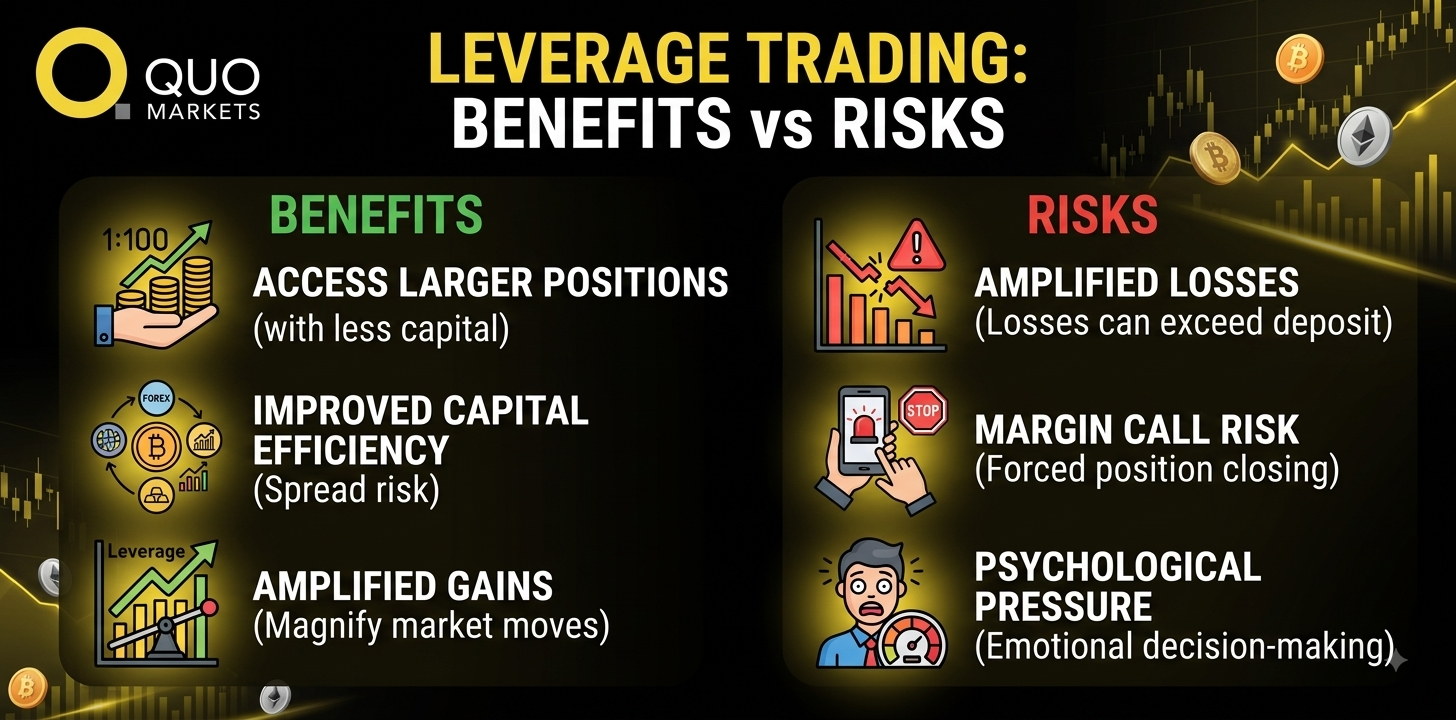
The biggest attraction is the ability to access larger market positions with less capital. Without leverage, a trader would need the full $30,000 to open a sizable position in a major currency pair. With leverage, the same market exposure may be possible with only $1,000. This gives smaller traders access to opportunities that would otherwise require far more money upfront.
Leverage also improves capital efficiency. Instead of locking an entire account into one position, traders can spread capital across multiple trades. Someone with a $10,000 account might use a $500 margin for one forex trade, another $500 for a second position, and still have the remaining funds available for additional opportunities. Without leverage, each trade would require the full trade value, making diversification much harder for smaller accounts.
In many cases, a leveraged trading strategy is really about efficient capital management. Experienced traders often use leverage to distribute exposure across different assets and markets while keeping overall risk under control.
Leverage also makes short selling with leverage more accessible. Traders who expect a market decline can open short positions just as easily as long positions, creating opportunities to potentially profit during bearish market conditions instead of waiting on the sidelines.
Disadvantages of Leverage Trading
While leverage offers clear advantages, the risks are equally real and deserve serious attention.
The biggest issue is simple: leverage increases losses just as quickly as it increases profits. In the earlier example, a 3.3% move against a 1:30 leveraged trade wipes out the entire margin balance. During periods of heavy volatility, this can happen before a trader even has time to react.
This is where the margin call comes into play. A margin call happens when your account equity falls below the broker’s required maintenance margin. At that point, the broker requires you to add more funds immediately or risk having positions closed automatically. If you fail to meet the margin call, the broker will liquidate positions to recover funds, often during highly unstable market conditions.
The liquidation risk in leveraged trading becomes especially dangerous during periods of extreme trading volatility. Economic news, central bank announcements, or geopolitical developments can trigger sudden price gaps that move past stop-loss levels before orders can execute. In some cases, losses may even exceed the account balance, leaving the trader with a negative balance owed to the broker.
There is also a major psychological challenge involved with leverage. Watching a leveraged position swing hundreds of dollars up or down within minutes creates emotional pressure that can affect decision-making. Traders under stress often abandon their strategy, move stop-losses, revenge trade, or hold losing positions longer than planned. These emotional mistakes are among the main reasons leveraged accounts get wiped out, and leverage makes every error far more expensive.
This is why risk management in leveraged trading is essential. Without it, even a strong strategy can collapse quickly.
Regulation and Leverage Limits
Financial regulators around the world have introduced leverage restrictions for retail traders after seeing how excessive leverage contributed to widespread account losses.
In the European Union, the European Securities and Markets Authority (ESMA) introduced rules limiting leverage to 1:30 for major forex pairs like EUR/USD, 1:20 for non-major currency pairs and gold, 1:10 for commodities excluding gold, and 1:2 for cryptocurrencies. These rules apply to retail clients using EU-regulated brokers.
In the United States, the Commodity Futures Trading Commission (CFTC) and the National Futures Association (NFA) limit leverage to 1:50 for major forex pairs and 1:20 for non-major pairs. These are considered some of the strictest retail leverage regulations globally.
In the United Kingdom, the Financial Conduct Authority (FCA) follows rules that are largely similar to those in the EU, with 1:30 leverage remaining the standard limit for major forex pairs. Australia’s ASIC has also introduced leverage restrictions that align the country with other major regulated markets.
It is important to remember that these limits are maximums, not recommendations. Regulators are not suggesting traders should use 1:30 or 1:50 leverage. They are simply setting the highest level brokers are legally allowed to offer. Professional traders may qualify for higher leverage, though that status comes with additional conditions and responsibilities.
How to Trade with Leverage
Understanding the risks is important, but managing them properly matters even more. Here are some practical guidelines for anyone using leverage.
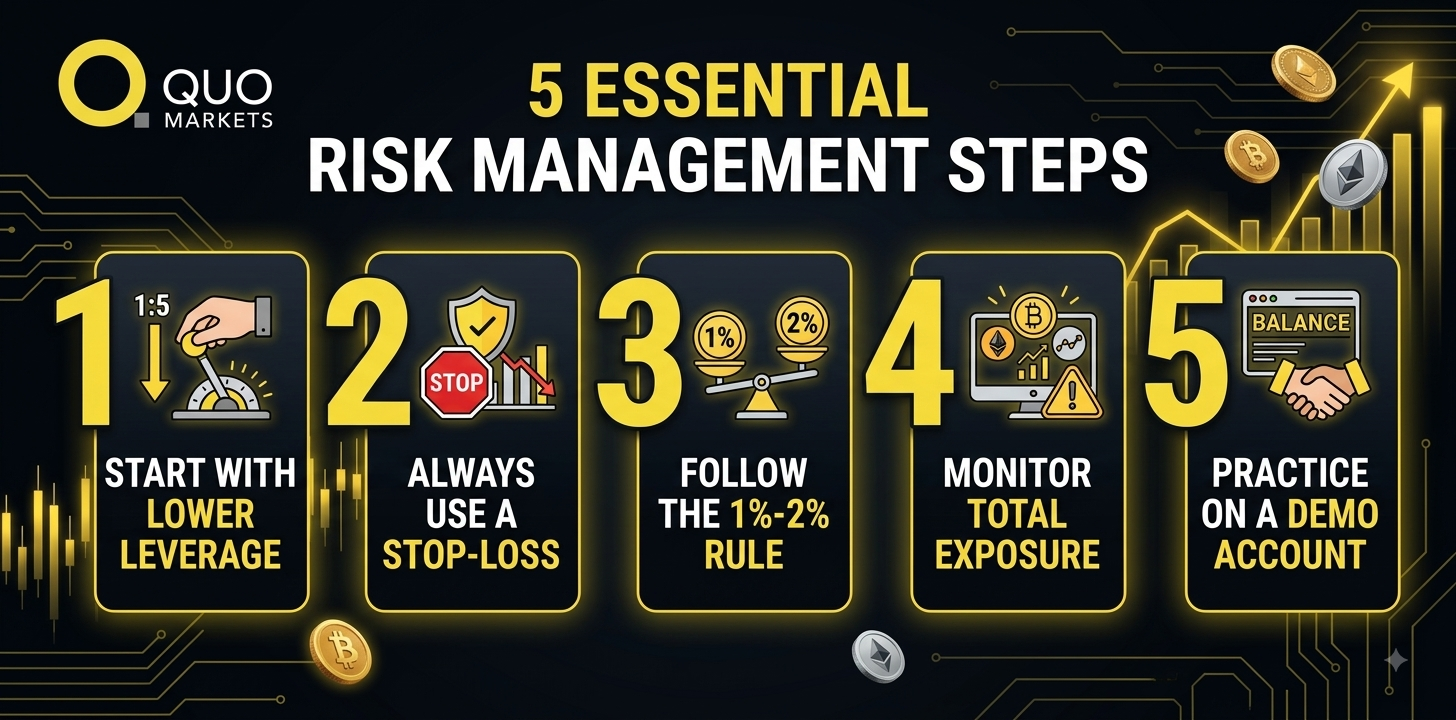
Start With Lower Leverage
Just because higher leverage is available does not mean it should be used. Many experienced traders prefer working with 1:5 or 1:10 leverage even when brokers offer much more. Lower leverage gives trades more room to handle normal market fluctuations and lowers the risk of sudden margin calls.
Always Use a Stop-Loss
A stop-loss with leverage is essential. It protects your account from a single trade causing major damage. Before entering any position, decide how much you are prepared to lose and place your stop-loss accordingly. Avoid moving the stop-loss simply because you hope the market will reverse.
Follow the One-to-Two Percent Rule
Risk management in leveraged trading often follows the rule of risking only 1% to 2% of the total account balance on a single trade. For example, if your account balance is $5,000, your maximum loss per trade should stay between $50 and $100. This may seem conservative, but it helps traders survive losing streaks without destroying their accounts.
Monitor Total Exposure
Many traders focus only on individual positions and overlook the combined exposure across all open trades. The total notional value of several leveraged positions can become much larger than expected. Monitoring overall exposure is critical for keeping portfolio risk manageable.
Practice on a Demo Account First
Most regulated brokers offer demo accounts that simulate real market conditions. Practicing leverage trading strategies in a demo environment allows traders to understand how margin, volatility, and stop-losses interact without risking real money.
Final Remarks
Leverage trading can provide larger returns, better capital efficiency, and broader access to financial markets. At the same time, every advantage comes with a matching risk. Amplified losses, margin calls, and account wipe-outs happen far more often than many traders expect. The same tools that make leverage attractive are also what make it dangerous.
Approach leveraged trading with a clear strategy, use conservative leverage levels, protect every trade with a stop-loss, and never risk money you cannot afford to lose. If you are new to leveraged products, spend time practicing on a demo account and treat that experience seriously before moving into live markets.
FAQs
What is the difference between margin and leverage?
Margin is the amount of money required to open a leveraged trade, usually shown as a percentage of the total trade value. Leverage is the ratio that shows how much buying power you receive compared to that margin. For example, a 2% margin requirement equals 1:50 leverage.
What happens if a leveraged trade moves against you?
If the market moves heavily against your position, your broker may issue a margin call asking you to deposit more funds. If you fail to do so, the broker can automatically close your trades to recover losses. In extreme situations, losses may exceed your account balance, leaving you with a negative balance owed to the broker. For added protection, many traders prefer brokers that offer negative balance protection.
What is leverage trading in simple terms?
Leverage trading means using funds provided by a broker to control a position larger than your account balance would normally allow. For example, with 1:10 leverage, a $500 deposit can control a $5,000 trade. Profits and losses are calculated based on the full $5,000 position.
Is leverage trading suitable for beginners?
Leverage trading carries significant risk and is usually better suited for traders who already understand market behavior, margin mechanics, and risk management. Beginners are generally safer starting with demo accounts and lower leverage ratios.
What are the main risks of leverage trading?
The main risks include amplified losses, margin calls, forced liquidation during volatile conditions, and the emotional pressure that comes with managing large price swings.