
Table of Contents
- What Are Margin Calls and Stop-Out Levels?
- How Margin Level Works in Trading
- Understanding Equity, Used Margin, and Free Margin
- What Causes a Margin Call?
- Margin Call Example: How Accounts Reach Danger Levels
- Stop-Out Levels Explained: When Brokers Close Your Trades
- Margin Call vs. Stop-Out: Key Differences
- How to Avoid Margin Calls and Forced Liquidation
- Why Broker Margin Rules Matter
- Final Thoughts
- Frequently Asked Questions (FAQs)
While leverage can increase potential returns by allowing traders to control larger positions, it also increases exposure to market movements. This means that the same leverage that can amplify profits can equally amplify losses if a trade does not go as planned.
Two of the most important concepts every leveraged trader needs to understand are margin calls and stop-out levels. Knowing how they work, how they affect your margin level, and how brokers respond when your account balance drops can make the difference between controlled risk and a wiped-out account.
How Margin Level Works in Trading
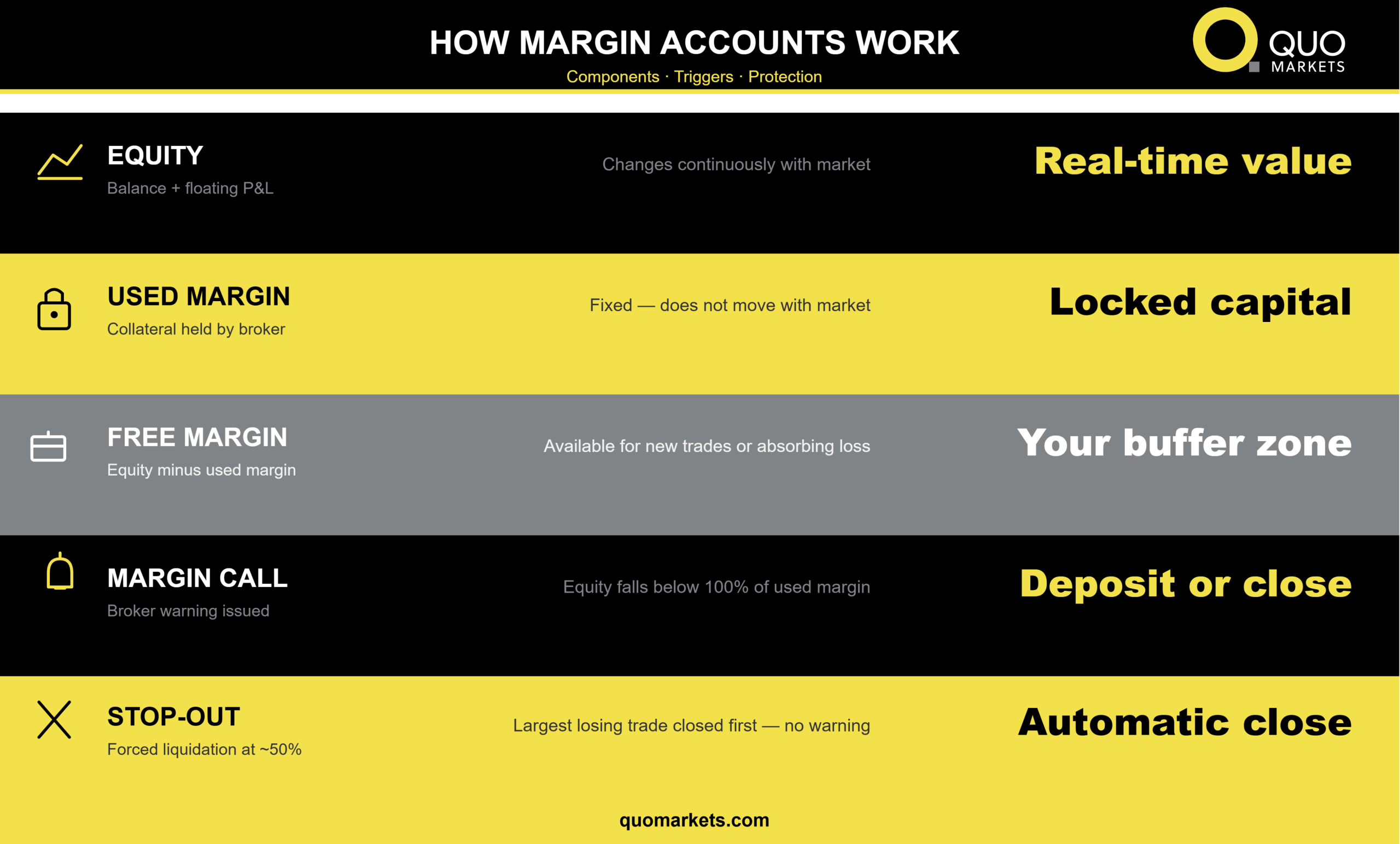
To understand margin calls properly, you first need to know how margin level is calculated and why brokers monitor it constantly.
The formula is simple:
Margin Level = (Equity ÷ Used Margin) × 100
Each part of this calculation matters.
Equity is your current account value after including profits or losses from open trades. For example, if your account balance is $5,000 and your open positions are showing a floating loss of $200, your equity becomes $4,800. Since the market is always moving, equity changes continuously.
Used margin is the amount your broker holds as collateral to maintain your open trades. Unlike equity, it does not fluctuate with market movement. It depends on your trade size and the leverage being used.
Free margin is the amount left after the used margin is deducted from equity. This is the money available for opening additional trades or handling further losses.
Free Margin = Equity – Used Margin.
Here is a practical example.
Imagine you have a $10,000 trading account and open a position requiring $2,000 in used margin. Your margin level starts at:
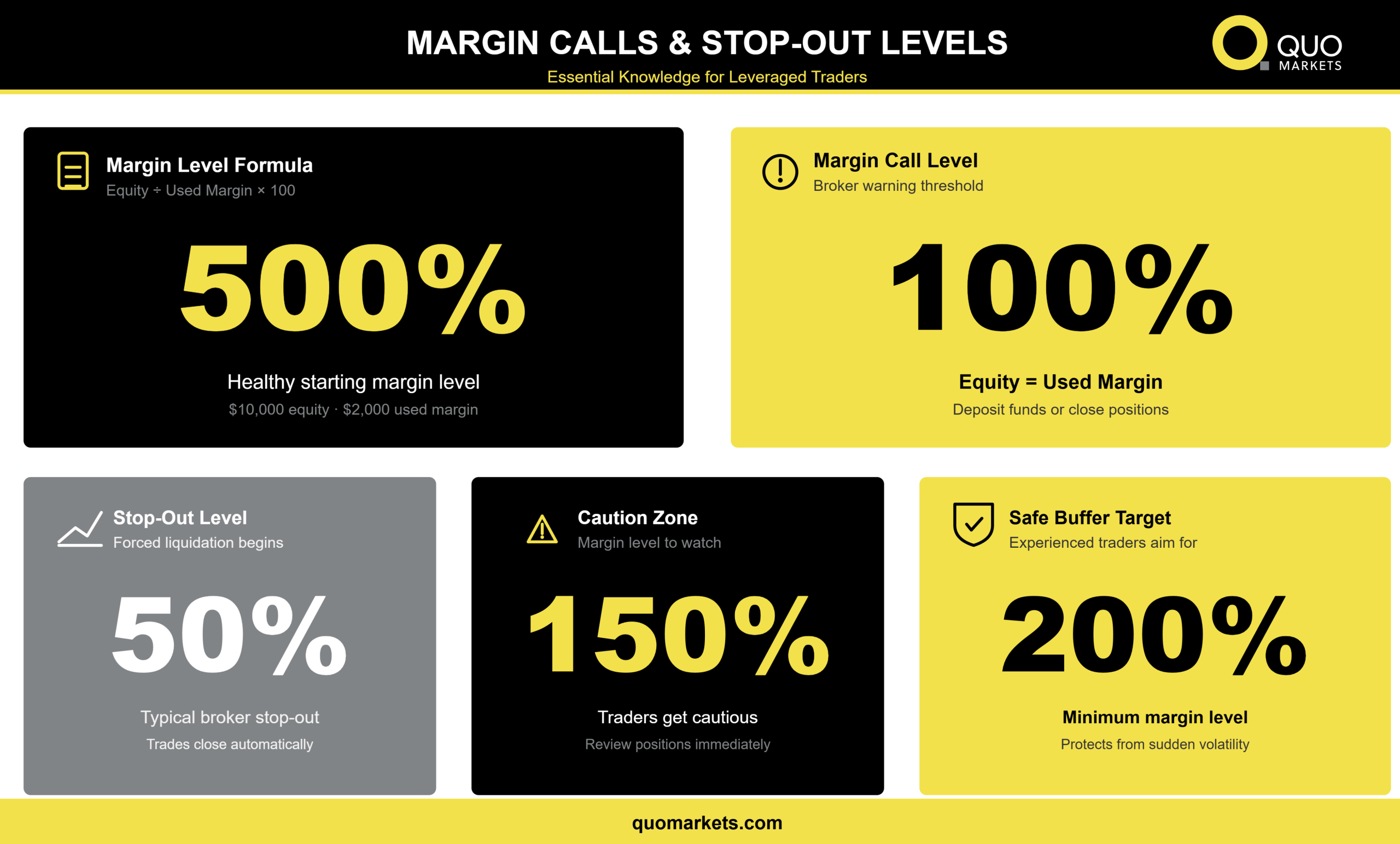
($10,000 ÷ $2,000) × 100 = 500%
That is considered a strong and healthy margin level.
Now, suppose the market moves against your trade and your equity falls to $3,000. Your new margin level becomes:
($3,000 ÷ $2,000) × 100 = 150%
You are still above most broker limits, but the situation is becoming riskier. If losses continue to grow, your margin level keeps falling, bringing you closer to a margin call.
What Causes a Margin Call?
A margin call happens when your margin level falls below a broker’s required threshold.
Years ago, brokers would literally contact traders and ask them to deposit more money. Today, most online trading platforms issue automatic alerts instead. The meaning is still the same: your account no longer has enough equity to safely support your open positions.
Many brokers place the margin call level around 100%. That means your equity has fallen to the same level as your used margin.
At this stage, the broker warns you that action is needed.
Usually, you will need to either:
- Deposit additional funds into your account
- Close some open positions to reduce the used margin
This is where proper margin trading risk management becomes extremely important. Traders using excessive leverage or holding multiple losing trades are much more exposed to margin calls during volatile market conditions.
A fast-moving market, unexpected news event, or price gap can push equity lower in seconds.
For example:
- Equity: $2,500
- Used Margin: $2,000
- Margin Level = 125%
Then the market gaps against your position, and your floating loss increases by $600.
Your equity drops to $1,900.
Now your margin level becomes:
($1,900 ÷ $2,000) × 100 = 95%
You have now fallen below the broker’s 100% margin call threshold. The broker sends a warning notification, expecting you to take action quickly. If nothing changes, the next stage begins automatically.
Stop-Out Levels and Forced Liquidation
A stop-out level is the point at which the broker stops warning you and starts closing your trades automatically.
A margin call is simply an alert. A stop-out is forced liquidation.
When your margin level drops to the broker’s stop-out threshold, the platform automatically closes positions to reduce risk. Depending on the broker, stop-out levels are often set around 50%, 20%, or sometimes even lower.
In most cases, the largest losing trade is closed first because it frees up the most margin. If that is not enough to recover the account, additional positions continue to close until the margin level rises above the required threshold.
Here is a full example of how the process works.
You start with:
- Account balance: $10,000
- Used margin: $4,000
- Starting margin level: 250%
The market moves against your trades over several sessions.
Your equity falls to $2,500.
Your margin level is now:
($2,500 ÷ $4,000) × 100 = 62.5%
Your broker’s margin call level was already triggered earlier at 100%.
Then losses continue, and your equity falls to $1,800.
Your new margin level becomes:
(4000 ÷ 1800) × 100=45%
If your broker’s stop-out level is 50%, the liquidation process starts automatically.
The broker closes your biggest losing position, releasing $1,500 in used margin. Your used margin falls to $2,500, your account stabilizes temporarily, and your margin level rises back above the stop-out threshold.
The key difference is simple:
- A margin call asks you to act
- A stop-out acts automatically without waiting for you
That is why every trader should know their broker’s exact margin call and stop-out percentages before using leverage.
How to Reduce the Risk of Margin Calls
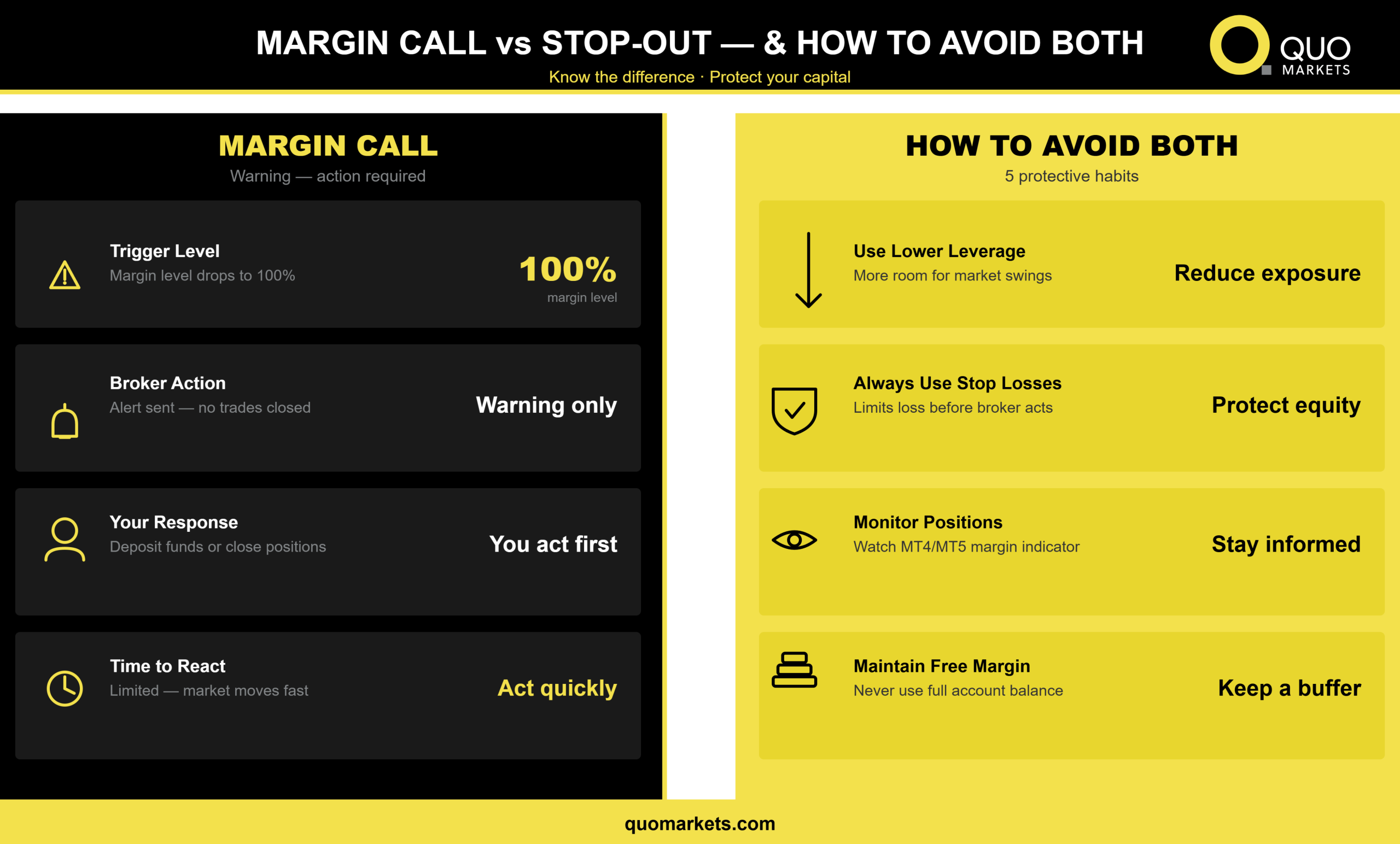
The good news is that margin calls and forced liquidations are usually avoidable when traders manage risk properly.
Use Lower Leverage
This is one of the most effective ways to protect your account.
Higher leverage increases both profits and losses. Traders using smaller leverage ratios usually have much more room to handle temporary market swings without pushing their margin level into dangerous territory.
Many experienced traders aim to keep margin levels above 200% whenever possible.
Always Use Stop Losses
A stop loss is your own protection system before the broker ever needs to intervene.
By limiting how much you can lose on a trade, stop losses help protect your equity and prevent your margin level from collapsing unexpectedly.
Monitor Your Positions Regularly
Markets can become volatile very quickly. Economic news, low liquidity, and sudden price gaps can move positions dramatically within minutes.
Keeping an eye on your margin level, especially through the MT4 or MT5 margin level indicator, helps you react before the situation becomes critical.
Both MetaTrader 4 and MetaTrader 5 display margin level information directly inside the trading terminal.
Maintain Extra Free Margin
Avoid using your entire account balance for active trades.
Keeping a healthy free margin buffer allows your account to absorb temporary losses without immediately triggering margin warnings.
Learn Your Broker’s Rules
Every broker operates differently. Some use a 100% margin call and 50% stop-out structure, while others use completely different levels. Many regulated brokers also provide negative balance protection, which prevents traders from losing more money than they deposited during extreme market conditions.
Always review your broker’s trading conditions before opening leveraged positions.
The traders who survive long term are usually not the ones taking the biggest risks. They are the ones managing risk consistently and protecting their capital.
Final Remarks
Margin calls and stop-out levels are not designed to punish traders. They exist to control risk inside leveraged markets and protect both traders and brokers from uncontrolled losses. Understanding how margin level works, what triggers a margin call, and when automatic liquidation begins gives you far more control over your trading decisions.
Careful leverage management, disciplined stop-loss usage, and maintaining a strong margin buffer are some of the most important habits any trader can develop. Over time, those habits matter far more than any trading strategy or technical indicator.
FAQs
What does a margin call mean in simple terms?
A margin call happens when your account’s margin level falls below the broker’s required threshold, usually around 100%. It means your equity is no longer sufficient to comfortably support your open trades, and you need to either add funds or reduce your positions.
What margin level is considered risky?
Many traders start becoming cautious once the margin level drops below 150%. When it reaches 100% or lower, you are approaching margin call territory. In many broker setups, levels below 50% can trigger automatic liquidation.
What are the best ways to avoid a margin call?
The safest approach is to use conservative leverage, apply stop losses on every trade, monitor your positions closely, maintain a healthy free margin, and avoid opening too many leveraged trades at the same time.
What is the main difference between a margin call and a stop-out level?
A margin call is a warning telling you that your account is running low on available margin. A stop-out level is the point at which the broker automatically closes your trades because the account risk has become too high.
Is it possible to lose more money than you deposited?
Yes, in rare cases involving extreme market volatility or sudden price gaps. However, many brokers now offer negative balance protection, which prevents accounts from going below zero.