
Table of Contents
- Gold Is Having a Moment in 2026
- Why Your Choice of Vehicle Actually Matters
- Physical Gold: What You Gain and What You Give Up
- Gold ETFs: A Simpler Way to Hold Gold
- Physical Gold vs ETFs vs CFDs at a Glance
- What a Gold CFD Actually Is
- Leverage: Your Biggest Lever, for Better or Worse
- Why Traders Gravitate Toward Gold CFDs
- What Gold CFD Trading Actually Costs
- So Which One Fits You?
- Getting Started With Gold CFDs
- Final Word: Pick the Exposure That Matches How You Trade
- FAQs
Gold Is Having a Moment in 2026
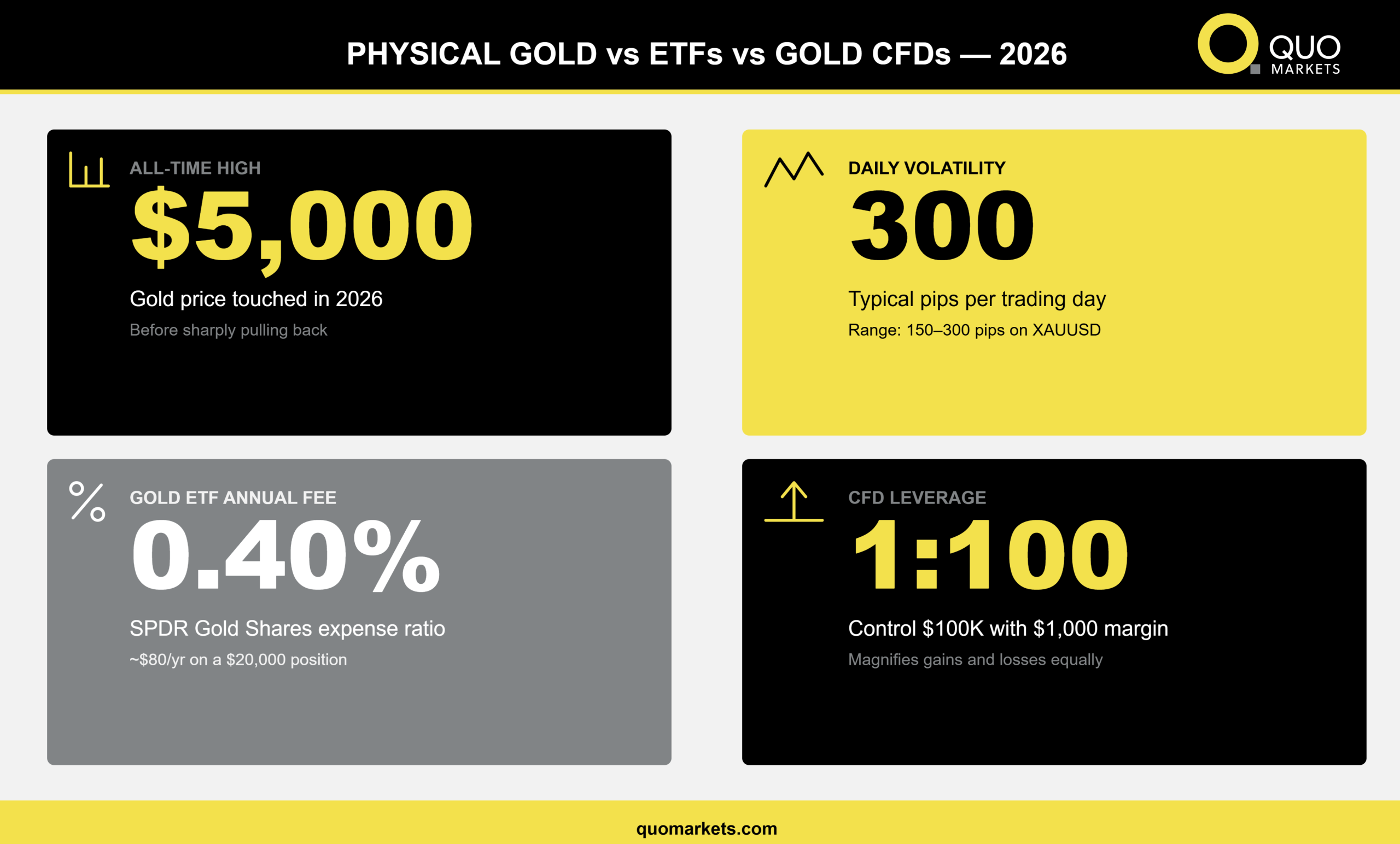
Gold has had quite a year. Prices climbed to all-time highs, briefly touched the $5,000 mark in 2026, and then pulled back hard. Through it all, gold has stayed one of the most talked-about assets on the planet, pushed along by inflation worries, central banks stocking up on reserves, geopolitical flashpoints, and a generally jumpy market.
All that attention raises a practical question: how should you actually get exposure to gold?
Some people want gold they can hold – bars, coins, the real thing. Others are happy owning a fund that tracks the price. And then there’s a third group, active traders, who turn to XAUUSD and gold CFDs specifically to play short-term price swings.
There’s no single right answer here. It depends on what you’re trying to do, how much risk you can stomach, and how involved you actually want to be. This article lays out physical gold, gold ETFs, and gold CFDs side by side, no sugar-coating, so you can figure out which one fits.
Physical Gold: What You Gain and What You Give Up
Physical gold is the original store of value. Long before anyone had heard of an exchange or a brokerage app, people were storing wealth in bullion, coins, and jewelry, and passing it down the family line.
Today, “physical gold” usually means bars, government-minted coins, or allocated storage accounts where a specific amount of gold sits under your name.
The appeal is straightforward: you actually own something. No broker standing between you and your asset, no fund manager, no counterparty risk. It’s been considered a safe haven for centuries, and that reputation hasn’t gone anywhere.
In places like the UAE, Indonesia, Thailand, and Colombia, gold ownership isn’t just an investment strategy; it’s baked into the culture. Families buy it, hold it for decades, and hand it down – partly as savings, partly as a hedge against currency trouble.
That said, if you’re trying to trade actively rather than just hold, physical gold gets in its own way pretty fast.
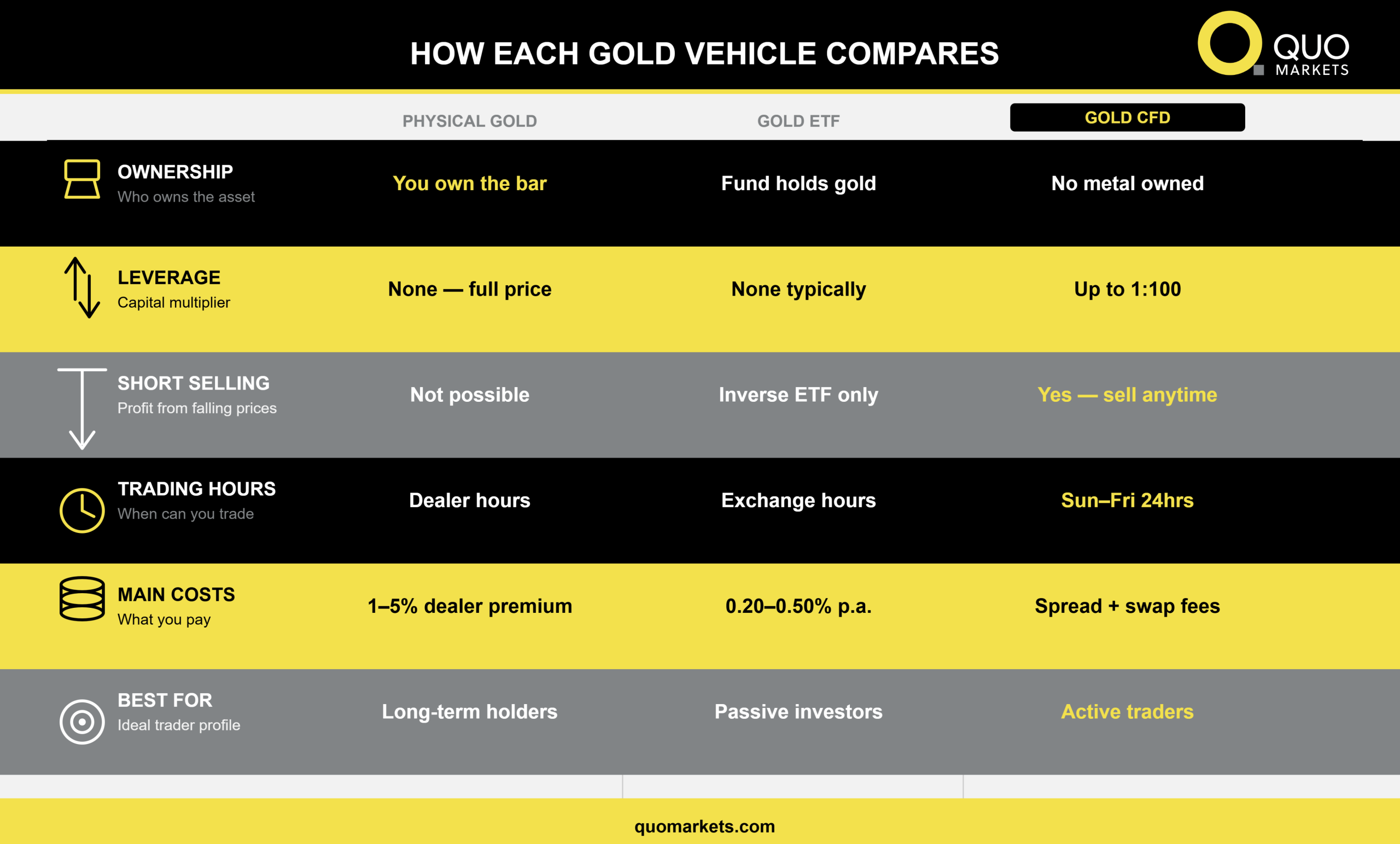
Start with cost. Dealers typically tack on a 1% to 5% premium over spot price. Add storage and insurance on top, and the expenses pile up quickly, especially for bigger holdings. You may also need to deal with authentication and secure storage logistics.
Then there’s liquidity, or the lack of it. You can’t just close a position in seconds the way you can in a financial market. Selling physical bars or coins takes time, which means you can’t react fast when conditions shift.
And finally, there’s no leverage. You pay full price for whatever you buy, and you can’t short it. If gold drops, physical gold owners can only watch.
For preserving wealth across years or generations, physical gold still holds up well. For someone trying to capture daily or weekly price swings, it’s simply not built for that.
Gold ETFs: A Simpler Way to Hold Gold
For a lot of investors, a gold ETF hits the sweet spot between ease and exposure.
A gold ETF is a fund that holds physical gold and trades on a stock exchange, just like any regular share. SPDR Gold Shares and the iShares Gold Trust are the names most people bring up here – not as recommendations, just as common reference points in the space.
The draw is obvious: you get gold price exposure without storing a single bar. Buy and sell through your existing brokerage account, whenever the market’s open.
Cost is one of the biggest wins. Annual management fees usually sit between 0.2% and 0.5%. SPDR Gold Shares, the largest gold ETF out there, carried an expense ratio of roughly 0.40% back in mid-2024. On a $20,000 position, that works out to about $80 a year.
ETFs are also easy to trade; you skip the whole storage headache while still getting regulated, traceable exposure to gold. Better ETF liquidity and more automated tax reporting have only made these funds more appealing heading into 2026.
The catch is that ETFs play by stock market hours, not the near-round-the-clock schedule the gold market actually runs on. Leverage is generally off the table, and shorting usually means reaching for something more complicated, like an inverse ETF.
There’s also a structural gap: ETFs don’t give you direct XAUUSD exposure. Their price tracks gold closely, but the trading experience itself is a different animal.
Access can be its own hurdle, too. In Indonesia, the UAE, Colombia, or Thailand, getting into US-listed ETFs often means setting up an international brokerage account first, which adds friction most retail investors would rather avoid.
If you want gold sitting in your portfolio without thinking about it day to day, ETFs make sense. If you’re trying to act on Monday’s jobs report or Friday’s headline news, they’re the wrong tool.
What a Gold CFD Actually Is
A gold CFD lets you speculate on gold’s price without ever owning the metal itself. Trading XAUUSD means trading gold’s value against the US dollar, and the price tracks the spot market closely, letting you profit whether prices climb or fall.
Here’s how it works: say gold sits at $3,200 an ounce and you expect it to rise, so you buy one standard lot. If it climbs to $3,250 and you close out, you’ve captured a $50 move per ounce, which comes to $5,000 on that standard lot.
It works the same way in reverse. If you think gold’s about to drop, you open a sell position and aim to profit from the decline.
That two-way flexibility is a big part of why gold CFDs have become the go-to instrument for experienced traders and prop firms. If you’re just getting started with XAUUSD, our “Beginner’s Guide to Trading Gold” walks through placing your first trade step by step.
Leverage: Your Biggest Lever, for Better or Worse
Leverage means controlling a bigger position with a smaller amount of your own capital. At 1:100 leverage, $1,000 in margin can control a $100,000 position, which is exactly why so many traders favor CFDs over physical gold or ETFs.
But leverage cuts both directions. It magnifies losses just as easily as gains, especially when volatility spikes. Gold has swung $150 to $200 in a single day during extreme conditions, and a typical trading day still sees moves of 150 to 300 pips.
This is the trade-off at the heart of CFD trading: leverage is what draws experienced traders in, and it’s exactly what beginners need to treat with real caution. Stop-loss orders, sensible position sizing, and disciplined risk management aren’t optional extras here – they’re what keep a volatile session from turning into a disaster.
Why Traders Gravitate Toward Gold CFDs
Trading Almost Around the Clock
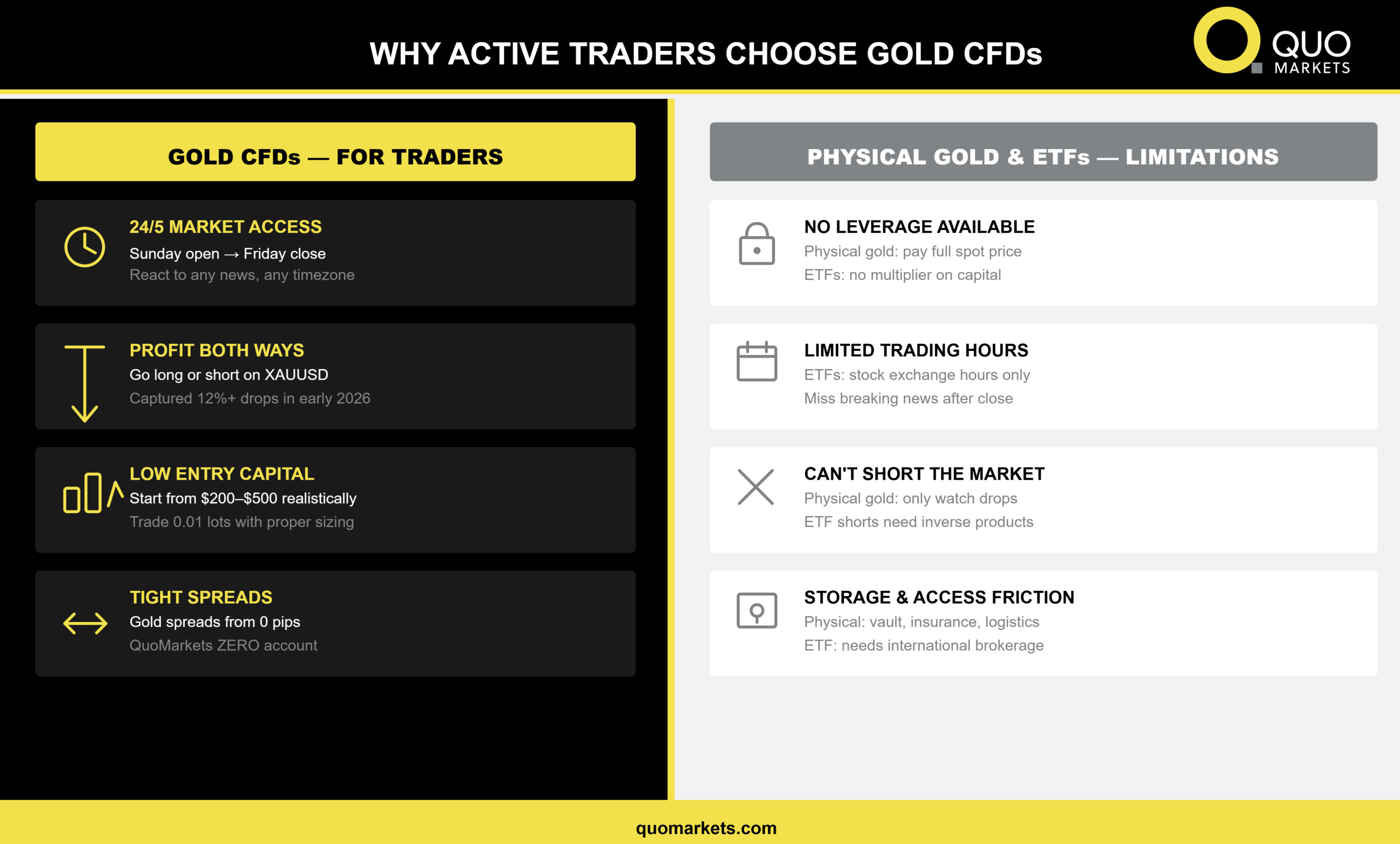
Unlike ETFs, the gold market barely sleeps. XAUUSD trading opens Sunday evening and runs straight through to Friday’s close, which means traders anywhere in the world can react the moment economic data drops, a central bank makes an announcement, or geopolitical tensions flare up.
The London and New York sessions bring the deepest liquidity and the biggest opportunities, particularly during their overlap, when major institutional players are most active. For traders based in Dubai, Jakarta, Bangkok, or anywhere else outside traditional market hours, that near-constant access means never having to wait for an exchange to open.
The Freedom to Go Short
One of the clearest differences between CFDs and both physical gold and most ETF structures is the ability to profit when prices fall.
Early 2026 brought some sharp corrections, including sessions where gold dropped more than 12% in a single day. Traders holding short XAUUSD positions had a shot at profiting from that move. Physical gold owners and most ETF holders just had to ride it out.
Being able to trade both directions gives active traders a lot more room to adapt as market conditions shift.
What Gold CFD Trading Actually Costs
CFD trading comes with its own cost structure: spreads, commissions, and overnight swap fees if you hold a position past the trading session. Brokers handle this differently – some offer zero-spread accounts and charge a flat commission per lot, while others fold the cost into wider spreads instead.
For anyone running multiple gold strategies in a given week, these cost differences add up and can meaningfully affect overall returns. If speed, two-way flexibility, and tight costs are what you’re after, gold CFDs are the most practical fit available.
So Which One Fits You?
If your time horizon is measured in years rather than days, and you don’t mind paying for a vault or insurance, physical gold is still hard to beat. In places like the UAE, Indonesia, and Thailand, it’s not even really framed as an “investment” – it’s just how families build and pass down wealth, and that kind of trust doesn’t come from watching a price chart.
If you’ve already got a brokerage account and just want gold quietly doing its job in your portfolio, an ETF is probably the path of least resistance. Buy it, check back in a month, move on with your life.
But if you want to actually engage with gold’s swings instead of just sitting through them, that’s where CFDs come in. You can react to a central bank decision the second it happens, flip your position when sentiment turns, and use leverage to make smaller moves count for more. The flip side is that the same leverage amplifying your wins amplifies your losses too, so this path demands more discipline in return.
Getting Started With Gold CFDs
Once you’ve decided CFDs are the right fit for 2026, the next step is picking the right setup to trade in.
Start with a regulated broker offering competitive spreads and clear pricing. QuoMarkets’ ZERO account, for example, offers gold spreads starting from 0 pips, which adds up to a real cost advantage if you’re opening multiple gold positions a week.
The platform matters just as much. MetaTrader 5 gives you 21 timeframes, advanced technical indicators, support for automated trading, and solid charting tools for analyzing gold.
Preparation is just as important as the platform. Keeping an eye on the economic calendar helps you track Fed meetings, CPI releases, employment data, and other releases that regularly move gold prices. If you want a deeper dive into specific approaches, including trend trading, breakout setups, and news trading, check out our 2026 Gold Trading Strategy Guide.
Before risking real capital, spend time on a demo account first. Getting a feel for how XAUUSD responds to volatility, inflation surprises, real yields, and geopolitical shocks will make a real difference once you do go live.
Pick the Exposure That Matches How You Trade
Gold in 2026 is one of the most actively traded assets in the world. The real question isn’t whether to have exposure to it; it’s which form of exposure actually fits how you trade.
FAQs
Is trading gold CFDs better than buying a gold ETF?
Depends how hands-on you want to be. CFDs offer leverage, shorting, and near-24/5 access, ideal for active traders. ETFs suit a calmer, buy-and-hold approach. Chart watchers will likely prefer CFDs.
Can I lose more than I deposit when trading gold CFDs?
Not with Negative Balance Protection, which Quomarkets includes on every account. Your losses stop at your deposit. Without that safeguard, leverage can theoretically push you below zero, so check before trading with any broker.
What’s the minimum amount needed to start trading gold CFDs?
It varies by broker. QuoMarkets has no set minimum, so you could technically start with $1. Realistically, $200 to $500 gives enough room to size trades properly at 0.01 lots.
What are some of the best gold trading strategies for 2026?
Trend following and breakout setups both hold up well, often paired with moving averages and average true range to gauge risk. Whatever the approach, solid risk management matters more than the entry itself.
Is buying gold through an ETF the same as buying physical gold?
Not quite. With SPDR Gold Shares or the iShares Gold Trust, you’re holding shares in a fund that owns the gold, not a bar in hand. It’s simpler exposure to precious metals, just without anything to physically store.