
Table of Contents
- The Real Risks of Copy Trading: How to Actually Protect Yourself
- Can Copy Trading Guarantee Profits?
- When Your Risk Tolerance and Your Provider’s Don’t Match
- The Platform and Execution Risks Nobody Talks About
- Social Media Hype and the Influencer Trap
- What Actually Safe Copy Trading Looks Like
- Going In With Your Eyes Open
- FAQs
The Real Risks of Copy Trading: How to Actually Protect Yourself
Copy trading has done something remarkable for everyday investors: it has put the markets within reach of people who never had the time, knowledge, or confidence to trade on their own. A few taps and you’re mirroring the moves of someone who does this for a living. That kind of convenience is genuinely appealing, and that’s exactly where the trouble starts.
The risks that come with copy trading are real, layered, and constantly underestimated by newcomers dazzled by polished profiles and flashy return charts. But knowing those risks isn’t an argument against copy trading. It’s the groundwork for doing it properly. Before you put a single dollar behind any provider, you owe it to yourself to understand what you’re actually signing up for, and what to do when things don’t go to plan.
Can Copy Trading Guarantee Profits?
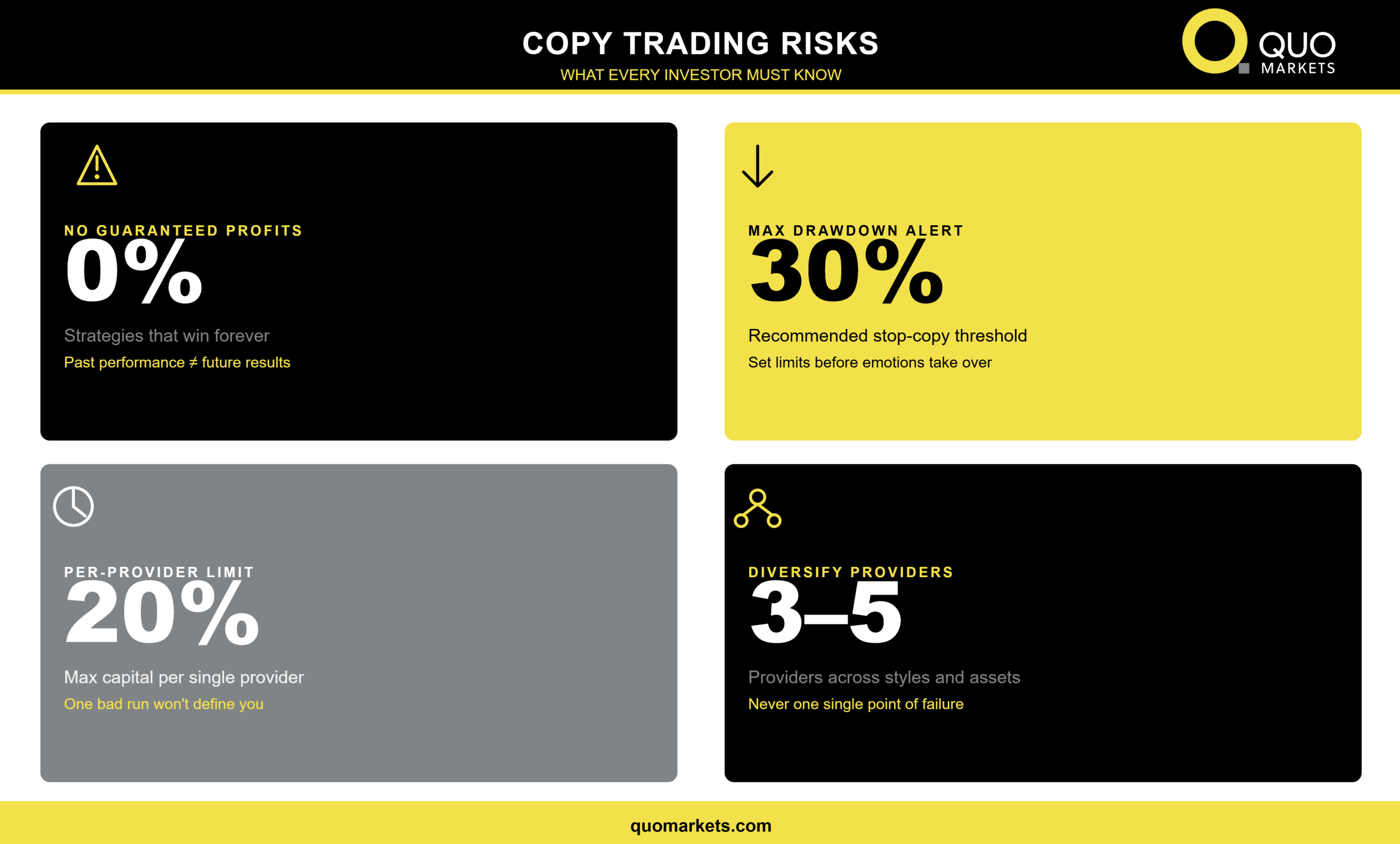
The first question anyone new to this space should be asking is whether copy trading can guarantee profits. It cannot, and any platform or influencer hinting otherwise is selling you something.
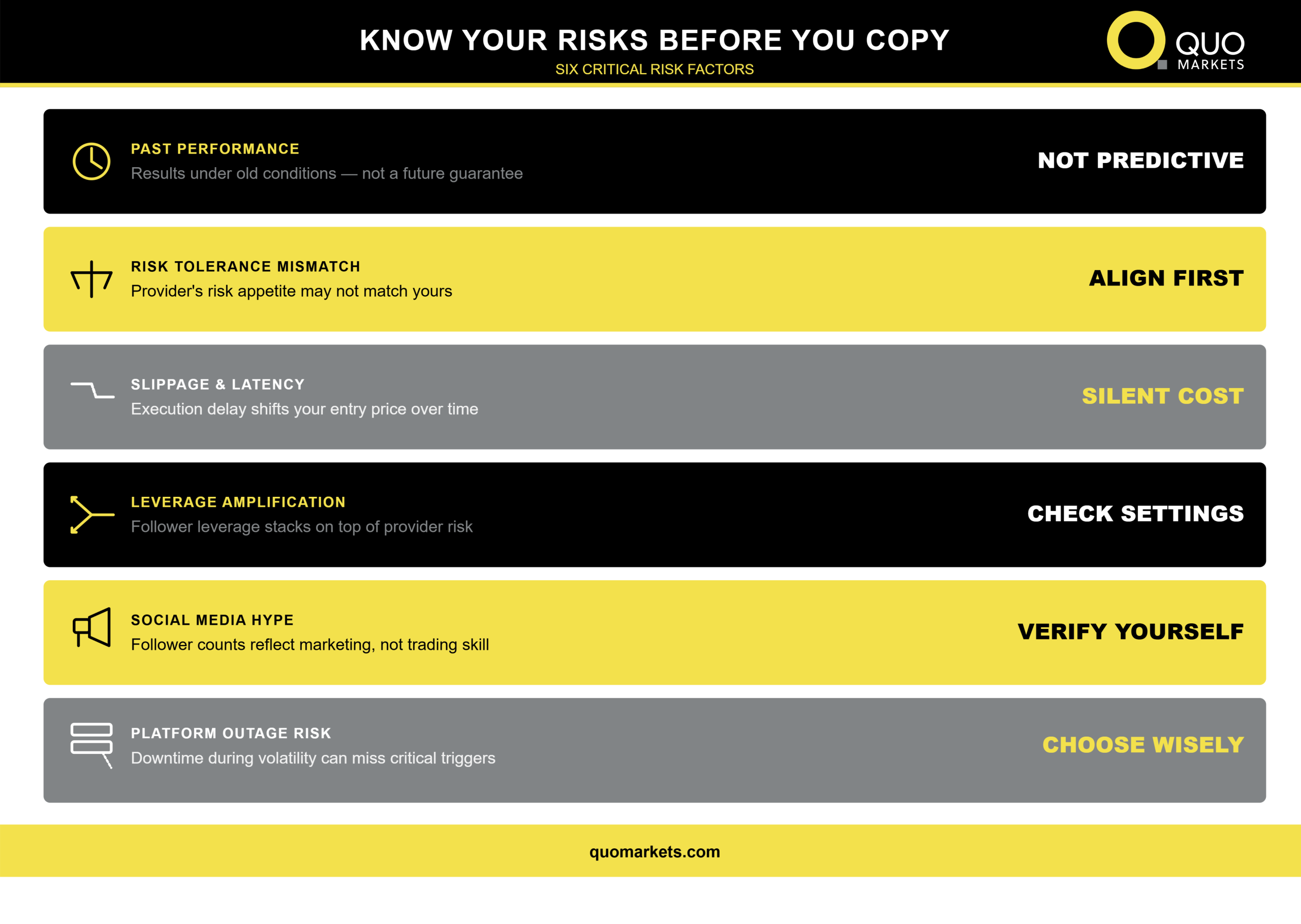
Past performance is probably the most cited and most misunderstood metric in all of trading. A provider who posted 40% returns over the last six months did that under a specific set of market conditions, with a particular mix of assets, at a specific point in the economic cycle. None of those conditions is guaranteed to come back around. Markets shift. Strategies that shine in trending conditions often fall apart when things get choppy or sideways. The trader who looked like a genius last quarter might be bleeding out this one.
What makes this especially painful for followers is that you absorb those losses in real time. When a provider’s approach stops working, your account takes the hit proportionally. You don’t get to pause and reconsider – the trade fires, the loss lands, and you find out after the fact.
This isn’t a flaw unique to copy trading. It’s just how financial markets work. No strategy wins forever. Having realistic expectations means accepting that drawdowns aren’t rare events; they’re a permanent feature of every trading journey. The difference between reckless copy trading and smart copy trading is whether you’ve planned for that before it happens.
Go beyond headline returns when evaluating a provider. Look at maximum drawdown percentages, win rates across different market conditions, and how long their recovery periods have historically been. Those numbers tell a far more honest story than one impressive month.
When Your Risk Tolerance and Your Provider’s Don’t Match
Risk tolerance mismatches are one of the most common problems in copy trading, and one of the least talked about. They cause a lot of avoidable stress and financial damage.
Here’s how it usually unfolds. You find a provider with an extraordinary track record. The monthly returns are eye-catching, the follower count looks impressive, and the platform metrics seem solid. What doesn’t always jump out immediately is that this provider runs aggressive leverage, takes large positions relative to their account size, and treats 20–30% drawdowns as a routine part of doing business. For them, that tradeoff makes sense. For you, it could be devastating.
That’s the heart of the mismatch: a strategy that fits one trader’s psychology and financial situation may be completely wrong for another’s. An experienced trader with a large account and years of conditioning can sit through a 25% drawdown without flinching. Someone newer to markets, or trading with money they genuinely can’t afford to lose, may panic, exit at the worst possible time, or face real financial harm.
The opposite problem exists, too. Conservative traders who copy low-risk, low-return strategies may grow frustrated with slow progress and start chasing higher-performing providers without really understanding what they’re taking on.
Before you copy anyone, ask yourself: What’s the biggest drawdown this provider has ever experienced? What leverage do they typically run? How does their average loss compare to their average gain? Is their strategy built on frequent small wins or occasional larger ones? These questions help you figure out whether their approach actually suits your risk appetite, not just your return ambitions.
The best starting point for beginners is this alignment exercise. Match providers to your real risk tolerance, not the one you imagine you’d have in a bull market. A provider whose worst-case scenario you can sustain emotionally and financially matters just as much as one whose best-case scenario looks attractive. Spreading capital across multiple providers with different styles and risk levels is one way to build a more balanced position.
QuoMarkets lets you dig into detailed provider statistics before committing, giving you the transparency to make that comparison properly.
The Platform and Execution Risks Nobody Talks About
Even when you’ve chosen the right provider and the market is cooperating, there’s a whole other category of risk that has nothing to do with the trader’s skill – it’s baked into how copy trading mechanically works.
Slippage and Latency
Copy trading never executes in perfect sync with the provider’s trade. There’s always a delay between when the original order goes through and when your mirrored order is processed. In fast-moving markets, that gap can shift your entry price in a way that matters. This is slippage, and while it’s often small on any individual trade, it adds up over time and can quietly eat into performance that looked much cleaner on the provider’s own account.
Technical Outages and Downtime
No platform is immune to technical problems. If an outage prevents your copied trades from executing at a critical moment – a stop loss that doesn’t trigger, an entry delayed during a breakout – the consequences can be significant. This risk is amplified during major news events or extreme volatility, exactly the moments when platform traffic spikes.
Leverage Amplification
Many copy trading platforms let followers apply their own leverage settings on top of the provider’s trades. This can turn a moderately risky provider trade into a high-stakes position for a follower who’s dialed up exposure without fully accounting for it. Understanding how your platform handles leverage and what your actual risk per trade looks like under those settings is essential.
What You Can Do
Choose platforms with solid infrastructure, transparent execution policies, and clear disclosures about how copied trades are processed. Check your execution reports regularly, not just your overall balance. The difference between copy trading and manual trading includes an additional layer of technical risk that manual traders simply don’t face. QuoMarkets’ tools are designed to give you visibility into execution quality so these issues don’t fly under the radar.
Social Media Hype and the Influencer Trap
Social media has become one of the most powerful and most dangerous recruitment channels in copy trading. Before you follow any trader you discovered through marketing content or influencer posts, it’s worth understanding how these systems actually work.
Influencer promotions typically feature traders with exceptional short-term results, curated screenshots, and testimonials designed to generate excitement rather than help you make an informed decision. The traders being promoted may be genuinely skilled, but the context behind those results is rarely shared. Did that gain happen during an unusually favorable market run? What did the drawdown look like during the same period? How does the trader hold up in difficult conditions?
One of the most common copy trading mistakes is acting on social proof without doing any independent research. A provider with 50,000 followers isn’t inherently more trustworthy or more competent than one with 500. Follower counts reflect marketing budgets and social reach, not trading quality.
That doesn’t mean every promoted trader is a bad choice. It means the responsibility for verifying performance lands entirely with you. Look at the provider’s complete trading history on the platform itself, not the highlights shared on outside channels. Cross-reference their stats across multiple time frames. Consider whether the strategy being promoted actually aligns with your goals, or whether the appeal is mainly emotional. In any financial context, emotional appeal is a warning sign.
What Actually Safe Copy Trading Looks Like
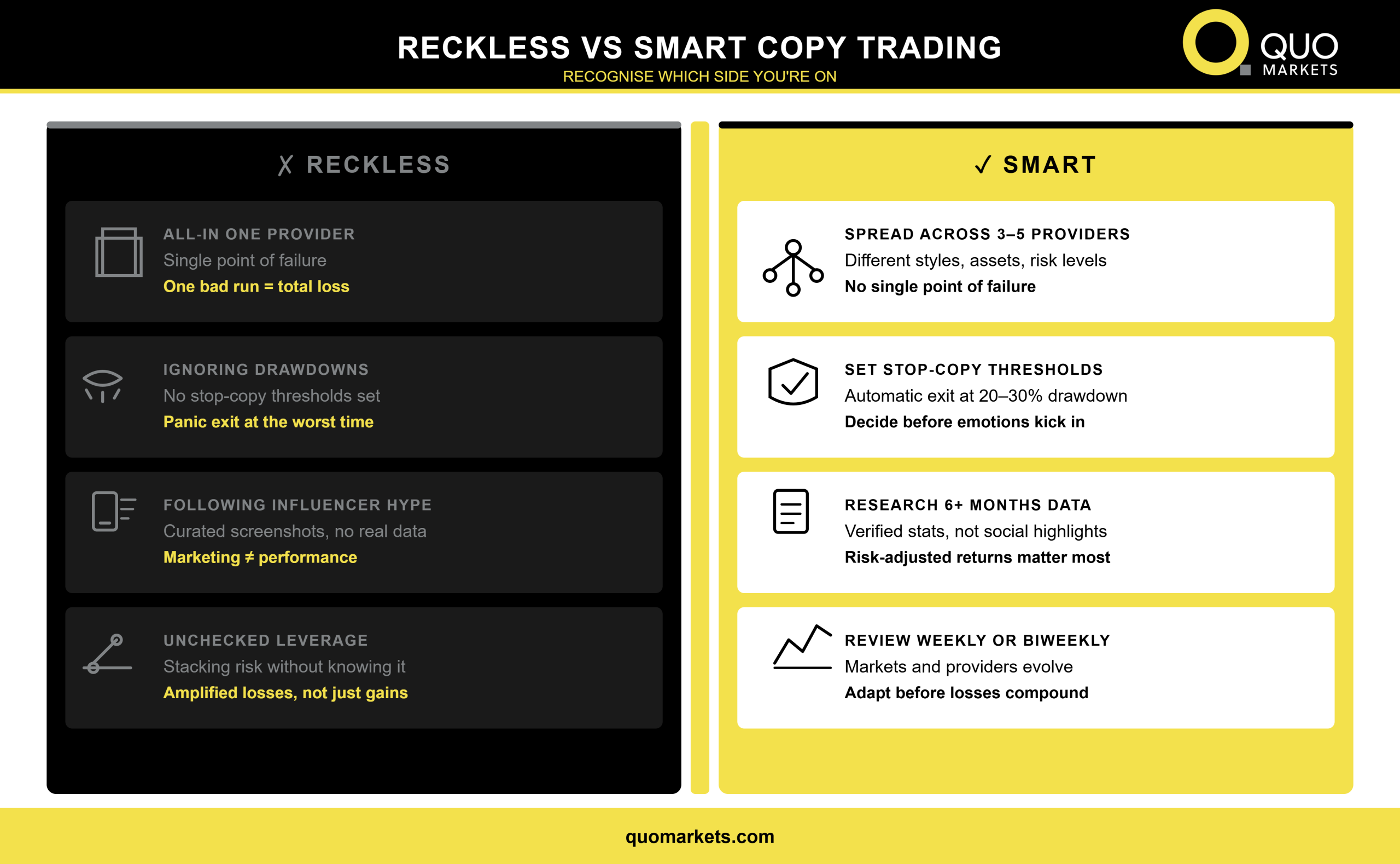
Understanding the risks is only half of it. The other half is building habits that let you participate in copy trading in a way that’s intelligent and sustainable.
Spread Across Multiple Providers
Putting all your copy trading capital behind a single provider creates one big point of failure. If that provider hits a sustained drawdown or changes their approach, your whole portfolio feels it. Distributing capital across three to five providers with different trading styles, asset classes, and risk profiles reduces that exposure significantly. A beginner-friendly copy trading strategy rarely rests on one bet, however confident you feel about it.
Set Stop Copying Thresholds
Most reputable platforms let you define a drawdown level at which you automatically stop copying a provider. Use this feature. Decide in advance, before emotions get involved, at what point you’d exit a provider relationship. A common approach is to set a maximum drawdown limit of 20–30% of your allocated capital for any single provider. When that threshold is hit, the system stops copying automatically, which protects you from the decision paralysis that typically leads to even bigger losses.
Check In Regularly
Copy trading isn’t something you can set up and walk away from. Markets change, providers evolve their strategies, and what worked in one environment may stop working in the next. Schedule regular reviews, weekly or biweekly, to assess how each provider is performing against your expectations and risk parameters. Focus on recent drawdown trends, not just the cumulative total.
Limit How Much Goes to Any One Provider
A practical approach is to allocate no more than 10–20% of your total copy trading capital to any single provider. That way, one bad run doesn’t define your overall outcome.
Actually Use the Platform’s Risk Tools
QuoMarkets offers built-in risk management features made specifically for copy traders: drawdown controls, stop-copying triggers, and performance analytics that give you the data to keep making informed decisions. These aren’t optional extras; they’re core infrastructure for anyone serious about managing copy trading risk over the long term.
Research Before You Allocate, Every Time
Choosing traders to copy safely comes down to one consistent habit: do the work before you commit, not after. Review at least six months of verified performance data, look at risk-adjusted returns rather than headline percentages, and make sure the provider’s stated strategy actually matches what their trade history shows.
Going In With Your Eyes Open
Copy trading is a legitimate and genuinely useful tool. It opens up market participation for people who want exposure without the time or expertise to manage every trade themselves. But those doors open into real markets with real risk, not a passive income stream.
The biggest copy trading pitfalls – misaligned risk tolerance, execution problems, the pull of social media hype – share one common thread: they hit hardest when people jump in without preparation. The traders who build lasting results in this space aren’t necessarily the ones who found the best provider on day one. They’re the ones who understood what they were getting into, built a disciplined approach, and consistently used the tools available to them.
QuoMarkets’ risk management features are there to support exactly that kind of participation. Use them as your foundation, not as a backup plan.
FAQs
What’s the biggest risk in copy trading?
Assuming that past success will continue. Strategies stop working, and your results may look very different from the provider’s, especially when markets shift.
How do you reduce copy trading risk?
Diversify across multiple providers, set stop-copy thresholds, review performance regularly, and make full use of your platform’s risk management tools.
Is copy trading safe for beginners?
It can be, if you approach it carefully. Take time to research providers, spread your capital, use the risk controls available to you, and start with an amount you’re comfortable losing.