
Meta Title: Scalping Trading Strategy: How It Works and What It Costs You
Meta Description: Fast trades, small targets, big discipline. This guide breaks down scalping strategy, the tools behind it, and the risk management rules that keep traders in the game.
Table of Contents
- What Is Scalping? A Beginner’s Guide to Scalping Trading
- What Actually Is Scalping, and How Does It Work?
- Tools and Indicators Scalpers Actually Rely On
- Advantages & Disadvantages of the Scalping Trading Strategy
- How Disciplined Scalpers Protect Their Capital
- Is Scalping Actually Right for You?
- Final Thoughts
- FAQs
What Is Scalping? A Beginner’s Guide to Scalping Trading
Have you ever watched a live trading chart and wondered how some traders fire off dozens of positions in the time it takes you to finish a coffee? Scalping is a short-term trading strategy built around capturing very small price movements, over and over, throughout a single session. Scalpers aren’t waiting for the next big breakout or holding a position overnight. They’re in and out within seconds or minutes, stacking tiny wins until they add up to something real.
It sounds simple enough. In practice, it takes a particular kind of mindset, the right tools, and a trading platform fast enough to keep up with you.
What Actually Is Scalping, and How Does It Work?
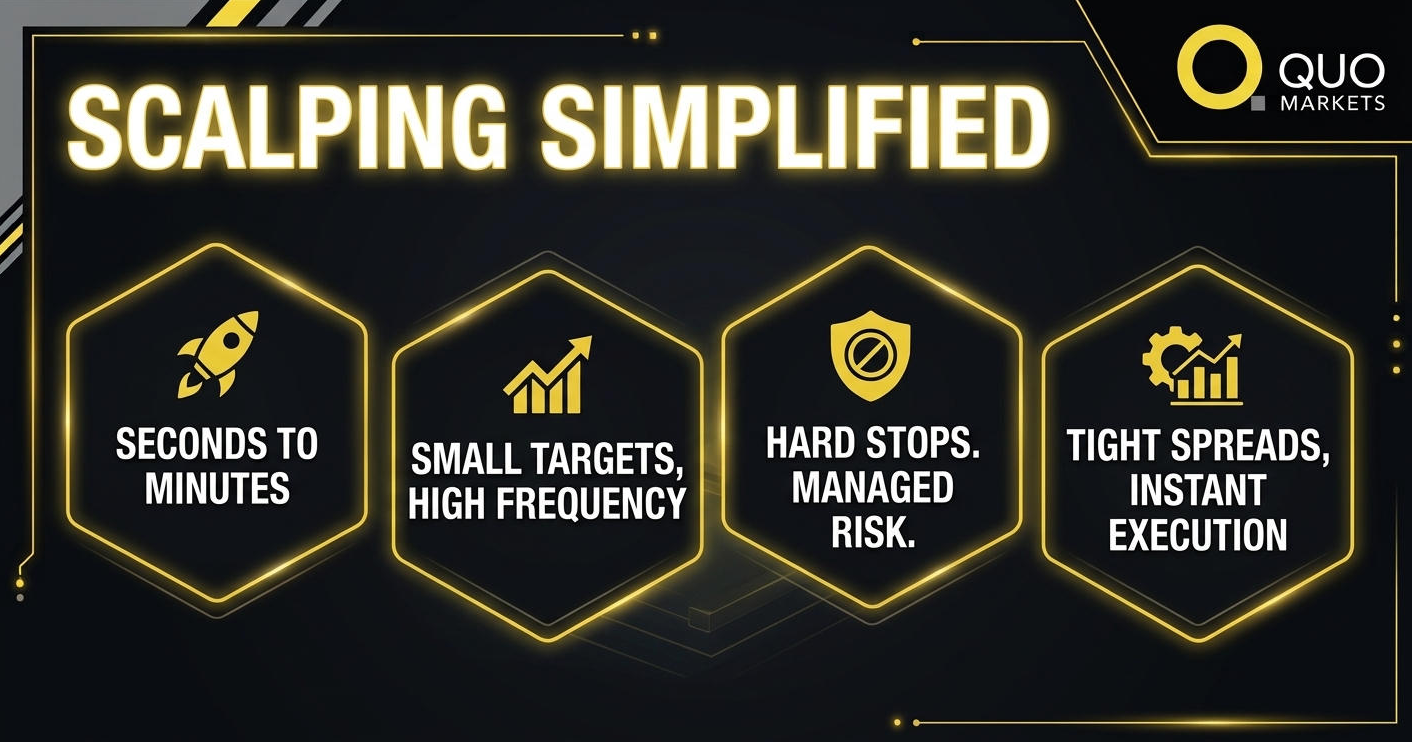
Scalping is an intraday strategy that targets micro-movements in price rather than larger directional trends. A scalp trader might aim for a gain of just a few pips in forex, a cent or two in stocks, or a fraction of a percent in crypto – then repeat that process anywhere from ten to hundreds of times in a single day.
The logic holds up well. Rather than waiting on one large move to pay off, scalpers spread their risk across many small trades. Each position carries limited exposure. If execution is clean and discipline stays intact, the cumulative result can outperform slower strategies in highly liquid markets.
Getting In and Getting Out
A scalper enters a trade when a technical signal or short-term imbalance shows up in the order flow, then exits the moment that small target is hit, or sooner if the position turns against them. Holding times run anywhere from a few seconds to a few minutes. There’s no room for hesitation.
Position Size and What You’re Actually Chasing
Because the profit target per trade is deliberately small, scalpers typically work with larger position sizes to make the numbers worthwhile. That magnifies both gains and losses, which is exactly why strict risk controls aren’t optional. A scalping strategy that works on paper will fall apart fast without proper sizing discipline.
Where Scalping Actually Shows Up
Scalping works best in liquid, fast-moving markets. Forex scalping is among the most widely practiced because the forex market offers tight spreads and near-constant price action. Crypto scalping has grown quickly as digital assets attract high volatility and trade around the clock. Stock scalping is common in large-cap equities and ETFs during peak session hours, when volume and liquidity are at their highest.
Tools and Indicators Scalpers Actually Rely On
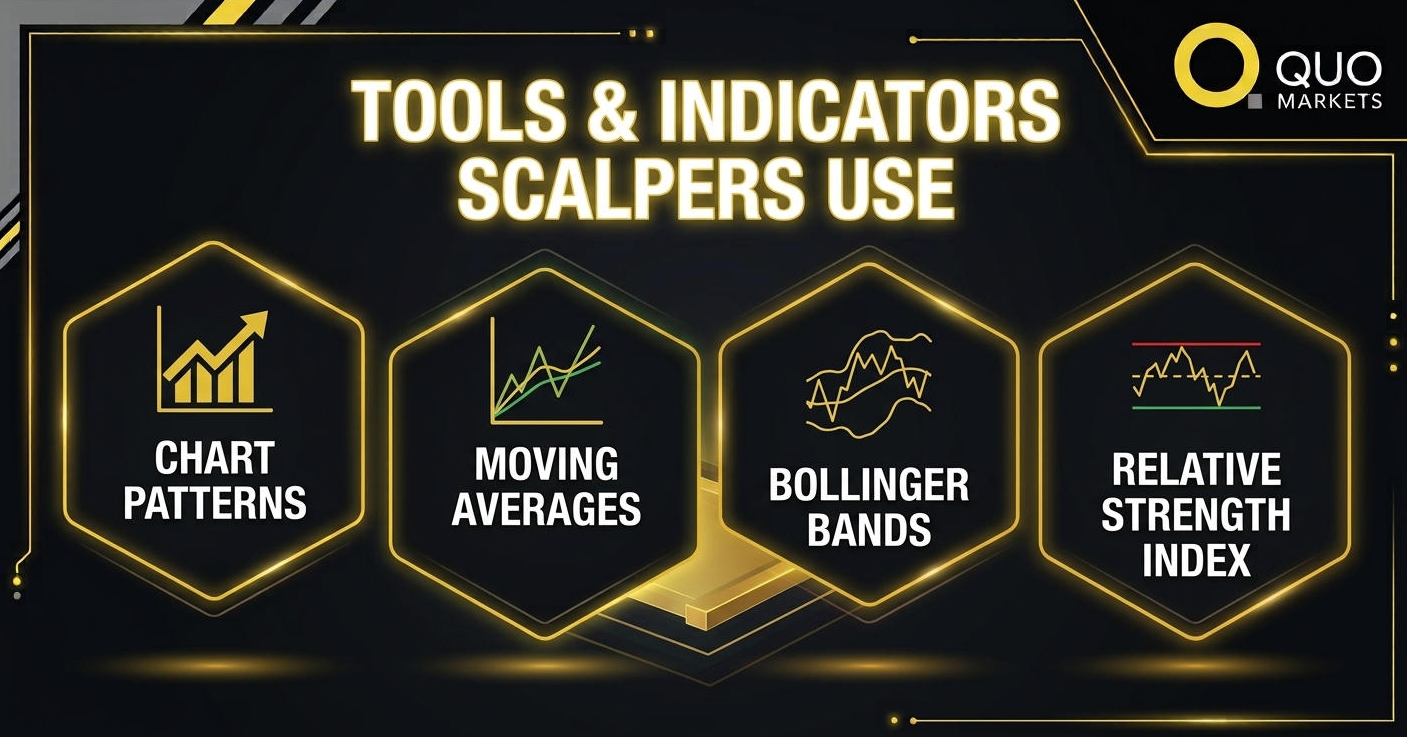
Scalping isn’t guesswork. The edge comes from reading market momentum and microstructure faster than the next trader. These are the core tools that serious scalpers keep in front of them.
Time and Sales (The Tape)
The time and sales feed, commonly called the tape, shows every executed transaction in real time: price, volume, and direction. Scalpers use it to catch sudden surges in buying or selling activity before those moves become obvious on a candlestick chart. Reading the tape well is one of the clearest dividing lines between experienced scalpers and people still finding their footing.
Level II Order Books
Level II quotes show the full depth of the market, all pending buy and sell orders across different price levels. This gives scalpers a real look at where supply and demand are stacking up. If a large sell wall appears just above the current price, a scalper might skip a long entry or tighten their target. For anyone learning scalping, this kind of context explains why prices stall or accelerate at certain levels.
Moving Averages
Short-period moving averages, particularly the 9, 20, and 50-period exponential moving averages, are standard for scalpers. They help identify trend direction on one-minute and five-minute charts. Common setups involve entering when the price pulls back to a key moving average and shows early signs of resuming the short-term trend.
RSI and Momentum Indicators
The Relative Strength Index is widely used in scalping setups to spot overbought or oversold conditions on very short timeframes. When RSI hits an extreme level while price is testing a key support or resistance zone, it can signal a high-probability reversal entry worth taking.
Bollinger Bands and VWAP
Bollinger Bands setups use the upper and lower bands as dynamic targets and reversal zones. VWAP scalping is especially popular in equity markets, where the volume-weighted average price acts as an institutional reference point. Scalpers often look for reversion entries when the price stretches too far from VWAP in either direction.
MACD for Momentum Confirmation
The MACD uses the convergence and divergence of moving averages to confirm momentum direction. A MACD crossover on a one-minute chart, lined up with price action near a key level, can serve as a precise trigger for entry or exit.
Advantages & Disadvantages of the Scalping Trading Strategy
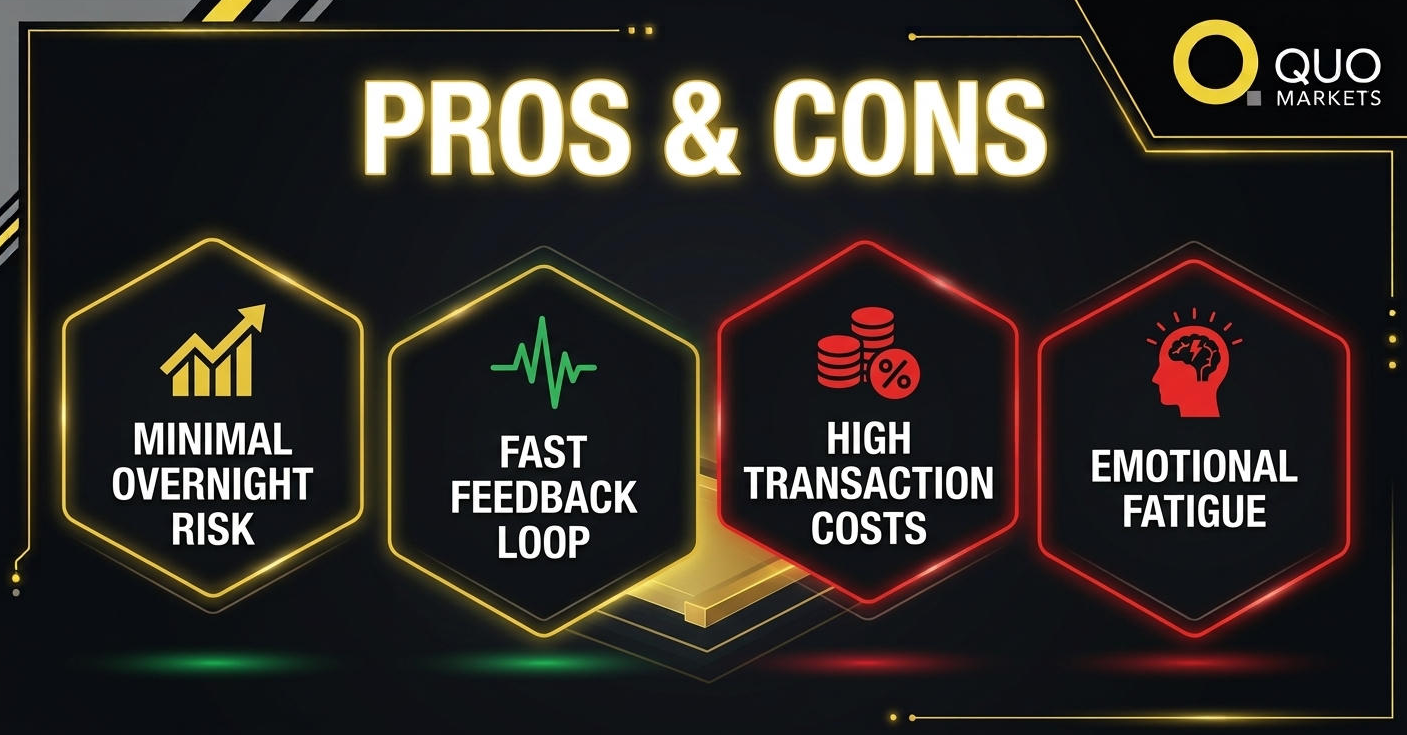
Every approach to the markets has real strengths and real limits. Understanding both honestly is part of trading this style responsibly.
What Works in Its Favor
One of the most cited benefits of scalping is minimal overnight risk. All positions close within the session, so scalpers aren’t exposed to the news events, earnings releases, or geopolitical developments that can gap prices dramatically between close and open.
Scalping also creates a rapid feedback loop. A trader using a swing-style approach might execute five to ten trades in a week and wait days to learn whether a thesis was right. A scalper can complete that same learning cycle in a single morning. For traders who want to refine their edge quickly, that compression of time is genuinely useful.
In liquid markets with tight spreads, scalping can also produce consistent, incremental compounding. Small, frequent wins build equity steadily, as long as losses are kept under control.
Where It Gets Hard
The cost of doing business adds up fast. Every trade involves a spread, and often a commission. Across fifty or a hundred trades per day, those costs become a real drag on profitability. Traders who make fewer, larger moves pay far less in transaction costs relative to their returns, and that gap matters.
Leverage deserves a direct mention. High leverage amplifies both gains and losses. A scalper using significant leverage during a losing streak can face drawdowns that are genuinely difficult to recover from. The psychological toll is real, not just the financial one.
And scalping demands constant attention. This is not something you run in the background while managing other things. The mental load is high, and fatigue over long sessions is a legitimate risk.
How Disciplined Scalpers Protect Their Capital
A scalping strategy without a risk management framework is just gambling with extra steps. Here’s how serious scalpers stay in the game.
Hard Stop-Losses, Every Time
Every scalping trade should have a predefined stop-loss level set before entry. In fast-moving markets, that means hard stops that execute automatically, not mental stops that depend on you reacting in time. Place the stop where the trade thesis breaks down, not at an arbitrary distance or a round number.
Cap Your Risk Per Trade
Most experienced scalpers risk no more than 0.5 to 1% of their total trading capital on any single position. That might sound conservative, but across dozens of trades per session, it provides a meaningful buffer against losing streaks without wiping out the account.
Know When to Stop Trading
Chasing losses by increasing position sizes or taking lower-quality setups is one of the most common ways scalping goes wrong. Setting a maximum number of trades or a daily loss limit, and actually sticking to it, protects both capital and decision-making.
Platform Quality Is Part of Risk Management
A fast execution platform with low latency and reliable order fill isn’t a nice-to-have for scalpers. It’s a requirement. A slow or unreliable system can turn a planned entry into a slippage problem that wrecks the intended risk-to-reward ratio. When evaluating a broker or ECN platform for scalping, confirm that execution speeds and order types actually support the strategy you’re running.
Is Scalping Actually Right for You?
Scalping doesn’t suit every personality, and there’s no reason to force yourself into a style that’s going to cause unnecessary stress and financial damage.
The Mindset It Requires
Scalping suits traders who stay calm under pressure, make decisions in seconds without overthinking them, and find genuine interest in how markets move at the microstructure level. It rewards technical skill, pattern recognition, and a methodical approach to repetition.
Patience might seem like a strange requirement for a fast-moving strategy, but it matters. Waiting for high-quality setups rather than forcing trades is a must-have skill for a scalper.
Where to Start
Scalping is generally not the best entry point for complete beginners. The feedback loop is fast, but it’s also unforgiving. Building a baseline understanding of technical analysis, market structure, and risk management through swing or position trading first gives you a more solid foundation to work from before stepping into this.
Final Thoughts
Scalping is one of the most demanding trading styles available to retail traders. It offers real advantages – minimal overnight risk, fast feedback, and the potential for steady, growing returns in liquid markets. It also requires discipline, emotional steadiness, a reliable platform, and a sharp awareness of what every single trade is actually costing you.
If scalping sounds like your kind of game, start in demo mode. Test your setups, track your results with full honesty, and refine your approach before putting real capital on the line. The market will still be there when you’re ready.
FAQs
Can scalping actually be profitable?
Yes, but it depends heavily on execution quality, cost management, and discipline. High transaction costs and emotional decision-making are the two factors that most commonly eat into scalping profits. Traders who manage both tend to see the most consistent results.
Which indicators work best for scalping?
The most commonly used include short-period moving averages, RSI, Bollinger Bands, VWAP, and MACD. Level II order books and the time and sales feed are also critical for reading what’s actually happening in the market in real time.
How is scalping different from day trading?
Scalping sits within day trading but operates on a much shorter timeframe. Day traders might hold positions for minutes to hours. Scalpers typically hold for seconds to a few minutes, targeting very small price movements across many trades per session.
How many trades do scalpers make per day?
It varies by style and market, but active scalpers can execute anywhere from 10 to over 100 trades in a single session. Market conditions, the strategy being used, and the trader’s focus throughout the day all play a role.