Table of Contents
- Introduction
- Indices 101: What You Are Actually Trading
- Same Category, Three Different Trades: S&P 500 vs NASDAQ vs DAX
- How to Trade Indices on QuoMarkets
- When Each Index Actually Comes Alive: Trading Hours Explained
- The Bottom Line
- Frequently Asked Questions
S&P 500 vs NASDAQ vs DAX: How to Trade Indices
There is a particular kind of relief that comes with not having to pick a single winning stock. Instead of betting on one company’s earnings call or one CEO’s next move, you are trading the mood of an entire market in a single position. That is the appeal of indices trading, and it is why so many traders eventually gravitate toward it once they get tired of chasing individual tickers.
Learning how to trade indices is not really about understanding indices in general. It is about understanding that the S&P 500, the NASDAQ and the DAX are three genuinely different instruments, with different personalities, different drivers and different rhythms. Knowing how to trade the S&P 500 well will not automatically make you good at trading the DAX, and treating them as interchangeable is where a lot of new index traders go wrong.
Indices 101: What You Are Actually Trading
An index is essentially a basket of stocks bundled together to represent the performance of a market, a sector, or an economy. Rather than owning shares in each individual company, index trading lets you take a position on the combined direction of that basket, moving up or down as a single number.
Same Category, Three Different Trades: S&P 500 vs NASDAQ vs DAX
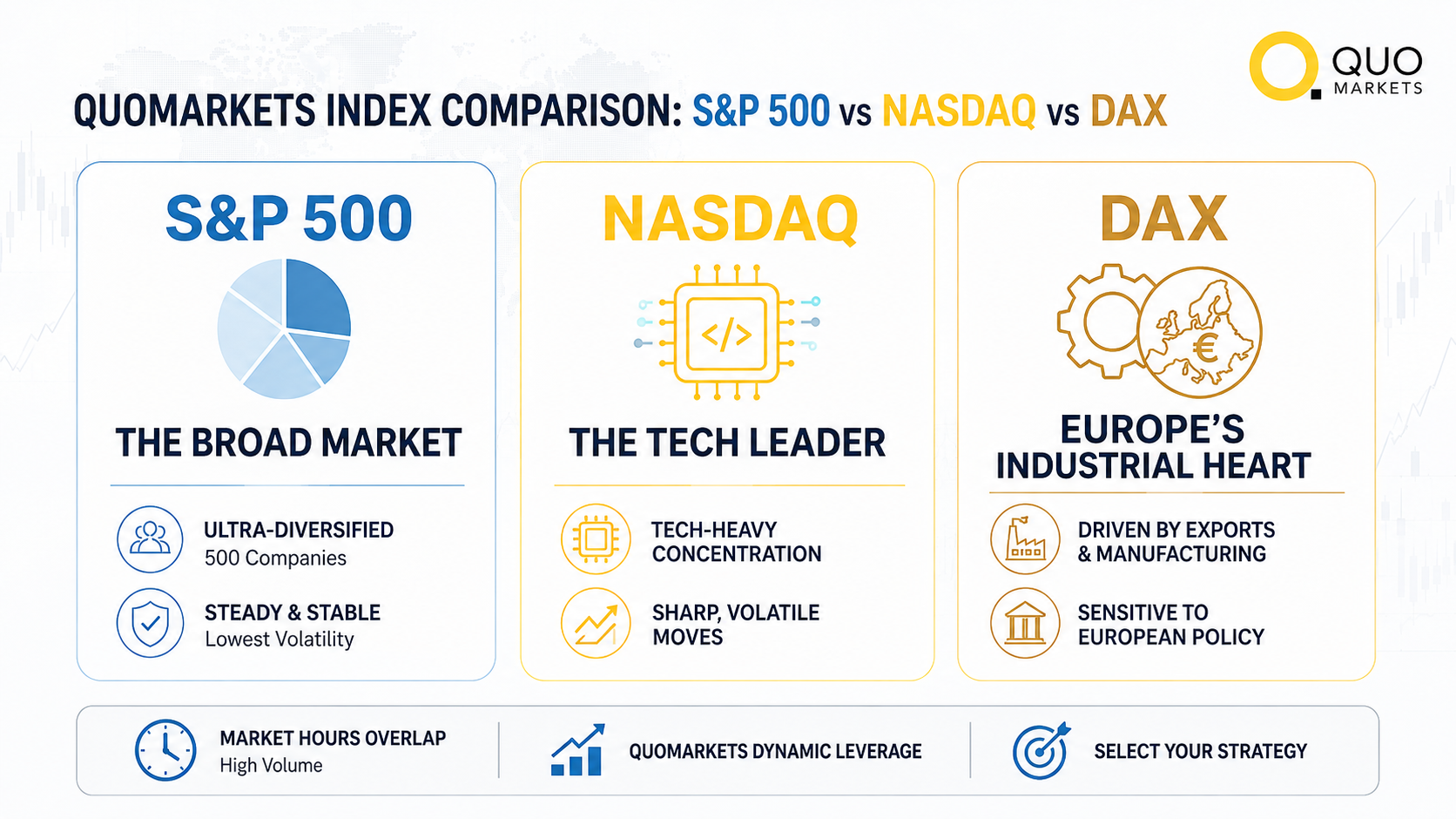
On paper, these are all just stock indices. In practice, they behave like three different personalities on your trading screen.
The S&P 500 tracks 500 of the largest publicly listed companies in the United States, spread across nearly every sector, from healthcare to energy to consumer goods. That breadth is exactly why it earns its reputation as the steadiest of the three. When one sector wobbles, another often absorbs the shock, which tends to smooth out its price action compared to its more concentrated peers.
The NASDAQ 100, by contrast, is heavily weighted toward technology. A handful of large tech and growth companies make up a significant share of its movement, which means it reacts sharply to earnings from major tech names and to shifts in interest rate expectations. This concentration is precisely what makes it the most volatile of the three, and also what makes it attractive to traders who want faster, sharper moves rather than gradual ones.
The DAX sits in a different macro world entirely. As Germany’s benchmark index, it is driven by Eurozone interest rate decisions, energy costs and export demand, particularly from Germany’s large industrial and manufacturing base. Its price action responds to European Central Bank policy and continental economic data in a way the two US indices simply do not, which makes it a genuinely separate exposure rather than just another version of the same trade.
For a trader deciding between them, this comes down to two questions. How much volatility can you tolerate, and which market’s trading session and macro calendar actually fits your schedule and your read on the world. Someone comfortable with the S&P 500’s steadier swings may find the NASDAQ’s sharper moves stressful, while someone who follows European economic data closely might find the DAX a more natural fit than either US index.
How to Trade Indices on QuoMarkets, Step by Step
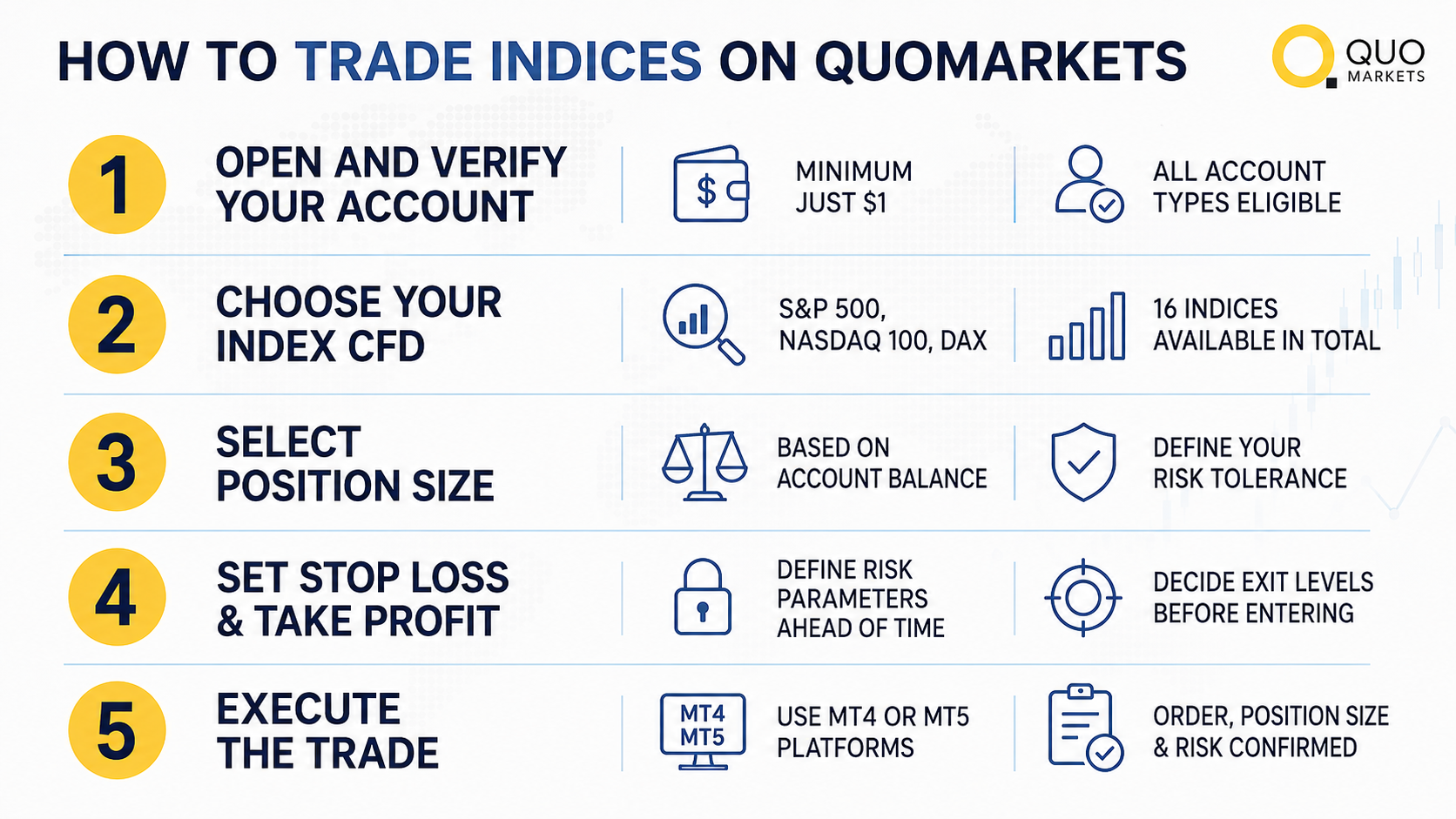
QuoMarkets offers 16 indices in total, including the S&P 500, NASDAQ and DAX, all available through MT4 and MT5. Accounts can be opened with a minimum deposit of just $1 across all account types.
Leverage on Standard, RAW and Zero accounts is dynamic, scaling up to 1:1000. On the Limitless account specifically, the S&P 500, NASDAQ and DAX are among the instruments eligible for a separate leverage scale, starting at 1:10,000,000 for positions between 0 and 0.5 lots, and stepping down progressively as trade volume increases, in line with the account’s published leverage table. As with any leveraged instrument, higher leverage increases both potential gains and potential losses, so it is worth reviewing the full leverage table and understanding how it applies to your position size before trading.
Once you know which index suits your approach, opening a position follows a fairly consistent process.
- Open and verify a trading account. This is the starting point regardless of which index you plan to trade first.
- Select the index CFD you want to trade, whether that is the S&P 500, the NASDAQ 100, the DAX or another of the indices on offer.
- Choose your position size based on your account balance and how much of your capital you are comfortable putting at risk on that trade.
- Set a stop loss and take profit level before you enter, so your risk parameters are defined ahead of time rather than decided mid-trade.
- Execute the trade through MT4 or MT5. Both platforms support index CFDs, so how you trade indices on MT4 comes down to the same core steps: placing the order, confirming your position size, and setting your risk levels within the platform’s trading window.
The mechanics stay largely the same whether you are trading the S&P 500, the NASDAQ, or the DAX. What changes is the research and timing behind the decision, which is why understanding each index’s character matters more than memorizing a checklist.
When Each Index Actually Comes Alive: Trading Hours Explained
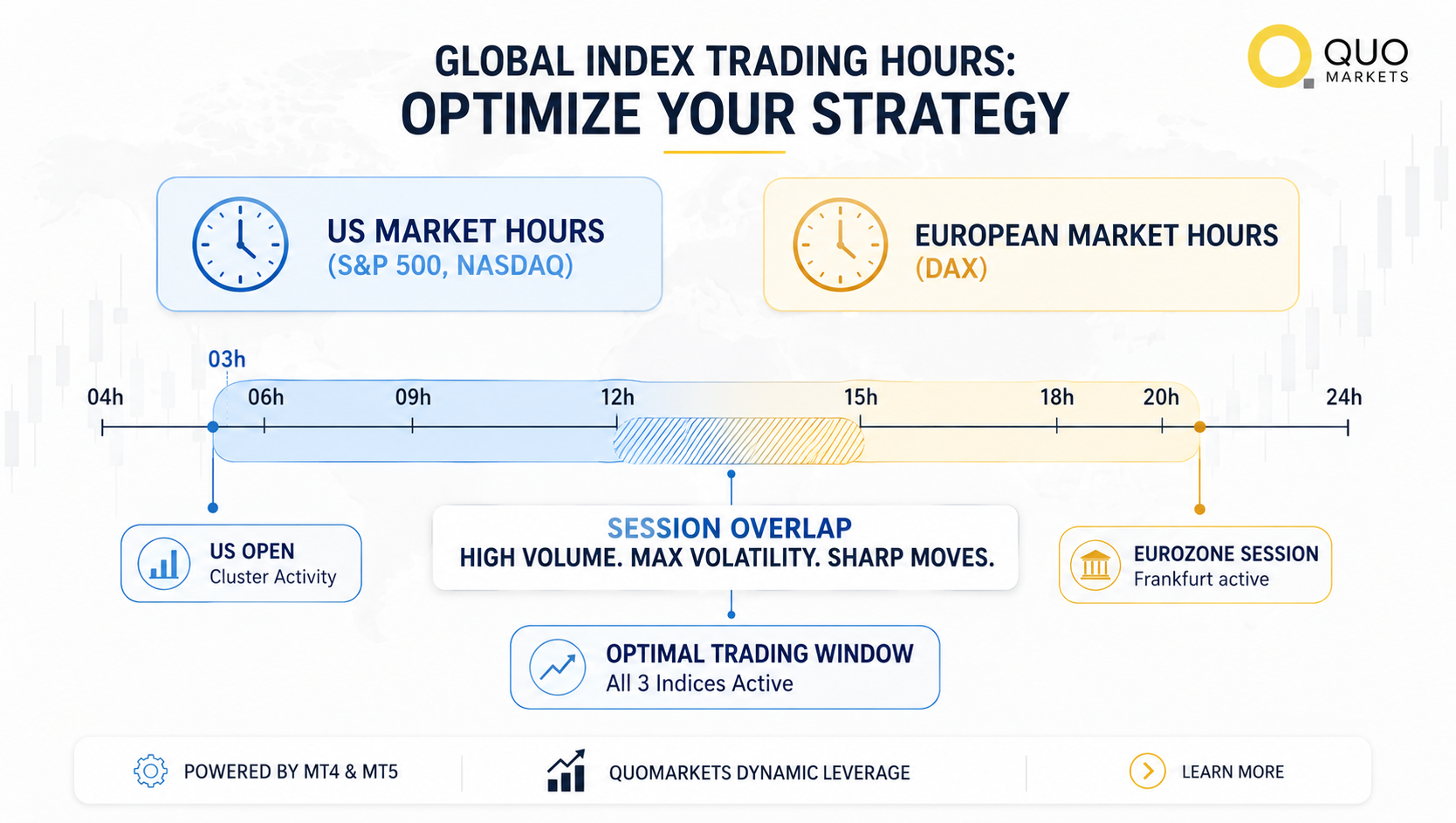
The S&P 500 and the NASDAQ follow US market hours, so their most active trading windows cluster around the US session. The DAX follows Frankfurt and broader Eurozone hours, meaning its liveliest activity happens earlier in the day relative to the US indices.
There is a window where the European and US sessions overlap, and that overlap period tends to bring higher volume and sharper moves across all three indices at once. For traders asking when they can trade the S&P 500 as a CFD, or simply looking for the busiest stretch of the day, this overlap is generally the moment worth paying attention to.
The Bottom Line
The S&P 500, the NASDAQ, and the DAX each offer a different way to trade market sentiment, whether that is the steadier breadth of the S&P 500, the sharper tech-driven swings of the NASDAQ, or the distinct European exposure of the DAX. Which one fits you, or whether you end up trading all three, really comes down to your own appetite for volatility and the hours you are able to watch the market. If you are ready to put any of this into practice, opening an account is the natural next step.
Frequently Asked Questions
Which is the best index to trade for beginners?
There is no single best index to trade answer for everyone, but many new traders start with the S&P 500 because its broad sector spread tends to produce steadier price action than the more concentrated NASDAQ 100.
How do I trade the NASDAQ index specifically?
Trading the NASDAQ index follows the same basic process as any index CFD: selecting the instrument, setting your position size and risk levels, and executing through MT4 or MT5, though its tech-heavy composition means it often moves faster than the S&P 500 or DAX.
Can I trade the DAX outside European hours?
The DAX is most active during Frankfurt and Eurozone trading hours, so while positions can technically be managed outside that window, the sharpest price movement and highest volume typically occur while the European session is live.
Do I need a large account to start trading indices?
Not necessarily. Account minimums vary by broker, and on QuoMarkets, for example, accounts can be opened with a minimum deposit of $1 across all account types.
Is higher leverage always better when trading indices?
No. Leverage amplifies both gains and losses, so it should be matched to your risk tolerance and position size rather than maximized by default. Reviewing the specific leverage table for your account type is a useful first step before trading.