

Table of Contents
- Introduction
- What Is Day Trading?
- What Is Swing Trading?
- Time Commitment and Lifestyle Each Style Demands
- Pros & Cons
- Which Style Is Right for You?
- Final Remarks
- FAQs
Introduction
There is always a heated discussion in trading communities about which approach comes out on top. Spend a few minutes on any trading forum, and you will see strong opinions from both sides. In reality, though, the swing trading vs day trading debate is not about proving one style is universally superior. It comes down to finding the approach that fits your lifestyle, personality, financial goals, and tolerance for risk. Your schedule, emotional discipline, and available capital matter far more than online claims about returns.
Before choosing one path over the other, it is worth understanding what each trading style actually involves and what it demands from the trader.
What Is Day Trading?
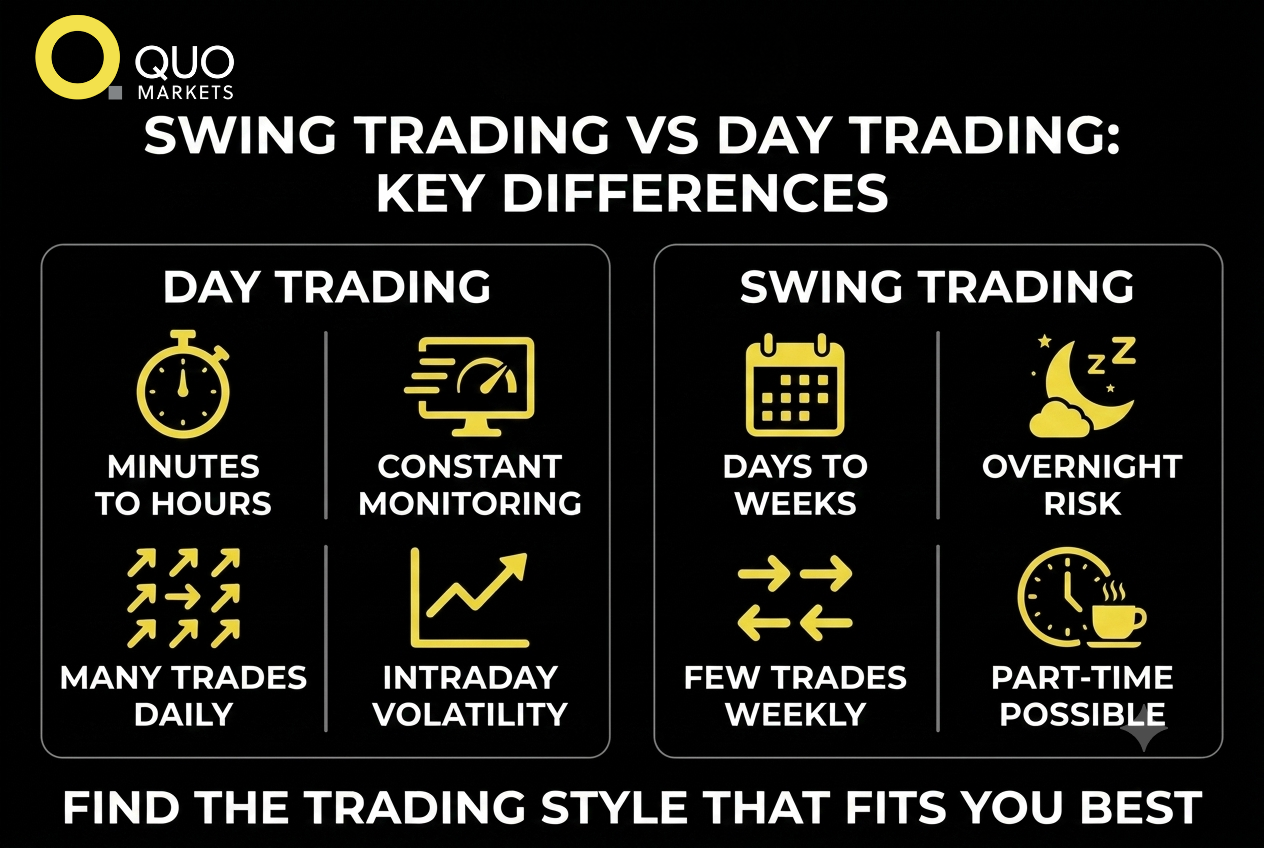
Day trading is exactly what it sounds like. Traders open and close positions within the same market session, meaning no trades remain active overnight. Once the trading day ends, all positions are closed, regardless of profit or loss.
Day traders usually focus on highly liquid markets such as major stocks, forex pairs, or futures contracts, where fast price movements and tight spreads create opportunities throughout the day. Technical analysis plays a major role in this style. Traders rely on candlestick formations, volume spikes, intraday support and resistance levels, and indicators such as RSI or MACD to make decisions that sometimes need to happen within seconds.
The learning process can be intense. Profitable day traders build the ability to read live price action quickly, manage pressure effectively, and execute trades without hesitation. One common day trading strategy is scalping, where traders capture small price movements repeatedly during a session. Others focus on breakout trades when an asset pushes through an important price level with strong momentum.
A practical example makes this easier to understand. During a volatile earnings season, a day trader may buy a technology stock as soon as it breaks above its pre-market high, ride a three percent move during the session, and close the trade before market momentum fades later in the day. Holding that same position overnight would introduce a completely different level of risk. For day traders, success often depends on entering efficiently, exiting decisively, and avoiding emotional attachment to trades.
How many trades do day traders make per day? That depends heavily on the strategy. Scalpers may execute numerous small trades throughout a session, while other intraday traders may focus on only a handful of high-quality setups. The objective is steady execution and consistency, not simply increasing trade volume.
What Is Swing Trading?
Swing trading sits between the fast pace of day trading and the slower rhythm of long-term investing. Swing traders usually hold positions anywhere from a couple of days to several weeks, aiming to profit from a larger price movement as trends develop or reverse.
This approach is generally more measured and less reactive. Technical analysis remains important, but many swing traders also use fundamental or macroeconomic analysis to support their decisions. For example, a trader may identify a company showing strong earnings momentum, wait for the stock to retrace toward an important support level, and then enter a position expecting the uptrend to continue. This combination of chart analysis and broader market awareness is one reason swing trading appeals to traders who prefer a more structured and thoughtful process.
How long do swing traders hold positions? Most swing trades last several days or a few weeks, depending on market conditions, the asset being traded, and the trader’s overall strategy. In forex markets, swing trades often revolve around macroeconomic events such as central bank meetings or major employment reports.
A good real-world example came in early 2023, when volatility in the U.S. banking sector shook financial markets. Many swing traders noticed regional bank stocks becoming heavily oversold after the initial panic. Traders who entered long positions near major support levels and held for one to two weeks benefited from strong recoveries as market sentiment stabilized. Trades like these require patience, planning, and emotional control, all key traits of successful swing traders.
Can swing trading be done part-time? Absolutely. That flexibility is one of its biggest advantages, and it plays a major role in comparing swing trading vs day trading.
Time Commitment and Lifestyle Each Style Demands
This is where the differences between swing trading and day trading become truly practical. The amount of time each style demands affects far more than your calendar. It shapes your entire experience with the markets.
Day trading requires complete attention during market hours. In U.S. stock markets, that generally means staying focused from 9:30 AM to 4:00 PM Eastern Time, with the busiest and most important activity often happening during the opening and closing hours. Missing a setup or stepping away from the screen at the wrong moment can quickly turn a winning trade into a losing one. This style is difficult to combine with a full-time job, childcare responsibilities, or any situation where constant monitoring is impossible.
The required setup also deserves attention. Serious day traders often invest in high-speed internet, multiple monitors, professional trading platforms, and real-time market data feeds. The financial and mental demands can become significant.
Swing trading works on a completely different schedule. Most of the preparation, such as reviewing charts, setting alerts, planning entries, and adjusting stop-loss orders, can be done after work hours or during weekends. Once a trade is active, swing traders usually monitor positions periodically instead of watching every market movement. That makes swing trading one of the most accessible active trading strategies for people balancing careers, families, or other obligations.
Still, less screen time does not mean no responsibility. Swing traders must remain aware of earnings reports, economic announcements, and major news events that can impact open positions. The main difference is that most of the decision-making happens during research and planning rather than continuously throughout the trading day.
For beginners, this distinction is extremely important. Learning swing trading allows newer traders to build discipline and improve chart-reading skills without the nonstop pressure of intraday volatility. Learning day trading, on the other hand, often feels overwhelming because traders must make rapid decisions while still trying to master the basics.
Pros & Cons
Both trading styles involve real financial risk. Neither offers guaranteed profits. However, the type of risk each strategy carries is very different.
Day trading risk is often tightly managed on individual trades because positions are closed before the session ends. However, frequent trading creates another problem: repeated mistakes can accumulate quickly. Many day traders also use leverage, especially in forex and futures markets, which increases both profits and losses. On top of that, high trading frequency generates commission costs that can quietly reduce profitability over time.
Swing trading profitability depends on capturing larger price movements, which usually means bigger potential returns per trade but also greater exposure while positions remain open. One major risk unique to swing trading is the overnight gap. Markets can open sharply higher or lower due to after-hours earnings reports, breaking news, or geopolitical developments. Even well-placed stop-loss orders may fail to execute at the expected price during extremely volatile conditions.
Is day trading more profitable than swing trading? The truth is that profitability depends more on the trader than the strategy itself. Research has shown that many retail day traders struggle to remain consistently profitable because of trading costs and emotional pressure. Swing traders who follow disciplined setups and proper risk management often achieve strong long-term results with less emotional exhaustion.
Is swing trading safer than day trading? Day trading removes overnight risk entirely, which is a clear advantage. However, when considering long-term sustainability and emotional strain, many experienced traders believe swing trading offers a more manageable learning curve for developing traders.
Which Style is Right for You?
Before choosing either style, it helps to ask yourself a few honest questions. Your answers will often reveal the better fit more clearly than any statistics ever could.
How much time can you realistically dedicate? If you already have a demanding career, family responsibilities, or limited availability during market hours, day trading may create more stress than opportunity. Swing trading is often better suited for traders who want flexibility while staying active in the markets.
How well do you manage stress and emotional pressure? Day trading demands fast decision-making during moments of financial uncertainty. Traders who frequently hesitate, panic during volatility, or struggle emotionally after losses may find day trading psychologically exhausting. Swing trading provides more time to think clearly and make decisions with less pressure.
Are you comfortable holding positions overnight? Some traders dislike the uncertainty of waking up to major price changes caused by overnight news. Others accept overnight exposure as a normal part of capturing larger market moves. Understanding your comfort level matters.
How much capital are you starting with? How much money do you need for day trading? In the United States, FINRA’s Pattern Day Trader rule generally requires traders making four or more day trades within five business days in a margin account to maintain at least $25,000 in equity. Swing trading does not carry this regulatory requirement, making it more accessible for traders with smaller starting balances.
Are you still learning the markets? For beginners, swing trading strategies usually provide a more forgiving environment to develop skills. The slower pace gives traders time to review mistakes, improve their strategy, and build confidence before stepping into faster-paced trading styles.
There is no universal best trading strategy for beginners, but many new traders find that starting with swing trading creates a more sustainable learning experience.
Final Remarks
The swing trading vs day trading discussion will probably never produce one clear winner. The best choice depends entirely on the individual trader. Day trading rewards people who thrive under pressure, can dedicate significant time to the markets, and feel comfortable making rapid decisions. Swing trading appeals to traders who want active market exposure without sacrificing their schedule or peace of mind.
If you are still unsure, paper trading both strategies before risking real money is often the smartest approach. Experience reveals far more than theory ever can. Ultimately, the best trading strategy is the one you can follow consistently, improve over time, and maintain without burning yourself out.
FAQs
Do swing traders trade every day?
Not always. Swing traders wait for setups that match their strategy, which may result in only a few trades per week. The focus is on quality opportunities rather than trading frequency.
Which trading style requires less time?
Swing trading generally requires far less daily screen time. Most research and planning can be done outside regular market hours, making it easier to combine with work or personal commitments.
Is day trading stressful?
For many people, yes. Day trading involves fast decision-making, continuous market monitoring, and frequent exposure to volatility. Managing emotions and trading psychology is one of the hardest parts of the day trading lifestyle, which is why many traders eventually move toward swing trading or longer-term strategies.
What is the main difference between swing trading and day trading?
Day trading involves opening and closing all trades within the same session, while swing trading holds positions for several days or even weeks. Day trading requires constant market attention, whereas swing trading allows for a more flexible and planned approach.
Can beginners start with swing trading?
Yes. Swing trading is often considered one of the more beginner-friendly active trading strategies because it provides more time for analysis, reduces pressure from real-time decisions, and does not require the same level of capital or screen time as day trading.