
USDT Meaning Explained: The Stablecoin Behind QuoMarkets’ Card
Imagine two accounts side by side. One holds Bitcoin. The other holds USDT. Over a rough week, the first one might swing 15% in either direction before Friday. The second barely moves at all. That gap, between an asset built to move and one built to sit still, is the entire reason USDT exists.
USDT isn’t trying to make anyone rich. It’s trying to be boring, reliably, at scale. And that boringness turns out to be extremely useful: for parking money mid-trade, for moving funds across borders in minutes, and, with QuoMarkets, for funding a card you can spend from like a regular dollar balance. Let’s get into what it actually is, how it holds its value, and how does USDT work once it reaches your wallet.
Where the “Digital Dollar” Label Comes From
What is USDT? In short, it’s a stablecoin, a type of cryptocurrency built to track the price of a real-world asset instead of floating freely. USDT’s target is the US dollar, at a 1:1 ratio. Tether Limited created it back in 2014, originally under the name RealCoin, before rebranding to Tether shortly after launch.
The “digital dollar” nickname isn’t just marketing. Every USDT token is meant to always be worth about one dollar, which is what separates it from an asset like Bitcoin, where price discovery is the whole point. Stablecoins trade that price discovery for predictability, and traders have rewarded that trade-off: Tether’s market cap sat near $99 billion in March 2024 and has since climbed past $186 billion by mid-2026, putting it at roughly 59% of the entire stablecoin market, comfortably the largest player in the category.
A few things worth knowing about the mechanics:
- USDT isn’t tied to one blockchain. It runs on Ethereum, Tron, Solana, the Liquid Network, and others, so users can pick whichever network is fastest or cheapest for a given transfer.
- Its earliest version actually launched on Bitcoin’s Omni Layer, a protocol layered on top of the Bitcoin network itself.
- By trading volume, USDT is regularly one of the top three crypto assets in the world, trailing only Bitcoin and Ethereum by market cap.
Is USDT a Stablecoin, and How Does It Actually Stay at $1?
Yes, and the “how” is more interesting than the “yes.” Is USDT a stablecoin in the same way a fixed-rate bond is stable? Not exactly; there’s no smart contract enforcing the peg automatically. Instead, Tether relies on a mint-and-burn process managed centrally by the company.
Here’s the flow: when large clients deposit dollars with Tether, the company mints new USDT to match. When clients redeem, Tether destroys, “burns”, the equivalent tokens. That constant matching of supply to demand is what keeps the price hovering near $1, rather than an algorithm doing the work.
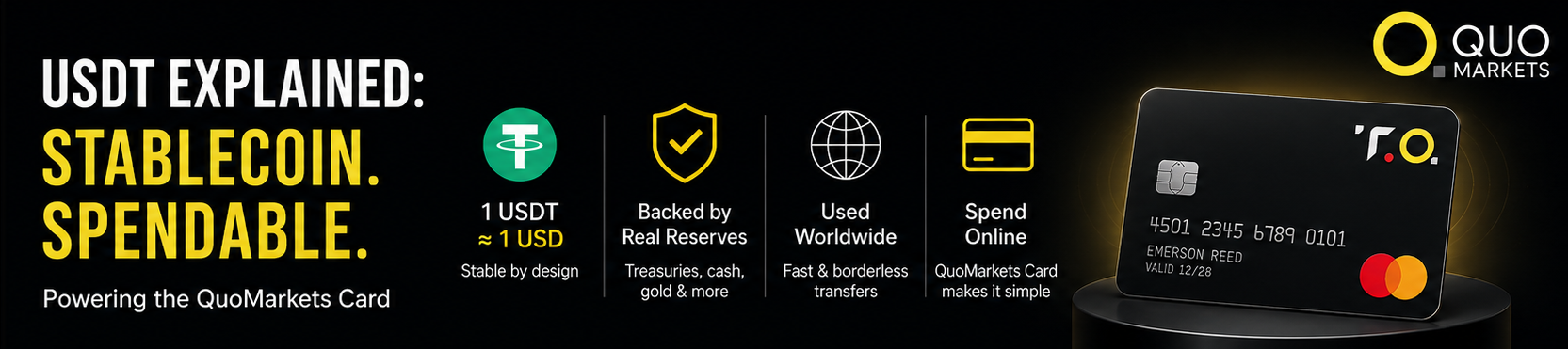
What actually sits behind those tokens matters just as much as the mechanism. Tether reports its reserves as a mix of cash and cash equivalents, US Treasury bills, secured loans, gold, and a small Bitcoin allocation. That mix has leaned harder into Treasuries over time – $63 billion held in 2023, growing past $127 billion by Q2 2025 – which is a big part of why confidence in the peg has strengthened. Tether also publishes quarterly attestations showing reserves outweigh liabilities, though for most of its history those fell short of a full independent audit under the strictest standards (more on that below).
None of this makes the peg unbreakable. USDT slipped as low as $0.95 during past bouts of market panic before arbitrage trading pulled it back within hours. Under ordinary conditions, though, it holds its line in a way Bitcoin and Ethereum simply don’t.

How Does USDT Work in Practice for Traders
Knowing the mechanism is one thing. Knowing why traders actually reach for USDT is another. A few of the most common uses:
As a safe harbor. When markets get volatile, traders exit Bitcoin or altcoin positions into USDT rather than cashing out to fiat entirely – it lets them dodge a drawdown while staying inside the crypto ecosystem, ready to re-enter fast.
As the default trading pair. USDT sits on nearly every centralized and decentralized exchange, which makes it the base currency for the majority of crypto trading pairs. It also shows up heavily in DeFi lending and staking.
As a way to bank gains same-day. Close a profitable trade, convert to USDT, and that value stops moving with the market. From there, shifting funds onto a spending QuoCard means real, usable money the same afternoon, not after a multi-day bank transfer.
As a cross-border shortcut. USDT transfers settle in minutes over blockchain rails, sidestepping the fees and delays that come with international wires.
As access in restrictive banking environments. For traders dealing in currencies like the Mexican peso or offshore Chinese yuan, USDT offers a workaround where local banking infrastructure is limited or slow.
Turning USDT Into Spending Power: The QuoMarkets Card

This is where USDT payment stops being abstract. QuoMarkets clients can spin up a virtual card instantly from the Client Portal – identity verification aside, there’s no extra paperwork and no waiting period.
One clarification worth making upfront: this is a crypto card at its core. Whichever wallet you fund it from, that balance gets automatically exchanged into USDT – USDT is the actual asset sitting behind your card balance, which is what keeps it steady instead of exposed to the swings of a more volatile crypto holding. That conversion happens automatically the moment you top up, so there’s no manual swap step on your end, and no conversion fee from QuoMarkets’ side.
The process, step by step:
- Fund from any of your wallets. Your balance is automatically converted into USDT
- Spend online or in physical shops wherever the card network is accepted – Apple Pay and Google Pay are both supported.
- Track it all inside the Client Portal.
Worth flagging before you start: this card works both online and in physical shops, so it covers everyday purchases, not just e-commerce and subscriptions. Virtual cardholders can also use contactless ATM withdrawals, with PIN support expected by the end of September 2026. A physical card is coming too, expected in October 2026, which will bring standard ATM withdrawals alongside it.
Setup costs a one-time $25 issuance fee, plus a $20 minimum on the first load, so plan for roughly $45 to get going. After that, top-ups are fee-free with a $20 minimum each time. If you spend in a currency other than USD, your bank may apply its own conversion rate at the point of sale – that’s separate from QuoMarkets’ fees. Availability varies by region, so it’s worth confirming your eligibility with support before you commit.
Why Hold USDT at All, Beyond the Card?
Liquidity. With tens of billions of tokens circulating and enormous daily volume, entering or exiting a USDT position rarely comes with meaningful slippage.
Flexibility. Capital sitting in USDT can move into a new trade the instant an opportunity appears, or onto the card the instant you want to spend it – no in-between step.
A calmer mental state. Watching a portfolio swing overnight is stressful. A stable, dollar-like balance takes that particular stress off the table, which – anecdotally, at least – seems to help traders avoid panic-driven decisions during downturns.
Risk and Regulatory History
USDT is useful, but it’s not without baggage, and understanding that baggage is part of understanding the coin itself.
In 2019, the New York Attorney General sued Tether and its affiliate Bitfinex, alleging they’d misrepresented reserves to cover up an $850 million shortfall. The case settled in 2021 – Tether paid $18.5 million without admitting wrongdoing, and was barred from operating with New York residents going forward.
Separately, a Commodity Futures Trading Commission investigation found that between 2016 and 2018, Tether’s reserves were, at points, only 27.6% backed by actual fiat – a sharp contrast to the “100% backed” language Tether had used publicly. That led to a $41 million fine in 2021. Tether was also investigated over alleged Bitcoin price manipulation in 2018.
More recently, Tether announced in August 2026 that it had completed its first full financial audit, conducted by KPMG and covering the 2025 financial statements – a genuine milestone, since for most of its operating history Tether had published attestations rather than a full audit under the strictest international standards. That distinction matters if you’re weighing how much trust to place in the reserve claims.
Beyond the history, a few structural risks are worth keeping in mind:
- Depeg risk – USDT has traded below $1 during extreme stress before, and could again.
- Centralization risk – a single company controls minting, burning, and the ability to freeze addresses.
- Counterparty risk – there’s no government deposit insurance behind USDT the way there is behind a bank account.
Buying, Storing, and Cashing Out USDT Without Losing It
USDT is available through centralized exchanges, on-ramp services that accept card or bank transfers, peer-to-peer platforms, and swaps from other crypto assets.
The single most important safety habit: USDT exists as separate tokens on separate blockchains, and they are not interchangeable at the wallet level. Sending an ERC-20 USDT transfer to a TRC-20 address (or the reverse) can destroy the funds permanently. Double-check the network every single time.
A short list of good habits:
- Use platforms and wallets with two-factor authentication enabled.
- Move larger, inactive balances to a hardware wallet rather than leaving them on an exchange.
- Only keep what you’re actively planning to trade or spend in a hot wallet.
To convert USDT back to cash, move it to a supported exchange, trade into local currency, and withdraw to a bank. Or, for QuoMarkets clients, the card sidesteps that step entirely – spend the balance directly without routing back through a traditional bank withdrawal.
It’s also worth knowing Tether isn’t standing still – the company has expanded into tokens pegged to other currencies, with more planned around the Euro. And USD Coin (USDC), the second-largest stablecoin, takes a notably different approach to reserve composition and reporting, which makes it a reasonable point of comparison if you’re deciding where to hold value longer-term.
So, Is USDT Right for You?
USDT proves its value in the short-to-medium term: hedging volatility, moving funds fast, and, through the QuoMarkets card, covering everyday spending without touching traditional banking rails. As a low-volatility tool inside a genuinely volatile market, it does its job well.
What it isn’t is a substitute for a regulated, insured bank account. Treating USDT as a long-term, risk-free savings option misreads what it is. If you’d rather hedge that risk, splitting holdings between USDT, USDC, and traditional fiat is a reasonable approach, particularly if you’re in a region where stablecoin regulation is still being worked out.
As always, this isn’t financial advice, and larger decisions around USDT allocation are worth running past a qualified professional or your own research first.
FAQs
What is USDT?
USDT (Tether) is a stablecoin built to hold a steady $1 value rather than trade freely like Bitcoin or Ethereum. It’s the largest stablecoin by market share, accounting for roughly 59% of the stablecoin market by mid-2026.
Is USDT a stablecoin?
Yes, that’s its defining feature. It’s pegged 1:1 to the US dollar and managed through a centralized mint-and-burn process rather than an algorithm.
How does USDT work?
Tether mints new tokens when institutional clients deposit funds and burns them on redemption, keeping supply matched to demand. Reserves backing the tokens are mostly Treasury bills, alongside cash, secured loans, and smaller allocations to gold and Bitcoin.
What is a USDT card?
A USDT card lets you spend a stable, dollar-pegged balance both online and in physical shops. QuoMarkets’ version funds from any of your wallets, automatically converts that balance into USDT, and works wherever the card network is accepted, including Apple Pay and Google Pay.
What is USDT payment typically used for?
Outside of trading, USDT payments cover fast cross-border transfers, DeFi lending, and, through tools like the QuoMarkets card, day-to-day spending funded by a dollar-stable balance.
What blockchain networks support USDT?
Several, including Ethereum, Tron, Solana, and the Liquid Network. Always confirm the network before sending – mixing up ERC-20 and TRC-20, for example, can permanently lose your funds.
Is USDT the same thing as a US dollar?
Not exactly. USDT tracks the dollar’s value but is a privately issued token backed by Tether’s reserves – it isn’t government-issued currency and carries no deposit insurance. It typically trades near $1, though it briefly fell to $0.95 during past market stress.
How is USDT different from USDC?
Both track the dollar 1:1, but from different issuers – Tether for USDT, Circle for USDC. USDT is the larger of the two by market share; the meaningful differences come down to reserve composition, audit history, and regulatory standing rather than the core peg mechanism.