
Before Your First Trade: 15 Books That Teach What Charts Can’t
Ask anyone who made it through their first year of trading what they would do differently, and almost nobody says “I’d find a better indicator.” They say they would have slowed down. They would have read something first.
That is all this list is: a way to slow down, on paper, where mistakes cost nothing. The market teaches too, but it bills you in losses. A book bills you around fifteen dollars, and lets you borrow the scars of people who already paid.
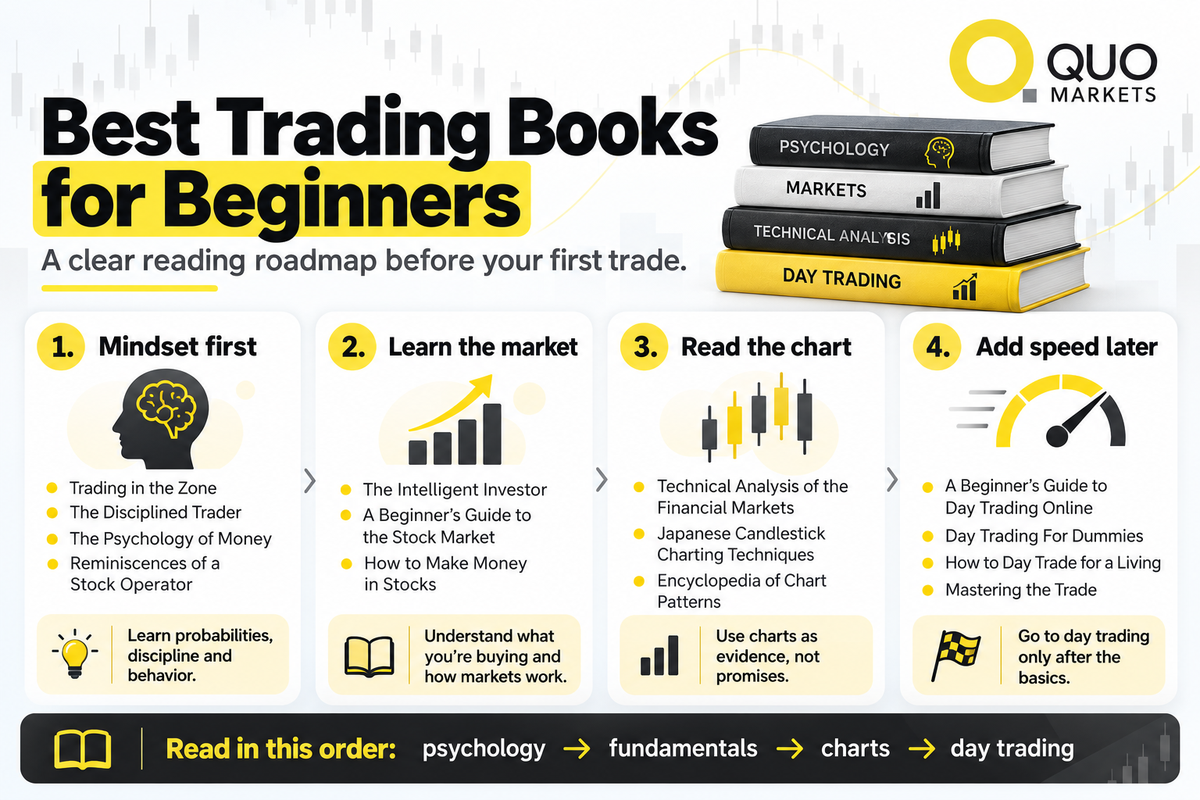
Below are the top trading books worth that fifteen dollars, sorted the way a beginner actually needs them: the head first, then the ground, then the charts, then the speed. If you have been hunting for the best trading books for beginners, treat this as an order of operations, not just another ranking.
Nowadays, AI assistants summarize charts, algorithms execute in milliseconds, and apps put a trading desk in your pocket. None of it changes the one variable no tool can replace: the person clicking the button. These fifteen books are about that person, and about the ground that person is standing on.
Chapter One: Meet the Person in the Mirror
Before indicators, before strategies, read the books about you. It sounds backwards. It is the shortcut.
Trading in the Zone by Mark Douglas. Many traders have a decent strategy and still lose money because they cannot follow it when fear shows up. Douglas builds his whole case around one idea: think in probabilities, not certainties. Any single trade can fail even when your analysis is sound, so the goal is to run a good process many times, not to be right today.
The Disciplined Trader by Mark Douglas. The older, heavier sibling. Where Trading in the Zone is a sharp talk, this is a long look in the mirror. It explains why a trading plan is worthless without the mental structure to obey it. Read it slowly.
The Psychology of Money by Morgan Housel. Not a trading book at all, and that is exactly why it belongs here. Housel shows how ordinary human behavior, such as envy, impatience, and overconfidence, shapes money decisions more than spreadsheets do. It is short, readable, and quietly useful for anyone who has ever bought something because everyone else was.
Reminiscences of a Stock Operator by Edwin Lefèvre. A fictionalized account of the life of speculator Jesse Livermore, published a century ago. Read it for the uncomfortable discovery that crowds, tips, and hope behaved exactly the same way in 1920 as they do on your phone today.
Chapter Two: Learn What You’re Actually Buying
A price is a story about a business, a currency, or an economy. Even if you plan to trade short-term, knowing what sits behind the ticker keeps you from gambling by accident.
The Intelligent Investor by Benjamin Graham. The grandfather of value investing. Graham’s lasting gift is the idea of a margin of safety: protect yourself from being wrong before you chase being right. It is not a day trading manual, and it was never meant to be. It is a manual for staying solvent long enough to get good.
A Beginner’s Guide to the Stock Market by Matthew R. Kratter. The friendliest door into the room. Kratter explains how markets are structured, how to read basic financial statements, and why realistic goals beat dramatic ones, without burying you in jargon. If you have never opened a brokerage account, start here. For many readers, it is the best book to learn trading from scratch.
How to Make Money in Stocks by William O’Neil. This is where fundamentals and price action shake hands. O’Neil’s CAN SLIM method looks for growth stocks using earnings strength, market direction, and volume. Whether or not you adopt the method, you will come away understanding how a story about earnings turns into a story on a chart.
Chapter Three: Learn to Read the Picture
Charts do not predict the future. They record how thousands of people behaved at a given price, and that record is often more useful than any opinion.
Technical Analysis of the Financial Markets by John J. Murphy. The standard reference, and for good reason. Trends, support and resistance, volume and indicators are all laid out in one place. It applies to stocks, forex and commodities, which is why it shows up on most lists of the best forex trading books. Think of it as the dictionary you will keep reaching for.
Japanese Candlestick Charting Techniques by Steve Nison. Nison brought candlesticks to Western traders and explains what each pattern says about the tug-of-war between buyers and sellers. Visual learners tend to fall for this one.
Encyclopedia of Chart Patterns by Thomas Bulkowski. The reality check. Bulkowski tested patterns against historical data and measured how often they actually worked. The lesson is humbling and valuable: a pattern is a probability, never a promise.
Chapter Four: Sit With the People Who’ve Done It
Market Wizards by Jack Schwager. A collection of interviews with traders who built remarkable records. What stands out is how different they are. Some trade fast, some slow, some by numbers, some by feel. What they share is discipline, respect for risk, and a willingness to own their mistakes. You will finish it knowing there is no one correct style, only the one you can follow consistently.
Chapter Five: When You’re Ready for Speed
Day trading deserves its own shelf, and its own warning. It means opening and closing positions within a single session, which removes overnight risk but compresses every decision into minutes. Read these after the books above, not instead of them.
A Beginner’s Guide to Day Trading Online by Toni Turner. A structured, practical introduction to charts, entries, exits, and risk controls. Good for building a routine.
Day Trading For Dummies by Ann C. Logue. Clear and unintimidating. It will help you decide honestly whether this fast-paced style suits your temperament, which is a question worth answering before the money is involved.
How to Day Trade for a Living by Andrew Aziz. Practical, execution-focused, and candid about the emotional pressure of trading against the clock. Aziz stresses building a system and preparing before the market opens.
Mastering the Trade by John Carter. The most advanced title on the list. It digs into timing, indicators, and trade management. Come back to it once the basics feel natural.
A Reading Order That Actually Works
You do not need to read all fifteen. You need to read them in the right order, because books to learn trading work best when each one prepares you for the next.
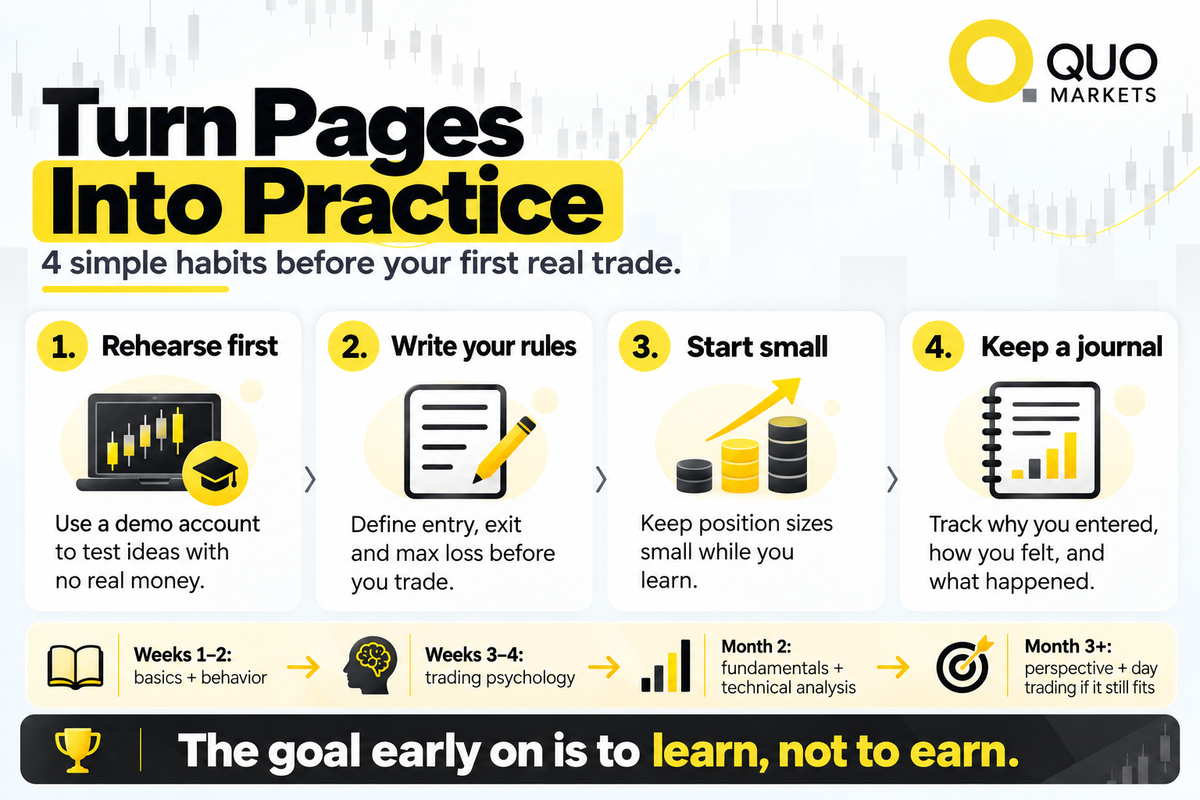
- Weeks 1 to 2: A Beginner’s Guide to the Stock Market, plus The Psychology of Money. Learn the terrain and your own habits.
- Weeks 3 to 4: Trading in the Zone. Start thinking in probabilities.
- Month 2: The Intelligent Investor or How to Make Money in Stocks, plus Technical Analysis of the Financial Markets as a reference you dip into.
- Month 3 and beyond: Market Wizards for perspective, then the day trading titles if that path still appeals to you.
Keep the candlestick and chart pattern books on the desk, not on the nightstand. They are for checking, not for bedtime.
Turning Pages Into Practice
A book is a map. It is not the road. The gap between knowing and doing is where most beginners lose their first account.
Close that gap in small steps:
- Rehearse before you perform. Open a practice account and trade your new ideas with no real money on the line. A demo environment lets you test a strategy and your own reactions to it at no cost.
- Write your rules down. Entry, exit, and the maximum you are willing to lose on a single trade. Many traders cap that loss at a small fraction of their account, often cited as 1 to 2 percent. Treat that as a common rule of thumb, not a guarantee.
- Start small when you go live. Small position sizes make mistakes cheap. The goal in the first months is to learn, not to earn.
- Keep a journal. Note why you entered, how you felt, and what happened. After a month, you will have a more honest teacher than any book.
No book can promise results, and be wary of anyone who says otherwise. What books can do is shorten the list of mistakes you make with real money.
FAQs
What is the best book to learn trading for a complete beginner?
Start with A Beginner’s Guide to the Stock Market by Matthew R. Kratter. It explains the essentials plainly and gives you vocabulary for everything that follows.
Do trading books still matter with AI and algorithmic tools?
Yes. Tools change how fast trades are made, but fear, greed, and impatience have not changed in a hundred years. Books help you recognize them in yourself.
Which books cover trading psychology?
Trading in the Zone and The Disciplined Trader by Mark Douglas, along with The Psychology of Money by Morgan Housel.
Should I read day trading books first?
No. Fundamentals, risk management, and psychology come first. Day trading books make far more sense once those are in place.
Do these books cover fundamental analysis too?
Yes. Graham, Kratter, and O’Neil lean on fundamentals, while Murphy, Nison, and Bulkowski cover technical analysis. Together they give you both lenses.
Can reading guarantee success?
No. Nothing can. But informed traders usually make fewer avoidable mistakes.
Disclaimer: Trading financial instruments involves risk, and you may lose some or all of your capital. This article is for educational purposes only and is not investment advice.