
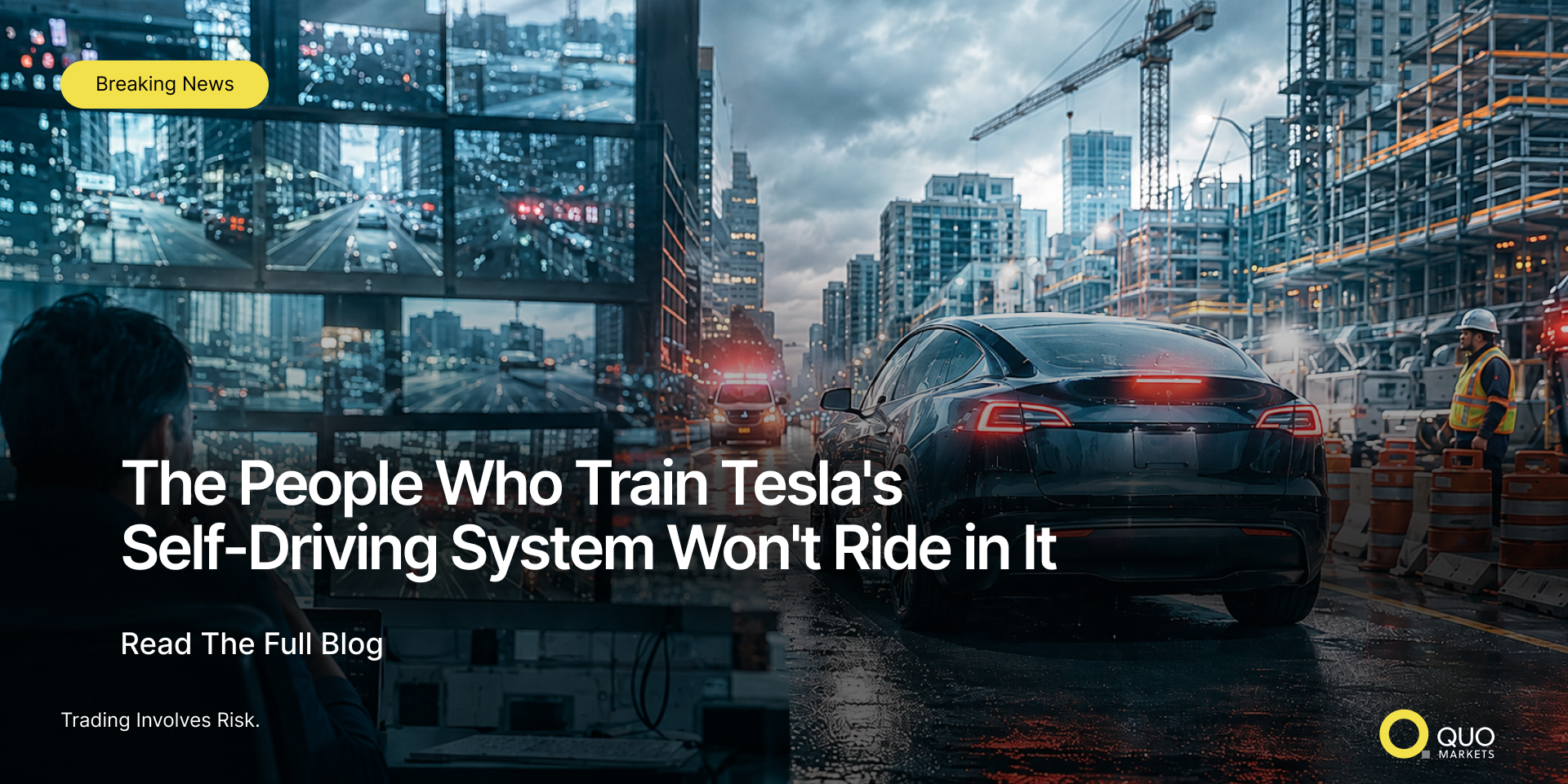
Elon Musk says Full Self-Driving is up to 10 times safer than a human behind the wheel. The people who actually watch it drive every day disagree, and most of them won’t get in the car.
A Reuters investigation, drawing on interviews with nine former Tesla data labelers, a former self-driving engineer, and 11 road-safety researchers, found a wide gap between what Tesla tells the public and what its own workforce sees on the job.
The Numbers Don’t Add Up
Tesla CFO Vaibhav Taneja first made the 10x safety claim last July. Board Chair Robyn Denholm repeated it at a November shareholder meeting. Musk himself showed a chart at that same meeting claiming “85% less crashes.”
Researchers who looked closely at the methodology found the comparison is built on a mismatch. Tesla measures airbag-deployment crashes in its own fleet against a federal crash rate that covers far less severe accidents. It also compares its cars to the average U.S. vehicle, which is about 12 years old, while Tesla’s fleet averages around 4 years. Newer cars crash less often regardless of who’s driving them. When researchers adjusted for age and severity, the safety edge dropped from 10x to roughly 3x. Ten of the 11 researchers who reviewed Tesla’s methodology said it amounted to misleading marketing rather than a serious safety analysis.
What the Footage Actually Shows
Data labelers, based primarily in a Utah office, review video from the eight exterior cameras on Tesla vehicles using FSD. They described regularly seeing FSD fail at basic tasks: pulling over for emergency vehicles, giving motorcyclists enough space, braking on freeway off-ramps, and navigating construction zones. In one incident, a Tesla drove into a construction zone and nearly struck workers.
The report also details FSD regularly exceeding speed limits by 20 to 30 mph after Tesla introduced a more aggressive driving mode, with one labeler reporting a vehicle traveling 60 mph in a 25-mph zone.
A specialized team in Palo Alto, known internally as the “trauma team,” focused specifically on near-misses involving pedestrians and children, including cases where drivers grabbed the wheel seconds before something serious happened.
Seven of the nine former labelers said they wouldn’t trust FSD to drive them. One said he wouldn’t ride in a Tesla robotaxi “if you fucking paid me.” A veteran self-driving engineer who had reviewed years of Tesla crash data called the company’s safety claims “bullshit” and added: “Definitely, don’t trust Elon on this.”
The Secret Behind the “Autonomous” Demos
One of the more damaging findings involves how Tesla prepared for its public launches. Before the October 2024 Cybercab unveiling and the June 2025 Austin robotaxi launch, former employees said Tesla used labor-intensive safeguards, filming and mapping limited service zones for months to make sure the software could handle specific maneuvers.
For weeks before the Cybercab event at the Warner Bros. studio lot, staff tested prototypes every night from 6 p.m. until dawn, capturing video of the exact routes the cars would follow. Data labelers then spent hundreds of hours annotating curbs and road markings. The same process was repeated before Austin.
This directly contradicts Musk’s long-standing argument that Tesla’s approach is superior precisely because it doesn’t require the kind of detailed local mapping that competitors use.
How Tesla Stacks Up in Texas
Texas regulatory data shows Tesla has 42 authorized driverless vehicles in the state, compared with 577 for Waymo, 317 for Avride, and 35 for Zoox. Tesla’s Austin robotaxi fleet was linked to 17 known incidents between July 2025 and April 2026, including two involving minor injuries.
Federal regulators have forced Tesla to recall over 2 million vehicles for Autopilot issues and opened multiple investigations into crashes involving emergency vehicles and low-visibility conditions. The NHTSA specifically flagged FSD’s tendency to roll through stop signs and behave unpredictably at intersections.
Musk said in 2019 that autonomous driving was “basically a solved problem.” More than six years later, the people paid to watch it in action every day still won’t let it drive their kids to school.