Handing your money over to a broker takes a leap of faith, but it shouldn’t be blind faith. A forex broker licence is basically the paper trail that proves a company has actually been checked out by someone other than itself. It shows you who’s keeping an eye on the broker, what they had to prove before they were allowed to open shop, and what your options are if things ever go sideways.
Let’s discuss what a licence covers, why one broker license isn’t automatically as strong as another, and how QuoMarkets’ own regulatory footprint stacks up across the regions where our traders live and trade.
So, What Exactly Is a Forex Broker Licence?
Put simply, a forex broker licence is official permission from a regulatory authority that lets a company legally offer forex trading services to the public. It’s not a box-ticking exercise. To earn one, a brokerage has to lay out, in detail, how it plans to run its business, protect client money, and stay standing if the markets turn ugly.
Every country regulates forex a little differently, but the point of licensing is always the same: keep the market functioning with some baseline of protection for the people trading in it. In the US, that means registering with the Commodity Futures Trading Commission (CFTC) and the National Futures Association (NFA) – two bodies known for actually enforcing the rules. The UK has the Financial Conduct Authority (FCA) doing similar work. Elsewhere you’ll run into names like the Cyprus Securities and Exchange Commission, South Africa’s Financial Sector Conduct Authority, or the Seychelles Financial Services Authority – each with its own rulebook and its own appetite for oversight.
To put the stakes in perspective: the forex market moves roughly $9.6 trillion a day, according to the latest global survey, up from $7.5 trillion just a few years back. That’s an enormous amount of money changing hands over the counter, with no single central exchange watching over it. Broker-by-broker licensing is how regulatory authority actually gets applied to a market that size.
Not All Licences Are Created Equal: Tier-1 vs. Offshore
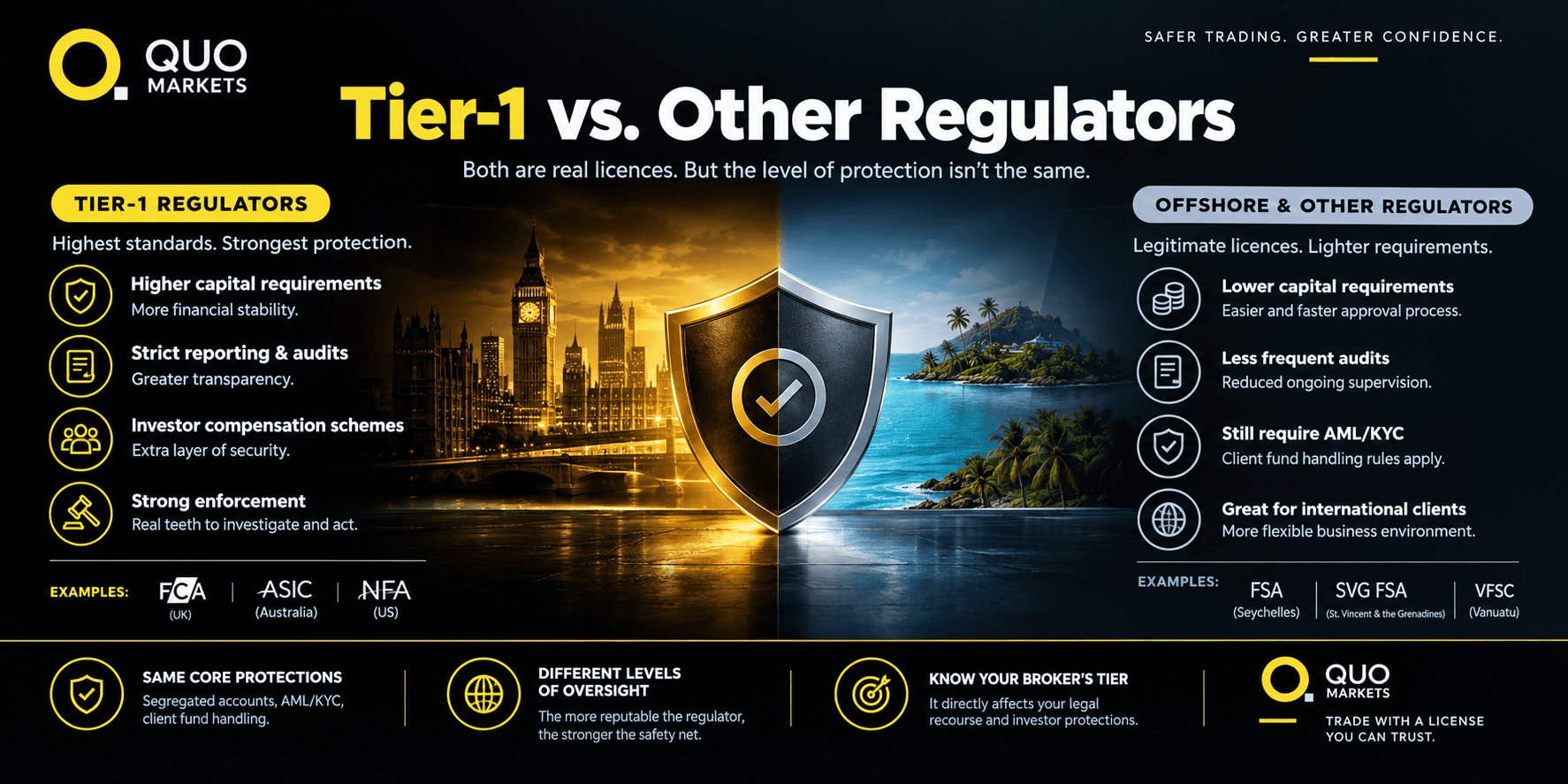
This is where a lot of traders get caught off guard: two brokers can both be “licensed” and still offer wildly different levels of protection.
Tier-1 regulators: think the FCA in the UK, ASIC in Australia, or the NFA in the US – set the bar high. High minimum capital requirements, strict reporting, mandatory investor compensation schemes, and frequent audits. These bodies also tend to have the resources and teeth to actually investigate complaints and enforce penalties, which matters a lot if you ever end up in a dispute.
Offshore jurisdictions: Seychelles, Vanuatu, and a handful of Caribbean nations sit at the other end of the spectrum. A forex broker license in SVG jurisdictions like St. Vincent and the Grenadines issue, or a Seychelles forex license, are still real licences with real obligations around anti-money laundering and client fund handling. But the minimum capital bar is lower, approval is faster, and ongoing supervision is generally lighter than what a tier-1 regulator demands.
That doesn’t automatically make offshore brokers untrustworthy. Plenty of legitimate companies hold offshore licences because those jurisdictions offer a friendlier business environment, lower corporate tax, and a licensing process built for firms serving international clients rather than one domestic market. What matters is that you know which tier your broker sits in, because it directly affects what legal recourse and investor protections you actually have if something goes wrong.
What a Broker Actually Has to Prove to Get Licensed
Getting a forex broker license isn’t a rubber stamp. Regulators typically want to see:
- A real business plan. Brokers have to explain their target market, their business model, and how they intend to manage trading and operational risk over time.
- Minimum capital on hand. Every jurisdiction sets its own bar, scaled to the type of business. In the US, for example, Retail Foreign Exchange Dealers (RFEDs) must hold at least $20 million in adjusted net capital, while Introducing Brokers face a much lower $45,000 threshold. Other regulators set their own capital adequacy rules, but the logic is always the same: a broker needs enough of its own money to absorb shocks without touching client funds.
- Segregated client accounts. This is one of the most concrete protections a licence gives you. Client money has to sit separately from the company’s own operating funds, so the broker’s day-to-day cash flow problems never bleed into what belongs to traders.
- AML and KYC compliance. Anti-money laundering and know-your-customer checks are non-negotiable under nearly every regulatory framework. This is also part of why licensed brokers can access banking and payment rails that would otherwise be closed to them.
- Documented risk management. Regulators expect to see how a firm handles margin exposure, and how it operates as a market maker or works with its liquidity providers.
- Time. None of this happens overnight – licensing in the UK alone can take 6 to 12 months once you factor in legal review, corporate banking setup, and back-and-forth with the regulator.
And getting licensed isn’t the finish line. Ongoing supervision means regular compliance checks, financial reporting, and audits – regulators keep enforcing minimum capital requirements long after the licence is issued, not just at the application stage.
QuoMarkets’ Regulatory Entities, Explained
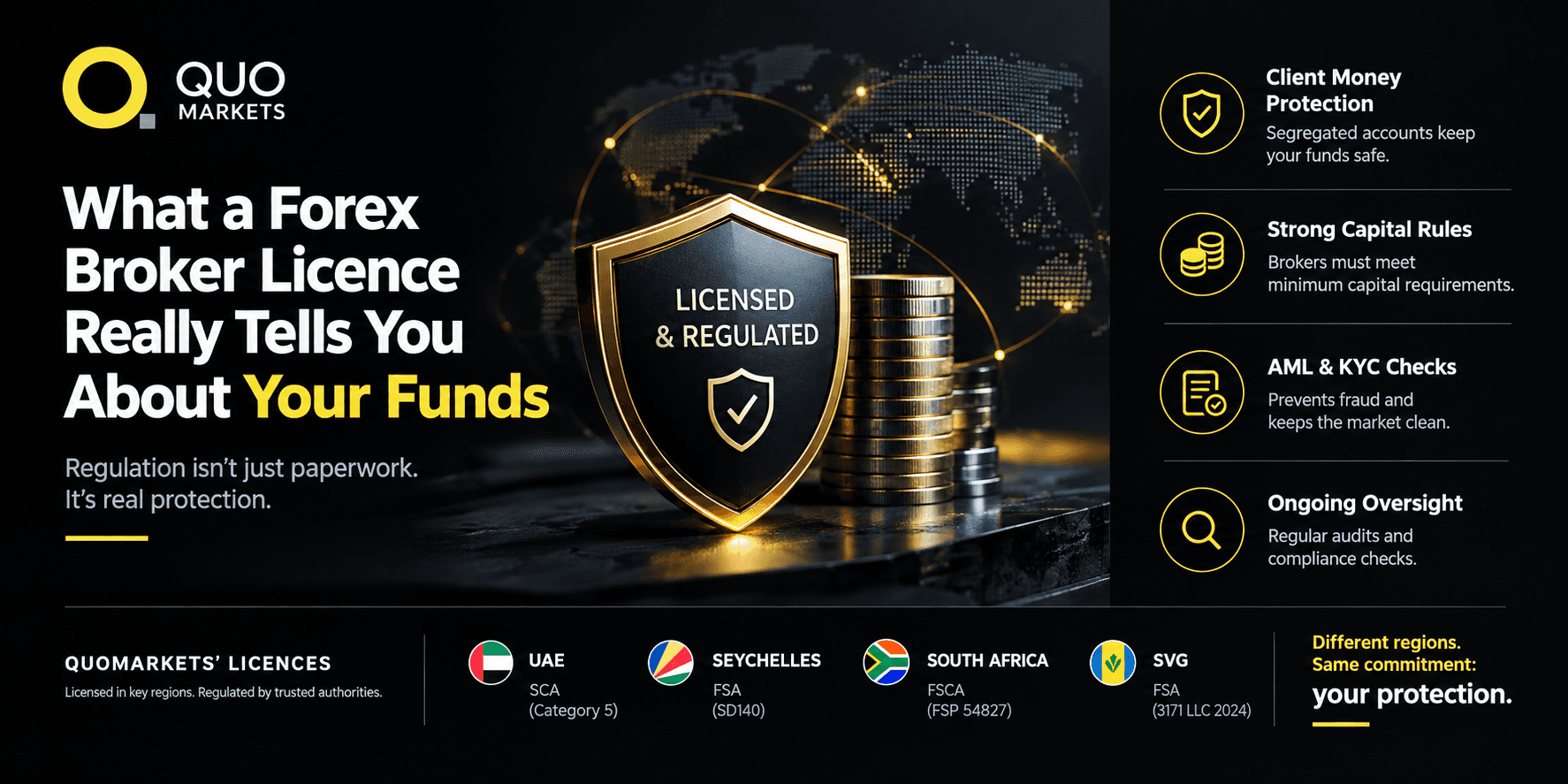
Rather than ask you to just take our word for it, here’s exactly where QuoMarkets is licensed and by whom:
- Tradequomarkets Financial Services L.L.C is registered, authorised, and regulated by the Securities and Commodities Authority (SCA) of the United Arab Emirates, under License No. 20200000320, Category 5, covering financial consultations and introduction services. Registered office: Business Tower, Main Business Village, Dubai, UAE.
- Trade Quo Global Ltd operates as a securities dealer, authorised and regulated by the Seychelles Financial Services Authority (FSA) under license number SD140 – a Seychelles forex license that covers our international client base.
- Tradequo (PTY) Ltd is licensed in South Africa by the Financial Sector Conduct Authority, under FSP license number 54827, registered on the 33rd Floor, 34 Whiteley Road, Johannesburg.
- Quo Markets LLC is registered with the Financial Services Authority under FSA: 3171 LLC 2024, based at Suite 305, Griffith Corporate Centre, Beachmont, Kingstown, SVG – a forex broker license SVG traders will recognize from other reputable brokers as well.
Each entity is tied to a specific region and regulator on purpose. It means clients in different parts of the world deal with the entity and the regulator that’s actually relevant to them.
What This Means Depending on Where You’re Trading From
UAE and MENA: Trading through Tradequomarkets Financial Services L.L.C puts your account under an SCA-licensed entity, governed by UAE rules on financial consultations and introduction activities. For traders in the Gulf and wider Middle East, this is the closest regulatory tie you’ll get to the region.
Colombia: Colombian traders, along with the wider LATAM region, typically deal with QuoMarkets through entities holding the Seychelles FSA licence.
Brazil and the rest of LATAM: The same setup applies here, Seychelles forex licence covers international account holders across the region. Worth noting for Brazilian traders: dispute resolution runs through the Seychelles FSA, not a domestic Brazilian regulator.
Thailand: Thai clients are typically onboarded through the same internationally licensed entities. Thailand does have its own regulatory framework for foreign-exchange businesses, including authorised FX brokers and other categories of operators, but the Bank of Thailand has been clear that it doesn’t license general online businesses to offer retail forex trading for speculation the way a standard retail broker might in other jurisdictions. Thai traders should double-check both the legal entity they’re signing up with and whether the specific service is permitted under Thai law.
Indonesia: A similar situation applies. Indonesian traders should separate a broker’s offshore regulatory status from its actual legal ability to market or offer specific products to Indonesian residents. Local rules have shifted in recent years, so it’s worth verifying current requirements alongside the exact entity named in your account agreement.
Across every region, three things stay constant: segregated client accounts, AML/KYC procedures, and compliance with whichever regulator issued that entity’s forex trading license.
How to Check Any Broker’s Licence Yourself (5 Minutes)
Before you fund an account anywhere, do this:
- Find the broker’s registered entity name, not just the marketing brand name.
- Look it up on the regulator’s public register: the NFA’s BASIC system, the FCA register, ASIC, CySEC, or the Seychelles FSA registry, depending on the entity.
- Confirm the licence number on the register matches what the broker is advertising.
We’ve walked through this verification process step by step, register by register, in our earlier post on forex regulation and trading safety, worth five minutes of your time if you haven’t checked it out yet.
FAQs
What does a forex broker licence actually protect?
It generally requires segregated client accounts, minimum capital requirements, and AML/KYC compliance, and it gives you a named regulatory authority to turn to if a dispute comes up. What it doesn’t do is guarantee profits or remove trading risk.
Is a Seychelles forex license or other offshore licence safe to trade under?
Yes. It’s still a genuine forex broker license with real AML and client-fund obligations, just with lighter capital and reporting thresholds than you’d see from the FCA or NFA. The trade-off is less oversight muscle if something goes wrong.
How much capital does a US forex broker need to hold?
US Retail Foreign Exchange Dealers need at least $20 million in adjusted net capital, while Introducing Brokers only need $45,000, both enforced through CFTC and NFA registration.
Why does QuoMarkets operate under several different licences instead of just one?
Because regulatory frameworks differ by region. Running separate licensed entities means clients in each region deal with the regulator that’s actually relevant to them, rather than a one-size-fits-all setup.
How long does it take a broker to get licensed?
It depends on the jurisdiction. In the UK, it can take 6 to 12 months, mostly due to how deep regulators dig into the business plan, capital verification, and compliance checks before signing off.
Disclaimer: Trading CFDs, including oil and other commodities, involves a high level of risk and may not be suitable for all investors. Leverage can work both for and against you, magnifying both profits and losses. Past performance is not a reliable indicator of future results. Please ensure you understand the risks involved and seek independent financial advice if necessary before trading.