
Table of Contents
- What Is CFD Trading?
- Going Long, Going Short — You Choose
- The Markets You Can Access
- The Vocabulary You Need to Know
- How to Place Your First CFD Trade
- Benefits of CFD Trading
- The Risks Are Real — Here’s How to Manage Them
- Final Thoughts
- FAQs
CFD Trading for Beginners: What Nobody Else Tells You
If you’ve been exploring ways to participate in financial markets without needing a small fortune to get started, you’ve probably stumbled across CFD trading. At first, the phrase “contracts for difference” sounds like something that belongs in a legal document, but the concept is actually more straightforward than the name suggests. Rather than buying actual shares of a company or physically owning a barrel of oil, you’re making an agreement with a broker to settle the difference between an asset’s price when you open your trade and its price when you close it.
That simple mechanic has drawn a lot of attention, and for good reason. It lets traders potentially make money whether prices are rising or falling, and it opens up access to global markets without requiring huge amounts of capital upfront. But that same flexibility comes with a learning curve, and anyone thinking about putting real money on the line needs to understand both the opportunity and the risk before diving in.
What Is CFD Trading
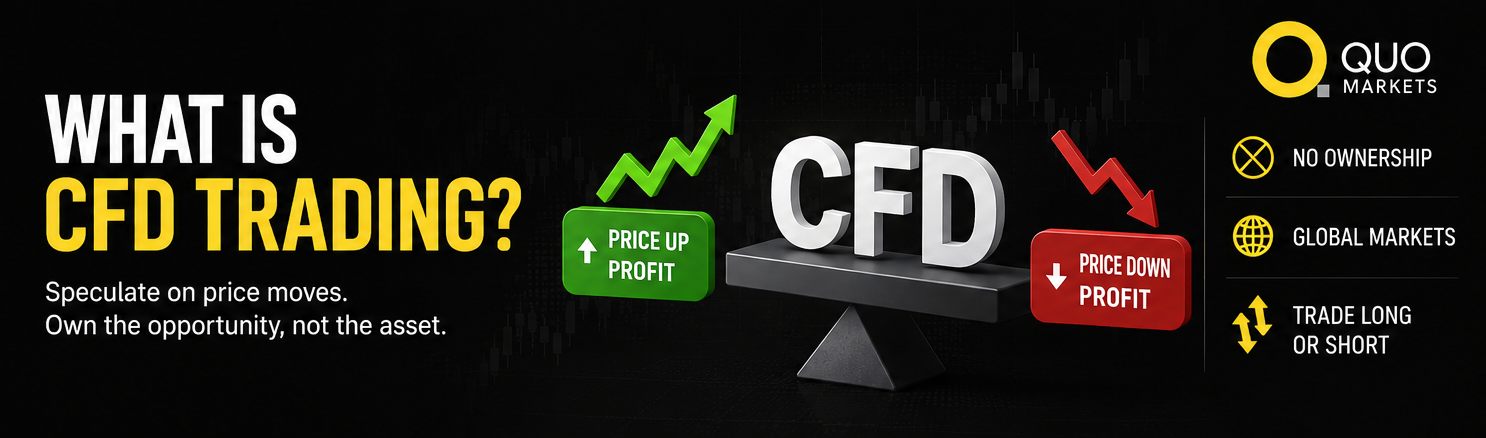
CFD trading is a type of derivative, meaning its value is derived from something else, the underlying asset, rather than being the asset itself. Whether you’re looking at company shares, currency pairs, gold, or crypto, the principle stays the same: you never actually own what you’re trading. You’re simply taking a position on which direction the price will move.
Here’s a practical example. Say you think Tesla shares are about to climb. With a traditional brokerage, you’d buy the shares outright, pay full price, and hold them. With a CFD, you tell your broker you want to open a position tied to Tesla’s price movement. If the share price goes up, your broker pays you the difference. If it drops, you pay them. It’s all about the price change, not ownership.
This also means there are no voting rights or dividends attached to your position. But on the flip side, there’s no stamp duty to worry about and no complicated physical delivery of assets. The whole system is built to mirror the price behavior of the real market, so you can stay entirely focused on direction and timing.
Going Long, Going Short – You Choose
One of the biggest things that sets CFD trading apart from traditional investing is that you’re not forced to wait for markets to rise. Open a long position if you think an asset’s price is heading up. Open a short position if you think it’s heading down. Either way, you’re in the game.
This means CFD traders can stay active and potentially profitable whether markets are booming or taking a hit – a flexibility that most traditional approaches simply don’t offer.
The Markets You Can Access
CFDs cast a wide net when it comes to what you can trade. Through a single account, you can access:
- Stocks
- Indices
- Commodities like gold, oil, and silver
- Forex currency pairs
- Cryptocurrencies
That range of options gives traders room to build strategies across multiple sectors without juggling accounts on different platforms.
The Vocabulary You Need to Know
Before you place your first trade, get comfortable with the language. These terms show up on every platform and in every conversation about CFD trading.
Margin
Margin is the deposit you put down to open a leveraged position. Think of it as collateral rather than a fee. Brokers typically express it as a percentage of the total trade value – so with a 5% margin requirement, you could open a $10,000 position for just $500.
Leverage
This is what makes margin possible. Leverage is expressed as a ratio of 1:30, for instance, meaning every dollar in your account controls thirty dollars in the market. It cuts both ways: leverage magnifies profits when trades go your way, and it magnifies losses when they don’t. This is why it’s so often called a double-edged sword, because that’s exactly what it is.
Spread
The spread is the gap between the price you can buy at (ask) and the price you can sell at (bid). When you open a trade, that gap means you’re already slightly offside. Spreads vary depending on the asset and how volatile the market is at any given moment, and for many brokers, the spread is their primary source of revenue.
Pip
Mostly relevant in forex, a pip (percentage in point) is the smallest standard price movement in a currency pair, usually the fourth decimal place. Traders use pips to measure gains and losses and to set precise entry and exit points. A shift in EUR/USD from 1.1000 to 1.1001 represents exactly one pip.
Financing Costs
Hold a position overnight, and you’ll encounter swap rates, also called financing costs. Because leveraged trading involves borrowed capital, brokers charge interest on positions that stay open past a set daily cutoff. Depending on the currencies involved, you might pay this charge or occasionally receive a small credit. Either way, these costs add up, which is why CFDs are generally better suited to shorter-term strategies than long-term holds.
How to Place Your First CFD Trade
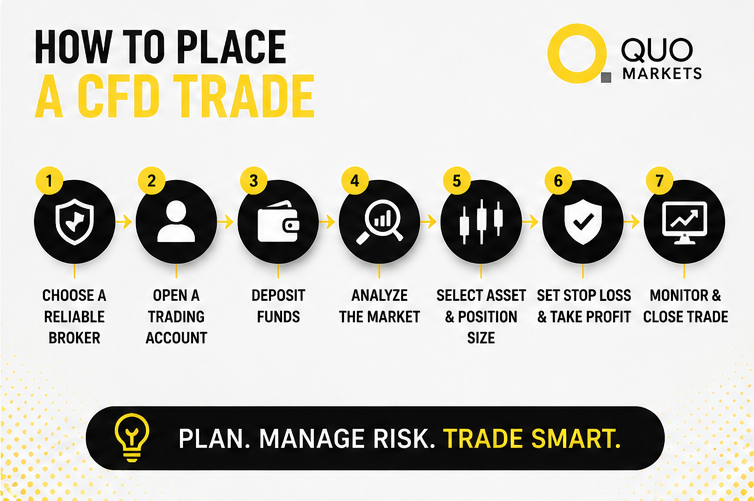
Walking into your first trade without a plan is how most beginners run into trouble fast. Here’s a clear path forward.
Step 1: Find a Broker You Can Trust
Start with a regulated broker that offers transparent pricing, solid market data, and a platform that doesn’t make you feel like you need a manual just to log in. The platform you choose will be your trading home – it needs to work reliably and give you the information you need when you need it.
Step 2: Open Your Trading Account
Expect to verify your identity and answer questions about your investment experience, financial situation, and appetite for risk. Most regulated brokers require this before you can fund an account. Many will also let you open a demo account right away, which is where you should spend serious time before going live.
Step 3: Fund Your Account
Once approved, deposit your starting capital. This becomes the base from which your margin requirements are drawn whenever you open a position.
Step 4: Read the Market
No good trade happens without preparation. Review economic data, run technical analysis, and watch how market conditions are shifting. Decide which approach fits your style: trend following, breakout trading, range trading, swing trading, news-based trading, and apply it consistently.
Step 5: Pick Your Asset and Size Your Position
Choose what you want to trade, then decide how large a position you’re comfortable taking. This step should always be guided by your risk tolerance, not by how confident you feel about a particular trade.
Step 6: Set Your Stop Loss and Take Profit
This step isn’t optional for serious traders. A stop loss automatically closes your trade if the price moves against you beyond a level you’ve chosen – it’s your safety net. A take-profit order locks in your gains once the market hits your target. Together, these tools are the foundation of sound risk management.
Step 7: Watch, Adapt, and Close
Once you’re in a trade, monitor it, but don’t obsess. Track how the market is moving, be ready to adjust your thinking if conditions change, and when it’s time to exit, simply place the opposite order to close your position.
Benefits of CFD Trading
The appeal of CFD trading comes down to a few things that traditional investing just doesn’t offer in the same way.
The ability to profit from falling markets is genuinely powerful. Most investment products require prices to go up for you to make money. CFDs let you take a position on the downside, which means market downturns can be opportunities rather than just losses on paper.
Leverage stretches your capital further. Instead of tying up a large amount of cash in a single position, you can open trades across multiple markets simultaneously with a fraction of the capital you’d need in a traditional account.
Global access from a single platform is another major draw. German indices, US tech stocks, Australian commodities, Japanese currency pairs – in most cases, you can reach all of them through one CFD account, without managing different accounts or navigating foreign exchange logistics just to place a trade.
And the sheer variety of available markets- stocks, forex, commodities, indices, crypto – means there’s nearly always something worth watching, regardless of where the economic cycle happens to be.
The Risks Are Real – Here’s How to Manage Them
Anyone who tells you CFD trading is easy is either inexperienced or selling something. The risks are genuine and deserve honest attention.
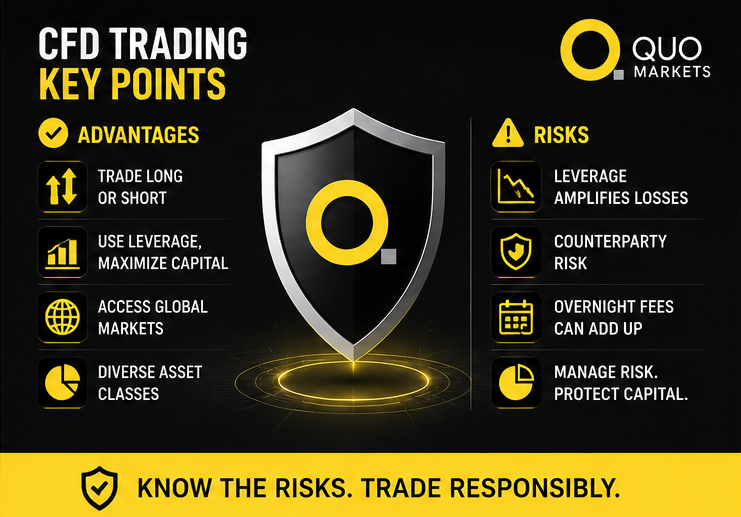
Leverage is the biggest one. The same mechanism that can grow your gains quickly can also accelerate your losses, sometimes beyond your initial deposit. This isn’t a worst-case scenario buried in fine print; it happens to traders who take on too much too fast without protective measures in place.
Counterparty risk is also worth understanding. Because you trade directly with your broker rather than through a centralized exchange, you’re dependent on that broker’s stability and integrity. If they run into financial trouble, your positions are at risk. Regulated brokers are subject to capital requirements and regulatory oversight, which is exactly why trading with an unregulated provider is a gamble you don’t need to take.
Overnight financing costs can quietly erode a trade that’s technically going your way. If you’re holding a position for an extended period, factor swap rates into your math from the beginning rather than discovering them when you close out.
Managing these risks isn’t complicated, but it does require discipline. Use stop losses on every single trade – no exceptions. Keep your position sizes modest, especially early on. Most experienced traders recommend risking only a small slice of your total capital on any one trade, so a bad run doesn’t take you out of the business entirely. And spread your exposure across different asset classes so that a shock in one sector doesn’t collapse your whole account.
Final Thoughts
CFD trading isn’t a shortcut to wealth, but it is a genuinely flexible and accessible way to participate in global markets for traders who go in prepared. The ability to profit in both directions, access diverse markets through a single account, and leverage your capital efficiently makes it worth learning. The risks, however, are proportional to those opportunities, and the learning curve, while manageable, is real.
If you’re just starting, the most valuable thing you can do is spend real time on a demo account first. Practice your approach. Get comfortable with the platform. Test how your risk management holds up when trades go sideways. Once you’ve done that groundwork, choose a regulated broker, keep your leverage conservative at the start, and treat every trade, win or lose, as something to learn from. The traders who succeed in CFD markets long-term are rarely the most aggressive. They’re the most consistent.
FAQs
What is CFD trading in simple terms?
It’s a way to speculate on price movements without owning the actual asset. You enter a contract with your broker based on the difference between the opening and closing price of an asset – that difference is your profit or your loss.
Why does risk management matter so much in CFD trading?
Because leverage amplifies everything – gains and losses. A clear risk management plan, including stop-loss orders and controlled position sizing, is what keeps a losing trade from becoming a devastating one.
Are CFD trading profits taxable?
That depends on where you live. Many jurisdictions treat CFD profits as taxable income or capital gains. Check with a local tax advisor or the relevant authority in your country to understand exactly what applies to your situation.
Can beginners start CFD trading safely?
Yes, but safely means starting on a demo account, not a live one. Practice with a platform that simulates real market conditions until you’re confident in your strategy and your risk management approach before putting real money on the line.
What markets can be traded with CFDs?
A wide range: stocks, commodities, indices, crypto, and forex currency pairs, usually all accessible from a single trading account.