
Table Of Contents
- Introduction
- Why CFD Risk Management Matters
- Understand Your Leverage Exposure
- Position Sizing
- Using Stop Losses
- Negative Balance Protection
- Diversification and Correlation Risk
- A Simple Risk Checklist Before You Trade
- Conclusion
- FAQs
Introduction
CFDs are leveraged instruments, and leverage cuts both ways. A small deposit can control a much larger position, which means gains and losses are both magnified compared to buying an asset outright. That is not a reason to avoid CFDs altogether, but it is exactly why CFD risk management deserves more attention than most traders give it before they place their first order.
This guide is not a pitch to convince you that CFD trading is risk-free, because no honest guide could make that claim. It is a practical toolkit. If you are still getting familiar with how CFDs work at a basic level, our beginner’s guide to CFD trading covers the fundamentals first, and it is worth reading before you dive into the risk controls below.
Why CFD Risk Management Matters
When you trade an unleveraged asset, your maximum loss is generally limited to what you put in. CFDs work differently. Because you are trading on margin, a relatively small price move against your position can produce a loss that is disproportionate to your initial outlay. This is the core reason CFD trading risks are structurally different from the risks of, say, buying shares directly.
Good risk management does not eliminate this dynamic. What it does is give you a set of decisions you can make in advance, before emotion or a fast-moving market takes the decision out of your hands. Position size, stop loss placement, and how much leverage you actually use are all choices, not fixed conditions of the trade.
Understand Your Leverage Exposure
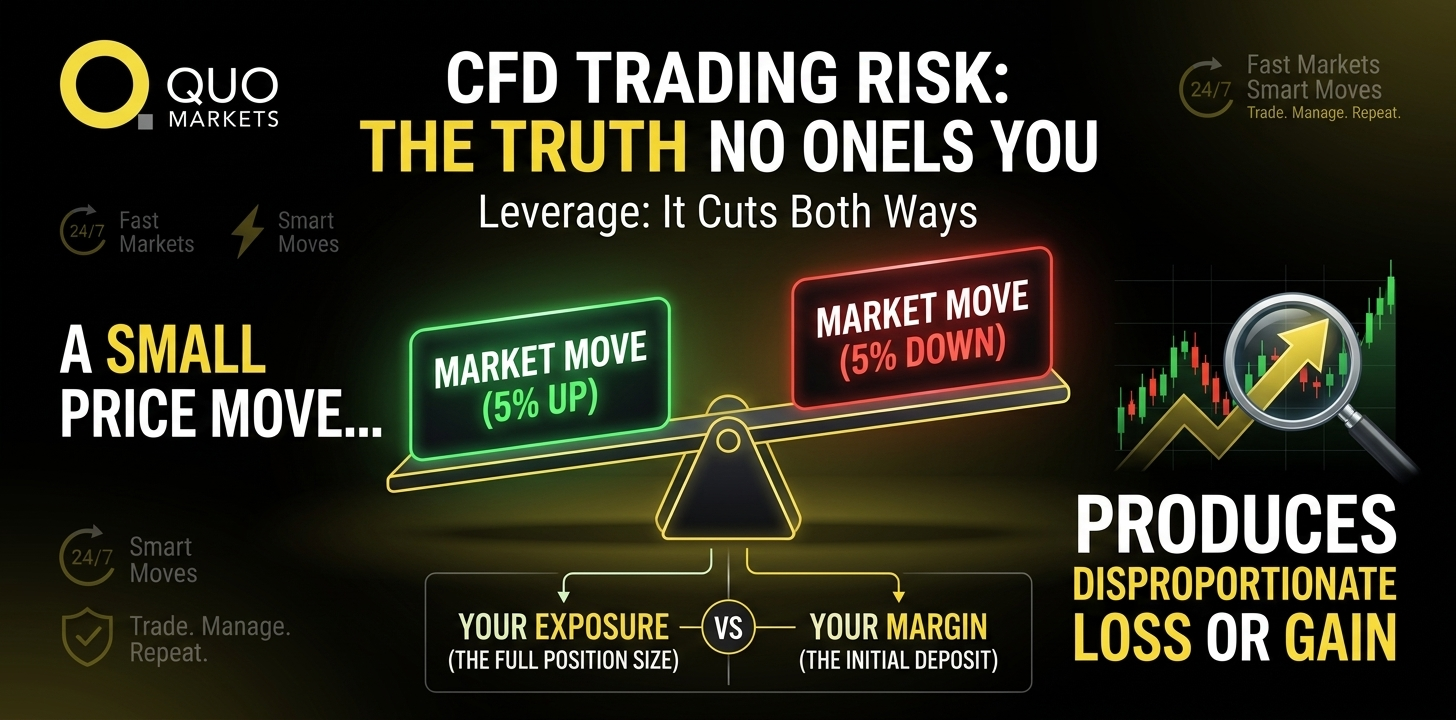
Leverage lets you open a position worth more than your account balance by putting down a fraction of the total value as margin. If the market moves in your favor, your return is calculated on the full position size, not just your margin, which is why CFD leverage is often described as amplifying gains. The same mechanism amplifies losses in exactly the same proportion.
It helps to think of leverage as a multiplier applied to whatever the market does, rather than as a tool that improves your odds. A five percent move against a leveraged position does not cost you five percent of your capital. Depending on how much leverage you are using, it can cost you a much larger share of it. Understanding your actual exposure, meaning the full value of the position you control, rather than just the margin you have put up, is the starting point for every other decision in this guide.
Position Sizing
One of the most practical levers you have is how much of your account you commit to any single trade. Rather than sizing a position around the maximum leverage your account allows, it is worth working backward from your account balance and deciding how much of it you are willing to have exposed to a single trade going wrong.
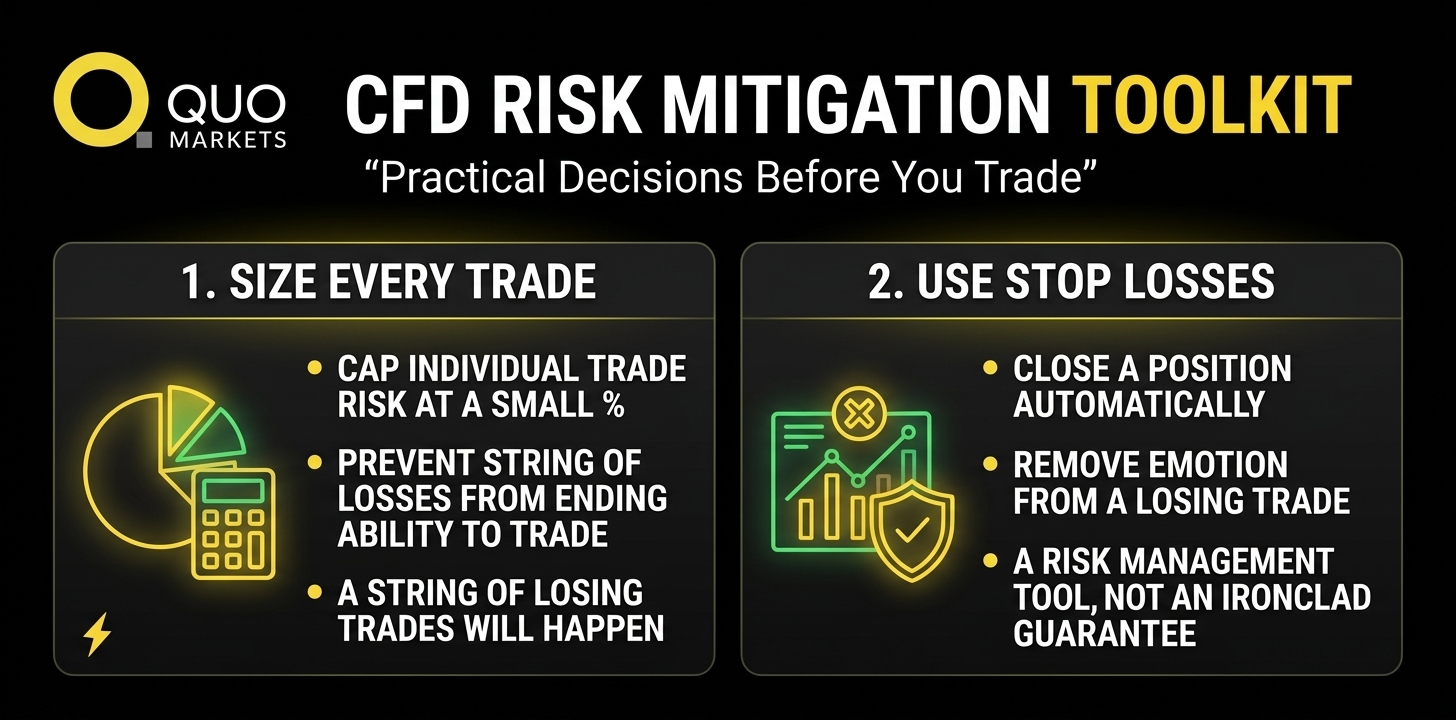
Many experienced traders cap individual position risk at a small percentage of total account equity, precisely because it keeps any one trade from being able to do serious damage to the account as a whole. This is not about being timid. It is about making sure that a string of losing trades, which will happen to every trader eventually, does not end your ability to keep trading.
Using Stop Losses
A stop loss is an instruction to close a position automatically once the price reaches a level you have set in advance. Mechanically, it removes the need to watch a position constantly, and it takes some of the emotional decision-making out of a losing trade.
It is worth being clear-eyed about what a stop loss does and does not guarantee. In fast-moving or gapping markets, price can move past your stop level before the order actually executes, meaning your position may close at a worse price than the one you set. A stop loss is a risk management tool, not an ironclad guarantee of exit price, and treating it as the latter can lead to unpleasant surprises during volatile sessions.
Negative Balance Protection
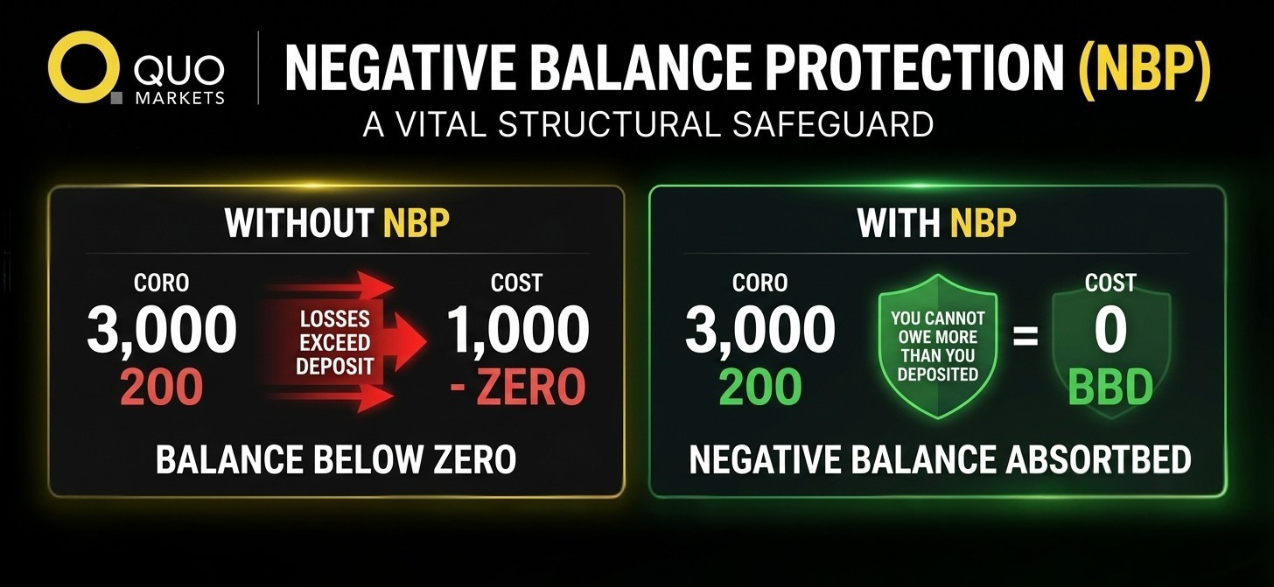
Negative balance protection, often shortened to NBP, is a structural safeguard that prevents your account balance from going below zero, even in extreme market conditions where losses could otherwise exceed your deposited funds.
Here is how it works in practice. Say a client deposits one hundred dollars into a trading account. The market then moves sharply against an open position, and without any protection in place, the account balance would fall to negative twenty-five dollars. The client then deposits another one hundred dollars to keep trading. With negative balance protection in place, the full one hundred dollars is available to trade, because the negative balance was absorbed rather than carried forward. Without that protection, only seventy-five dollars would be available, since the shortfall would be deducted from the new deposit.
NBP does not prevent losses, and it will not stop a losing position from costing you the funds already in your account. What it does is set a floor, so you cannot end up owing more than you deposited.
Diversification and Correlation Risk
It is tempting to think of diversification purely in terms of holding different instruments, but correlation matters just as much as variety. Two positions that appear unrelated on paper can move together closely if they are both sensitive to the same underlying driver, whether that is a currency, a commodity, or broader market sentiment.
Concentrating exposure across several correlated instruments can quietly recreate the same risk as holding one oversized position, even if it does not look that way on your trade list. Before opening a new position, it is worth asking whether it genuinely diversifies your existing exposure or simply duplicates it under a different name.
A Simple Risk Checklist Before You Trade
Before entering a new position, a short checklist can catch the mistakes that tend to happen when a trade feels urgent.
- Confirm your position size relative to your total account balance, not just the maximum size your leverage allows.
- Set a stop loss at a level that reflects your risk tolerance, and understand that execution can occur at a different price in fast markets.
- Check whether the position adds correlated exposure to trades you already hold.
Only commit capital you can afford to lose, since CFDs can result in losses that exceed the amount initially deposited on accounts without negative balance protection.
Conclusion
None of the tools covered here turn CFD trading into a risk-free activity, and no combination of stop losses, position sizing rules, or negative balance protection changes that. What they do is give you a repeatable process for deciding how much risk you are taking on and where your limits sit, rather than discovering those limits the hard way. Risk management is a discipline you apply consistently, not a guarantee against loss.
Disclaimer: CFDs are complex instruments and come with a high risk of losing money rapidly due to leverage. You should consider whether you understand how CFDs work and whether you can afford to take the high risk of losing your money.
FAQs
What is the risk in CFD trading?
The main risk is that leverage magnifies both gains and losses, so a relatively small market move can produce a loss that is large relative to your initial deposit. On accounts without negative balance protection, losses can exceed the funds you originally deposited.
Why does high leverage increase CFD trading risk?
Leverage means you control a position larger than your account balance. Because profit and loss are calculated on the full position size, a given percentage move in the market translates into a larger percentage change in your account equity, which increases both potential reward and potential loss.
How do you manage risk in CFD trading?
Common tools include sizing positions relative to account balance rather than maximum available leverage, setting stop losses in advance, checking for correlation between open positions, and only trading with capital you can afford to lose.
How do professional traders manage risk in CFD trading?
Professional traders tend to apply the same core principles consistently, including strict position sizing rules, predefined stop loss levels, and ongoing monitoring of correlated exposure across their open positions, rather than adjusting their approach trade by trade based on how confident they feel.
Is CFD trading safe?
CFD trading is not safe in the sense of being free from risk. It is a leveraged product, which means losses can happen quickly and can be large relative to your initial deposit, and on accounts without negative balance protection, losses can exceed what you originally deposited.
What are the benefits and risks of CFD trading?
CFDs let traders gain exposure to price movements across markets like shares, indices, and currencies without owning the underlying asset, and leverage means a trade can be opened with a smaller upfront deposit than buying the asset outright would require. The tradeoff is that the same leverage that reduces the capital needed to open a position also magnifies losses, so a small adverse price move can produce a loss that is large relative to your deposit.