
CFD Leverage: What QuoMarkets’ Dynamic, Fixed & LIMITLESS Options Actually Mean for Your Trades
Ask five traders what CFD leverage means to them, and you’ll probably get five different answers. For some, it’s the reason they can trade at all with a modest deposit. For others, it’s the reason a single bad move can wipe out an account faster than expected. Both reactions make sense, because leverage isn’t good or bad on its own. It’s a multiplier. It scales up whatever you put into a trade, good decisions and bad ones too.
QuoMarkets doesn’t hand every trader the same CFD leverage number regardless of what they’re trading or how much. Instead, there are three distinct structures at play – Dynamic Leverage, Fixed Leverage, and LIMITLESS Leverage – and which one you’re working with depends on your account type and the instrument in question.
Let’s walk through what each one means in practice, with real numbers, so you can trade with a clear picture of your CFD margin and risk rather than guessing.
The Basic Idea: What CFD Leverage Actually Does
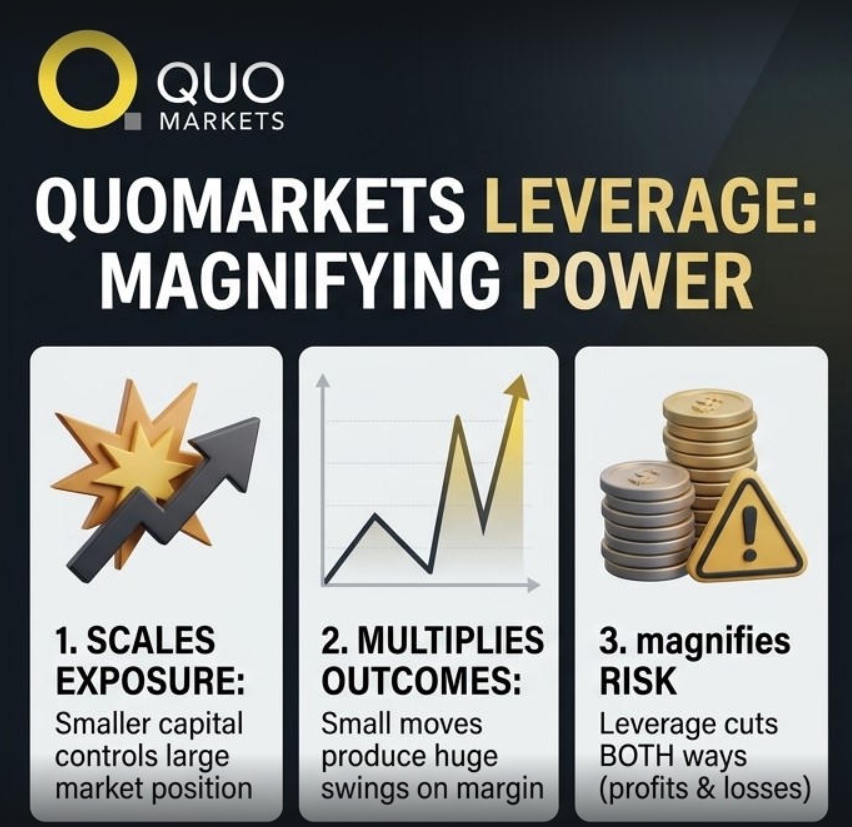
CFD leverage is simple: it lets you control a position bigger than the cash sitting in your account. You put down a slice of the position’s value, called CFD margin, and that slice gives you exposure to a much larger amount. At 1:30 leverage, for instance, every $1 of your own money controls $30 of market exposure.
This works because a CFD (contract for difference) never involves owning the underlying asset – you’re purely speculating on price movement, which is why CFD margin and leverage are built to work together. The “initial margin” opens the trade; the “maintenance margin” keeps it open as prices shift.
Quick example: Open a $100,000 position at 1:30 leverage, and your required margin comes out to roughly $3,333 – your capital controlling thirty times that in exposure. At 1:20 leverage, a 1% move in the market translates to roughly a 20% swing on your margin, before costs. At 1:10, a 5% price move becomes a 50% swing on your margin. That’s how leverage affects CFD trading: it compresses a small market move into a much bigger outcome on the money you actually put down, for better or worse.
CFD margin requirements themselves aren’t fixed across the board. They shift with the asset, your jurisdiction, account type, instrument, leverage level, position size, and even short-term market conditions. As a general guide: major forex pairs usually sit at 2–5% margin, commodities like oil closer to 10%, cryptocurrencies as low as 2% depending on the platform, and indices somewhere between 5–10%. The pattern behind these numbers is volatility: the more an asset tends to swing, the bigger the cushion needed to protect both trader and broker.
What You Need to Know Before You Trade on Margin
A few mechanics apply across every QuoMarkets account type – Raw, Standard, Zero, or Limitless:
- Lot size is standardized. One lot always equals 100,000 units of the base currency.
- Margin calls happen at 100% equity. Once your account equity drops to 100% of the required margin, that’s your signal to add funds, cut exposure, or close positions.
- Stop-out follows at 20% (0% for THB-denominated accounts) – this is where the platform starts closing positions automatically to stop further losses.
- Negative balance protection has your back. If a position gaps or spikes hard against you, it’s technically possible to lose more than your deposit. This protection resets your account to zero instead of letting it go negative.
- Heavily hedged accounts can hit a quirk. If equity runs low while you’re holding multiple hedged trades, MT5 may block you from closing a position due to “insufficient funds”, even though closing it is the goal. This isn’t a bug; it’s a safeguard against negative balances, and a small top-up usually resolves it.
With those basics in place, here’s where it gets more interesting, because not every instrument plays by the same leverage rules.
Three Ways QuoMarkets Structures Leverage
1. Dynamic Leverage – scales with your volume
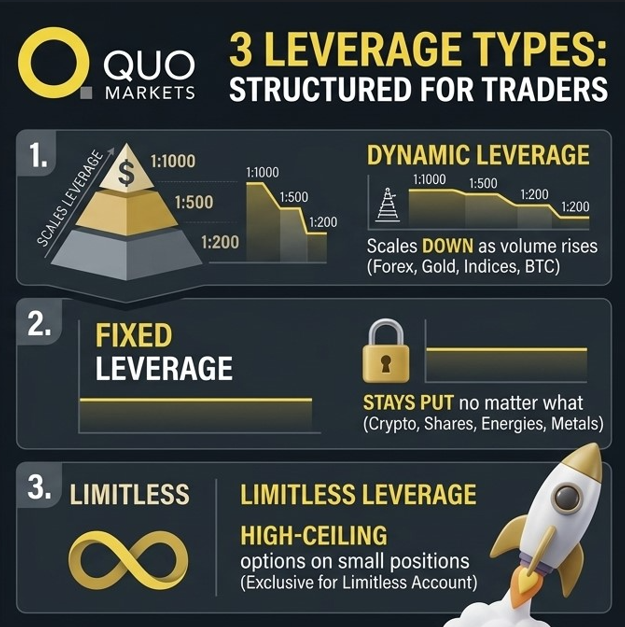
Available on Raw, Standard, Zero, and Swap-Free accounts, Dynamic Leverage applies mainly to Forex, Gold, Indices, Mini Index, and BTCUSDT CFDs. Instead of a flat number, it steps down as your total volume across open positions increases:
- Forex & Gold: up to 1:1000 (0–5 lots) → 1:500 (5–10 lots) → 1:300 (10–20 lots) → 1:200 (beyond 20 lots)
- Indices & Mini Index: starts at 1:500, easing to 1:100 at higher volumes
- BTCUSDT: its own tiered scale, starting at 1:333
Why it matters: as your exposure grows, the system automatically tightens leverage, which helps guard against surprise margin calls, but it also means your margin requirement climbs as you scale up. Know your tier before you add to a position.
2. Fixed Leverage – stays put no matter what
This applies to Crypto CFDs and Shares (1:5), Energies (1:100), and Metals other than Gold (1:100). Since it doesn’t move with volume, Fixed Leverage is the more predictable option if you want your margin requirement to stay put as a position grows.
3. LIMITLESS Leverage – the high-ceiling option
Exclusive to the Limitless account, this covers Forex, Gold, Silver, and select indices/commodities (DJI30, SP500, NASUSD, D40EUR). For small positions (0 – 0.5 lots), leverage starts at a minimum of 1:10,000,000, about as close to zero margin requirement as a retail account gets, before scaling down through 1:1500, 1:750, 1:333, and finally 1:100 past 20 lots. BTCUSDT under LIMITLESS runs a parallel scale, starting near-infinite before easing to 1:50 at higher volumes.
Regulatory guardrails that apply regardless of tier:
- Every day, 23:25–01:30 server time, ZERO and LIMITLESS accounts see leverage on newly opened positions temporarily reduced to 1:250 (existing positions aren’t affected).
- Similar temporary adjustments apply around rollover windows for instruments like XAUUSD, XAGUSD, and NGCUSD.
- If account equity drops below a threshold (10 USD/EUR/GBP, 1,500 JPY, or 350 THB), new-position leverage is automatically capped at 1:250.
QuoMarkets’ compliance team can adjust LIMITLESS status down to a standard 1:100 following a suitability review, when it’s judged to be in the client’s best interest.
Putting the Tiers in Context
A trader in the 0 – 5 lot Forex/Gold bracket at 1:1000 leverage is operating under a very different margin requirement and risk profile than one who’s scaled into the 1:200 tier past 20 lots. That step-down isn’t a penalty; it’s dynamic leverage doing its job, tightening the safety margin automatically as exposure grows.
Your CFD Leverage Safety Checklist
- Don’t default to maximum leverage. A lower ratio than your account’s ceiling gives you a bigger buffer before a margin call becomes a real risk.
- Always set a stop-loss. No exceptions; it’s the most direct way to cap damage on a trade that turns against you.
- Size positions around your equity, not your leverage ceiling. A common guideline is risking just 1–2% of account balance per trade.
- Diversify across asset classes. Spreading exposure lowers the odds that one market event takes out a concentrated bet.
- Know your tier before scaling up. Because leverage steps down as volume rises, your margin requirement can shift mid-strategy if you’re not tracking it.
Final Takeaway
CFD leverage isn’t inherently risky or inherently rewarding – it’s a multiplier, and the outcome depends on the discipline behind the trade. QuoMarkets’ three-tier system gives you real flexibility: Dynamic Leverage that adapts to your volume, Fixed Leverage that holds steady for specific assets, and LIMITLESS Leverage for traders who want extreme ratios on smaller positions. None of it replaces sound position sizing, a clear read on your CFD margin, and consistent risk management – it just gives you more precise tools to work with, provided you know which tier you’re in.
FAQs
How does leverage affect CFD trading?
Leverage lets you control a much larger position than your deposit alone would allow, which magnifies the effect of every price move, both up and down. A small percentage shift in the underlying market translates into a much bigger percentage swing on the margin you’ve put down. That’s why leverage is often described as a multiplier: it doesn’t change the market’s direction, just the size of the outcome for your account.
How does QuoMarkets decide which leverage type applies to my trade?
It comes down to your account type and the instrument you’re trading. Dynamic Leverage covers Forex, Gold, Indices, Mini Index, and BTCUSDT on Raw, Standard, Zero, and Swap-Free accounts. Fixed Leverage applies to Crypto CFDs, Shares, Energies, and Metals other than Gold. LIMITLESS Leverage is exclusive to the Limitless account and covers Forex, Gold, Silver, and select indices/commodities.
Why does leverage go down as I trade bigger positions?
This is Dynamic Leverage’s built-in risk management. As your total volume across open positions increases, the leverage tier steps down; for example, Forex and Gold drop from 1:1000 to 1:500 once you cross 5 lots. It’s designed to keep margin requirements proportional to your growing exposure.
Is higher leverage automatically riskier?
Not on its own. Higher leverage lets you control a bigger position with the same margin, which can amplify gains and losses, but your actual risk comes down to position size, account equity, and how the market moves, not the leverage number in isolation.
What actually happens if a trade moves against me?
If losses push equity below the required margin, a margin call or stop-out kicks in, and positions may close automatically to limit further loss. Negative balance protection then ensures your account can’t go below zero.
What’s the simplest way to trade leverage safely?
Use less than the maximum available, put a stop-loss on every trade, and size positions based on your account equity – not on how much leverage you technically have access to.
Disclaimer: Trading CFDs, including oil and other commodities, involves a high level of risk and may not be suitable for all investors. Leverage can work both for and against you, magnifying both profits and losses. Past performance is not a reliable indicator of future results. Please make sure you understand the risks involved and seek independent financial advice if necessary before trading.
Available leverage can vary depending on your jurisdiction, regulatory status, and account conditions. The leverage figures described here reflect the conditions published by QuoMarkets and may not apply to every client.