
What Is the S&P 500? Meaning, History, and How to Trade It
The S&P 500 is the most widely followed stock market index on the planet, and for good reason. For CFD traders, it offers a single instrument to express a view on the entire U.S. economy. Let’s break down how the index works, why it moves, and how to trade it through CFDs on QuoMarkets.
Key Takeaways
- The S&P 500 is a market capitalization-weighted stock market index that tracks 500 of the largest publicly traded companies in the United States.
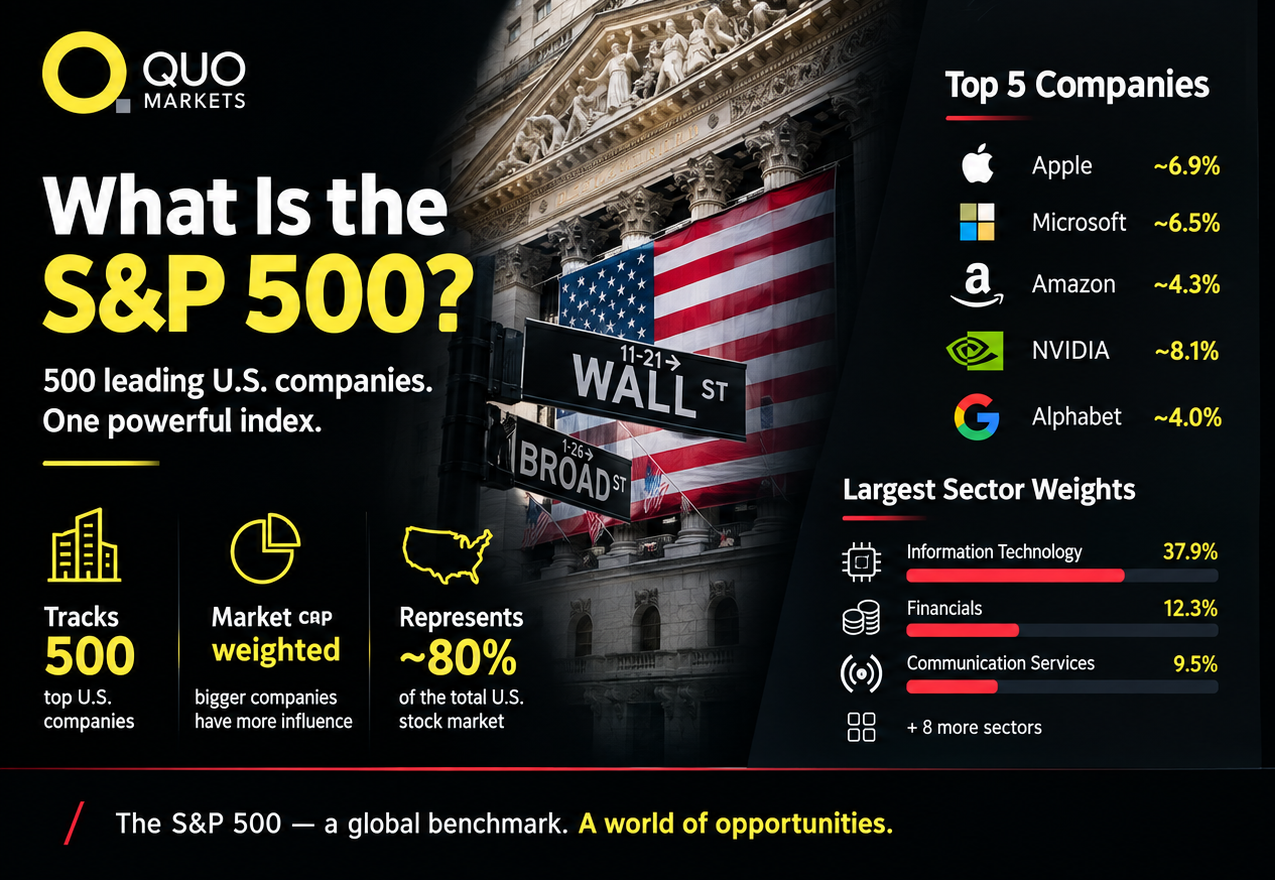
- Mega-cap names like Apple, Microsoft, Amazon, NVIDIA, and Alphabet dominate the index’s weight, meaning larger companies have a greater influence on index movements than smaller companies.
- Core advantages of S&P 500 CFDs include high liquidity, tight spreads, nearly continuous trading during U.S. sessions, and the ability to hedge stock portfolios.
What Is the S&P 500 Index?
The S&P 500 is a U.S. stock market index that tracks 500 of the largest publicly traded American companies by free-float market cap. It is maintained by S&P Dow Jones Indices and is considered a key benchmark for the overall U.S. economy.
- The name stands for Standard & Poor’s 500. The S&P 500 was launched in March 1957 by Standard & Poor’s (originally the Standard Statistics Company, which merged with Poor’s Publishing). Today it is used by global wealth management firms, institutional investors, and active traders as a primary performance benchmark.
- As of February 2026, the S&P 500 index includes 503 stocks due to multiple share classes. Alphabet, for example, has two share classes (Class A and Class C) that both appear in the index. The index captures about 80% of the total U.S. stock market value.
- The S&P 500 acts as a “one-number” barometer for U.S. stock market performance and broader economic sentiment, which is why many investors and traders watch it every single trading day.
How the S&P 500 Is Built: Market Cap, Sectors, and Companies
Understanding how the index is constructed helps traders see why some companies have a much larger impact on its movements than others.
- The S&P 500 is a float-adjusted, market-capitalization-weighted index. Companies with larger float-adjusted market values receive larger index weights, so their share-price movements have a greater effect on the benchmark.
- As of August 31, 2026, the index had 503 constituents, with the top 10 accounting for 37.8% of its total weight. NVIDIA was the largest constituent at 8.1%.
- The index covers all 11 GICS sectors. Information technology currently has the largest sector weight at 37.9%, followed by financials at 12.3% and communication services at 9.5%.
- Companies considered for inclusion must meet requirements covering U.S. domicile, eligible exchange listing, market capitalization, liquidity, public float, and financial viability. For new additions, S&P’s current methodology includes a minimum unadjusted market capitalization threshold of $22.7 billion, along with additional float and liquidity requirements.
- Meeting the eligibility requirements does not automatically guarantee inclusion. The S&P Index Committee also considers factors such as sector balance and index turnover when selecting constituents.
- The S&P 500 is rebalanced quarterly in March, June, September, and December, while constituent changes can also be made when needed between scheduled rebalances.
Why the S&P 500 Matters for CFD Traders
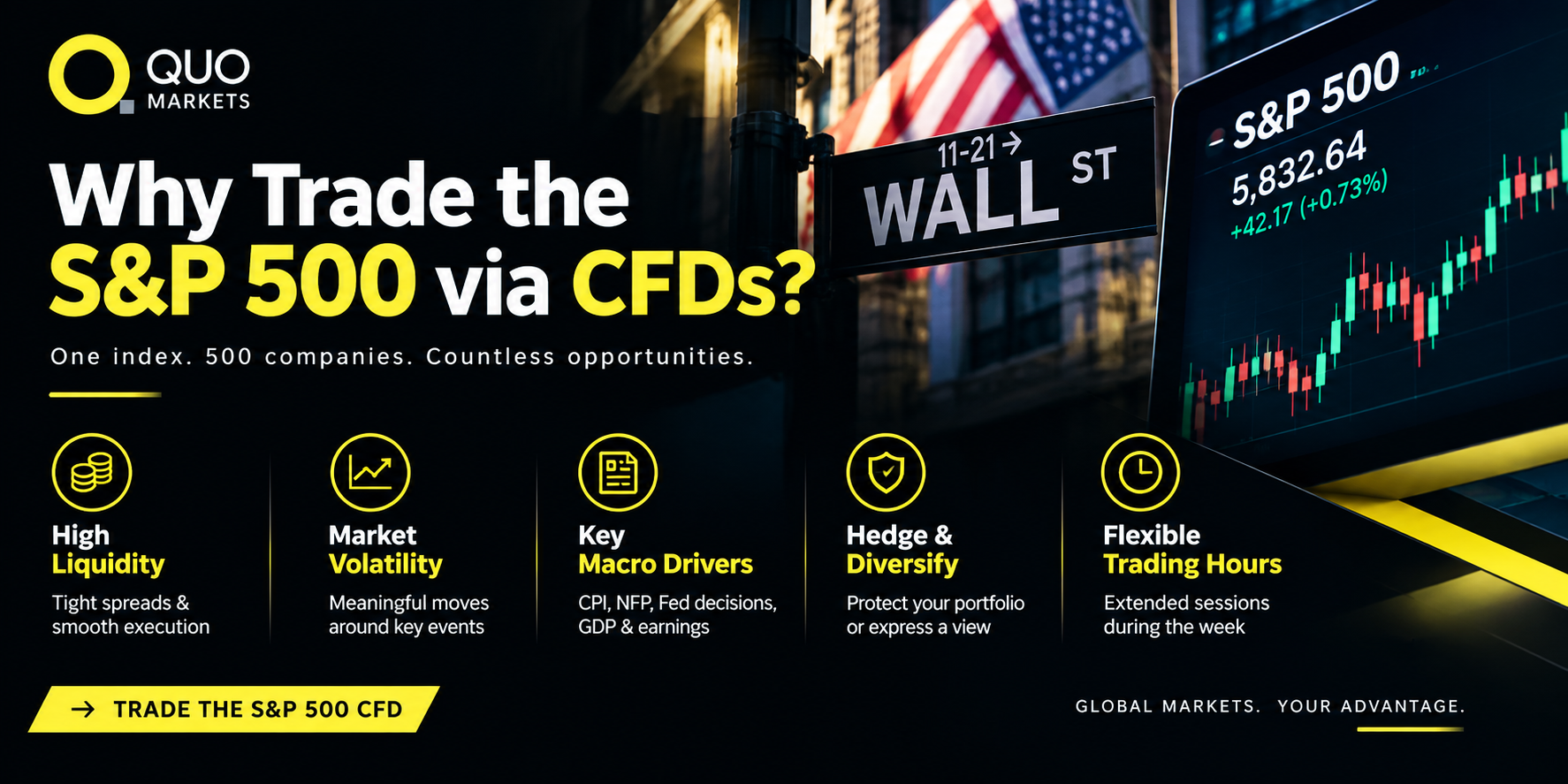
Moving from investor language (index funds, exchange-traded funds) to active trading language, here is why the S&P 500 is one of the most traded index CFDs globally:
- Liquidity: S&P 500 futures and related instruments trade enormous volumes during U.S. market hours. For CFD traders, this typically translates into tight spreads and smoother price action compared with thinner markets on individual stocks.
- Volatility profile: The index is generally less explosive than single tech stocks, yet still delivers meaningful intraday swings around macro data releases. Major macroeconomic data releases can cause sharp volatility in the S&P 500.
- Macro drivers: Key catalysts to track include U.S. CPI, Non-Farm Payrolls, Fed interest rate decisions, GDP growth, and earnings from top-weighted firms. The S&P 500 is influenced by factors such as corporate earnings and Federal Reserve policy.
- Hedging and correlation: S&P 500 CFDs are frequently used to hedge U.S. stock portfolios or to express a directional view on the broader market without picking individual stocks across all the companies in the index.
- Time-of-day effects: Expect higher activity and tighter trading conditions around the London–New York overlap and at the official U.S. cash market open (09:30–16:00 New York time on each trading day).
How to Trade the S&P 500 via CFDs on QuoMarkets
Unlike long-term investing in index funds, CFD trading on the S&P 500 lets you speculate on short-term price moves up or down with leverage. QuoMarkets offers S&P 500 index CFDs alongside other global indices.
Step-by-step on QuoMarkets:
- Open and verify a QuoMarkets trading account following the firm’s KYC/AML requirements.
- Fund the account and launch your chosen trading platform (MT4 or MT5).
- Search for the S&P 500 CFD symbol (e.g., SPXUSD or the platform’s equivalent) and add it to your Market Watch list.
- Open a chart, choose a timeframe (M5 to H4 for intraday, D1 for swing trading), and apply your preferred technical indicators.
- Decide whether to go long (Buy) or short (Sell) based on your analysis. Select position size carefully given leverage, set stop-loss and take-profit levels, and place the order.
- Monitor margin level and open P&L. Adjust or close ahead of key news if needed.
Costs and leverage: QuoMarkets offers dynamic leverage on most account types-higher leverage increases both potential profits and potential losses. Trading costs typically include spread, possible commissions depending on account type, and overnight financing fees. CFDs can incur overnight financing fees if positions are held past market close.
Key S&P 500 CFD Trading Considerations and Strategies
Risk management:
- Risk only 0.5–2% of account equity per trade and always set a predefined stop-loss.
- Understand contract specifications on your platform (tick value, minimum lot size, margin requirements) before increasing position size.
- Avoid over-leveraging. Maintain a comfortable margin buffer to reduce the chance of margin calls or forced liquidation.
Short-term trading:
- Scalping and day trading work best around the U.S. open, key economic data, and Fed announcements, focusing on intraday support/resistance and volatility spikes.
- Keep technical tools simple and repeatable: moving averages, RSI, MACD, or clean price action patterns for entries and exits.
Swing trading and macro positioning:
- Hold positions for several days to weeks around macro themes-Fed rate cycles, inflation trends, earnings seasons, or recession-versus-soft-landing narratives.
- Combine higher-timeframe chart analysis (daily and weekly trends) with fundamental views on the U.S. economy and growth outlook.
Hedging: An equity investor could open an S&P 500 CFD short as a partial hedge against downside risk in a portfolio of U.S. stocks. Account for basis risk and overnight financing costs.
No strategy is guaranteed. Backtesting and demo trading can help refine an approach. Adapt to your own time zone, risk tolerance, and experience level.
FAQ
Can I trade the S&P 500 index directly on an exchange?
No. The index itself is a mathematical construct, not a tradable security. You trade derivatives or products based on it-such as CFDs, futures, options, index funds, and ETFs. On QuoMarkets, you trade S&P 500 CFDs that mirror the index’s price movements without owning the underlying publicly traded companies.
What are typical trading hours for S&P 500 CFDs?
The underlying U.S. stock market for S&P 500 companies trades from 09:30 to 16:00 New York time on business days, but index CFDs are often available for extended or nearly 24-hour sessions during the work week. Check the specific S&P 500 CFD trading hours inside your QuoMarkets platform or on the product specification page, as CFD session times can differ from the cash market.
Do S&P 500 CFDs pay dividends?
The S&P 500 itself does not pay dividends because it is an index. Its constituent companies do. Depending on the CFD provider, dividend-related adjustments may be applied to open index CFD positions around relevant ex-dividend dates.
How much capital do I need to start trading S&P 500 CFDs?
Minimum capital depends on margin requirements, contract size, and your risk management rules. With leverage, even small accounts can open positions, but that does not mean they should trade large sizes.
Risk Warning: CFDs are complex instruments and come with a high risk of losing money rapidly due to leverage. You should consider whether you understand how CFDs work and whether you can afford to take the high risk of losing your money.