
Every trader has a story about the trade that “should have worked.” The setup looked perfect, the indicator agreed, and the account still took the hit.
Usually the problem wasn’t the setup. It was the person clicking the button: the revenge trade, the moved stop-loss, the position that was a little too big.
That’s why the best trading books are still worth your time in 2026. Platforms are faster, AI tools are everywhere, and you can open a chart on your phone in seconds. But fear, greed, and overconfidence haven’t changed in a century. Books are the cheapest way to learn from other people’s expensive mistakes.
Below are 20 books grouped by what they help you fix, so you can start with your weak spot instead of working through a random list.
How to Use This List

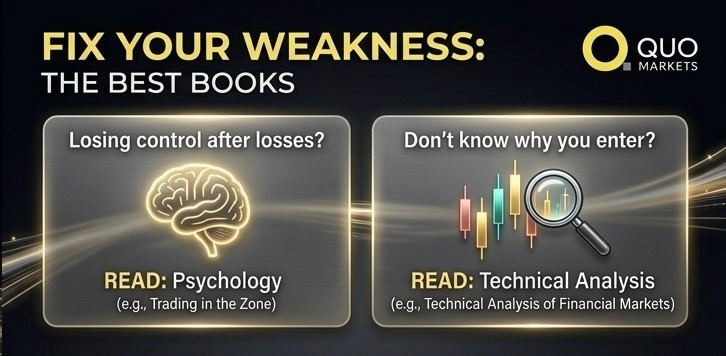
Don’t read all 20 in order. Pick the category that matches your biggest problem right now:
- Losing control after losses? Start with Psychology.
- Don’t know why you’re entering trades? Jump to Technical Analysis or Forex.
- Want to understand the bigger picture? Begin with Market Foundations.
Part 1: Trading Psychology (Fix the Trader First)
1. Trading in the Zone by Mark Douglas (2000)
This is the book most traders name when asked what changed their approach. Douglas’s core idea is simple and uncomfortable: any single trade can lose, even a great one, so stop treating each outcome as a verdict on you.
Takeaway: Think in series of trades, not single results.
Best for: Anyone who knows their strategy but can’t follow it.
2. The Disciplined Trader by Mark Douglas (1990)
The earlier, heavier companion to Trading in the Zone. It digs into the beliefs behind bad habits, like needing to be right or fearing a loss so much that you freeze. It’s less polished but goes deeper into the “why.”
Takeaway: Discipline comes from what you believe about risk, not from gritting your teeth.
Best for: Traders who keep repeating the same mistake.
3. The Best Loser Wins by Tom Hougaard (2022)
Hougaard, a veteran index trader, argues that our instincts are built backwards for markets: we take small wins fast and let losers run. His fix is practical, blunt, and sometimes funny.
Takeaway: Learning to lose small is a skill, and it can be trained.
Best for: Day traders battling the urge to hold a loser “just a bit longer.”
4. The Psychology of Money by Morgan Housel (2020)
Not a trading manual, but a sharp look at why smart people make poor money decisions. Housel’s short chapters on luck, patience, and “enough” help when profits start tempting you to take bigger risks.
Takeaway: How you behave with money matters more than how much you know.
Best for: Anyone growing an account and wanting to keep it.
Part 2: Learning From the Greats
5. Market Wizards by Jack Schwager (1989)
Schwager interviews top traders across futures, stocks, and currencies. The surprise is how little they agree on. Some trade charts, some trade news, some hold for minutes, others for months. What they share is strict risk control.
Takeaway: There’s no single “right” style, only one that fits you and is managed carefully.
Best for: Beginners hunting for a style that suits them.
6. Reminiscences of a Stock Operator by Edwin Lefèvre (1923)
A thinly veiled biography of legendary speculator Jesse Livermore. The slang is dated, but the story of big wins, big losses, and ego getting in the way could have been written last week.
Takeaway: Markets change; human nature doesn’t.
Best for: Readers who learn best through stories.
7. The Playbook by Mike Bellafiore (2013)
A look inside a proprietary trading firm, where traders prepare, review every day, and track their own stats. It reframes trading as a performance craft, like sport.
Takeaway: Preparation and review beat prediction.
Best for: Active traders who want a routine.
8. The Man Who Solved the Market by Gregory Zuckerman (2019)
The story of mathematician Jim Simons and Renaissance Technologies, whose Medallion Fund became one of the most successful in history using data models instead of gut feel. Remember that its results came from a team of scientists with enormous resources, so treat it as inspiration rather than a blueprint.
Takeaway: Edge comes from testing, not hunches.
Best for: Anyone curious about algorithmic and quant trading.
Part 3: Risk and Trading Systems
9. Trade Your Way to Financial Freedom by Van K. Tharp (1998)
Tharp pushes you to stop hunting for the perfect entry and focus on position sizing and exits. His “R-multiple” idea, measuring each trade as a multiple of what you risked, is still one of the cleanest ways to judge performance.
Takeaway: How much you risk per trade often matters more than where you enter.
Best for: Traders building their first real system.
10. How to Day Trade for a Living by Andrew Aziz (2016)
A hands-on guide to intraday trading: setups, risk rules, journaling, and keeping your head straight. It’s written plainly and avoids get-rich promises.
Takeaway: Day trading is a business with rules, not a hobby with hopes.
Best for: Beginners curious about short-term trading.
Part 4: Technical Analysis
11. Technical Analysis of the Financial Markets by John J. Murphy (1986)
The standard reference for charting. Trends, support and resistance, volume, and how different markets influence each other are all covered in one place. Keep it on your desk rather than reading it cover to cover.
Takeaway: A complete map of how charts are read.
Best for: Anyone building a technical foundation.
12. The Art and Science of Technical Analysis by Adam Grimes (2012)
Grimes is skeptical of chart “magic.” He asks whether a pattern actually works, then shows how to test it. It’s dense but rewarding if you want evidence over folklore.
Takeaway: If you can’t test it, be careful trusting it.
Best for: Analytical traders and former sceptics.
13. Japanese Candlestick Charting Techniques by Steve Nison (1991)
Nison introduced candlesticks to Western traders. You’ll learn how dojis, hammers, and engulfing bars show the tug-of-war between buyers and sellers. Today most platforms default to candles, so this is practical knowledge.
Takeaway: Each candle tells a small story about sentiment.
Best for: Traders who rely on price action.
14. Encyclopedia of Chart Patterns by Thomas Bulkowski (2000)
Bulkowski counted and measured thousands of patterns to see how often they succeed. The takeaway is eye-opening: some famous patterns are far less reliable than people assume. Use it for reference.
Takeaway: Patterns have odds, not guarantees.
Best for: Pattern traders who want data.
15. Mastering the Trade by John F. Carter (2005)
Carter shares his day-to-day approach to futures and equities, including the TTM Squeeze idea of volatility tightening before a move. It’s a good look at how one professional organizes a trading day.
Takeaway: Timing and structure can be systematized.
Best for: Intermediate traders refining entries.
Part 5: Forex Focus
16. Naked Forex by Alex Nekritin and Walter Peters (2012)
A case for clean charts with no stack of indicators. The authors focus on raw price action: zones, rejection, and momentum. If your screen looks like a Christmas tree, this one is for you.
Takeaway: Less clutter, clearer decisions.
Best for: Forex traders drowning in indicators.
Part 6: Fundamentals and the Long View
17. The Intelligent Investor by Benjamin Graham (1949)
Graham’s lessons on “Mr. Market” and the margin of safety are really lessons about risk. Even short-term traders gain from understanding how value investors think.
Takeaway: Price is what you pay; value is what you get.
Best for: Anyone wanting to understand fundamentals.
18. One Up on Wall Street by Peter Lynch (1989)
Lynch argues that everyday observations, like a product everyone you know suddenly loves, can lead to great ideas if you back them with research. It’s friendly, funny, and easy to read.
Takeaway: Know what you own and why.
Best for: Stock-focused beginners.
19. A Random Walk Down Wall Street by Burton Malkiel (1973)
Malkiel makes the case that beating the market consistently is very hard. You might disagree, but reading the strongest argument against your approach is healthy. It keeps expectations honest and risk management front of mind.
Takeaway: Be humble about your edge.
Best for: Traders who want a reality check.
20. The Stock Trader’s Almanac by Jeffrey A. Hirsch (updated annually)
A yearly guide to seasonal patterns, market cycles, and historical tendencies. Treat it as supporting context for planning, not a crystal ball, since past patterns can fade.
Takeaway: History offers context, never certainty.
Best for: Active traders who like calendars and data.
Where to Start: A Simple Reading Path
If you’re a complete beginner, begin with Trading in the Zone, then How to Day Trade for a Living, then Trade Your Way to Financial Freedom. That covers mindset, process, and risk in that order.
If you’re already trading and struggling, pick the one book that matches your pain point (psychology, risk, or analysis) and ignore the rest for now.
Turn Reading Into Results
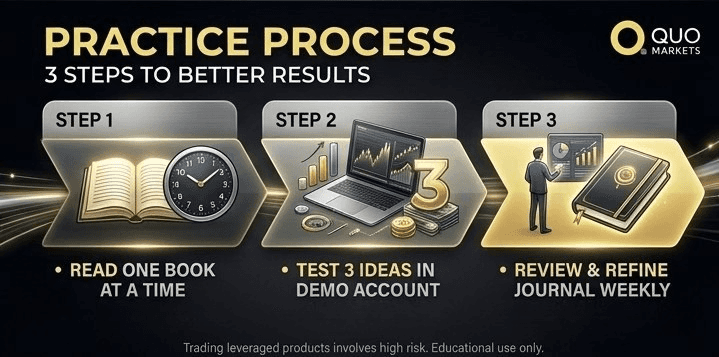
Reading doesn’t improve your trading on its own. Here’s a simple method:
- Read one book at a time.
- Pull out three ideas you can actually test.
- Practice them on a demo account for a month, and note what you feel before each trade.
- Review your journal weekly, then decide what to keep and what to drop.
Practicing on demo first lets you test ideas without putting real money on the line.
Final Thoughts
The goal isn’t to collect books. It’s to find the two or three ideas that change how you behave when the market moves against you. Start with the book that matches your biggest weakness, apply it, and come back for the next.
Disclaimer: Trading leveraged products such as forex and CFDs carries a high level of risk and may not be suitable for all investors. This article is for educational purposes only and is not financial advice.
FAQs
What are the best trading books for beginners?
Trading in the Zone, How to Day Trade for a Living, and Trade Your Way to Financial Freedom are strong starting points because they cover mindset, process, and risk.
Which trading books focus on psychology?
Trading in the Zone, The Disciplined Trader, and The Best Loser Wins are the most widely recommended.
What are the best forex trading books?
Naked Forex is a popular pick for price-action trading. Pair it with a risk-focused book like Tharp’s.
Which technical analysis books should I read?
Murphy’s Technical Analysis of the Financial Markets for the foundation, Nison’s for candlesticks, and Grimes’s for a skeptical, evidence-based view.
Are trading books still worth reading in 2026?
Yes. Tools change quickly, but the human mistakes that cost traders money stay the same.