
What Is Prop Trading? The Truth About Funded Accounts
Prop trading has become a popular topic among traders looking for access to larger trading accounts without having to provide all the trading capital themselves. But what is prop trading, how do prop firms work, and what does it actually mean to receive a funded trading account?
The answers are more complicated than many advertisements suggest. Traditional proprietary trading firms and modern online funded-account programs can operate very differently. Some firms put their own capital at risk, while many retail-focused programs evaluate traders in simulated environments and pay eligible rewards according to specific contractual rules.
Understanding that distinction matters before you pay an evaluation fee, spend weeks trying to pass a challenge, or commit to a particular trading model. This guide explains how prop trading works, how prop firms make money, what to check before pursuing a funded account, and how CFD trading through a broker differs from a prop firm arrangement.
What Is Prop Trading?
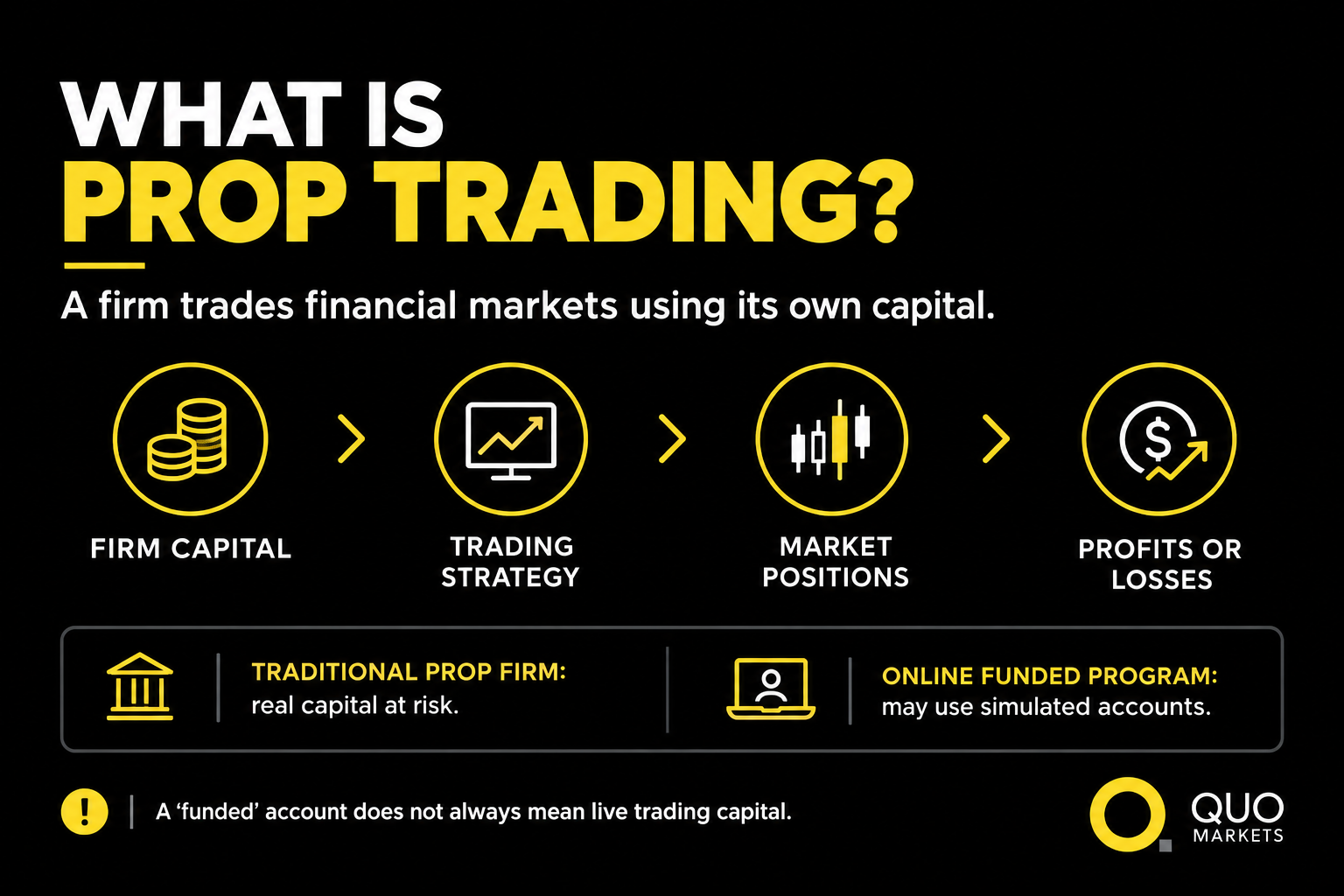
Proprietary trading, commonly known as prop trading, is when a firm trades financial instruments using its own capital to seek a profit. Instead of primarily executing trades on behalf of clients, a proprietary trading firm takes positions for its own account.
Traditional prop traders may work for banks, specialist trading companies, or other financial institutions. Depending on the firm’s strategy, they may trade currencies, stocks, bonds, commodities, derivatives, and other financial instruments.
Some firms use market-making strategies, while others pursue opportunities such as merger arbitrage, volatility arbitrage, or quantitative trading. Their approach depends on their expertise, technology, available capital, and appetite for risk.
In a traditional proprietary trading model, the firm provides the trading infrastructure and capital. The trader contributes market knowledge, research, and execution skills. The firm bears the financial consequences of its trading activity, subject to its internal risk limits and compensation arrangements.
However, the term prop trading has acquired another meaning in the retail market.
Online prop trading firms often invite individuals to pay for an evaluation. Traders must meet specified performance targets while following rules governing losses, trading behaviour, and account management. Those who qualify may receive access to a funded-style account and become eligible for a share of profits or performance-based rewards.
The important distinction is that an account described as funded does not necessarily contain real trading capital. Many retail programs use simulated accounts, even after a trader passes the evaluation.
How Do Prop Firms Work?
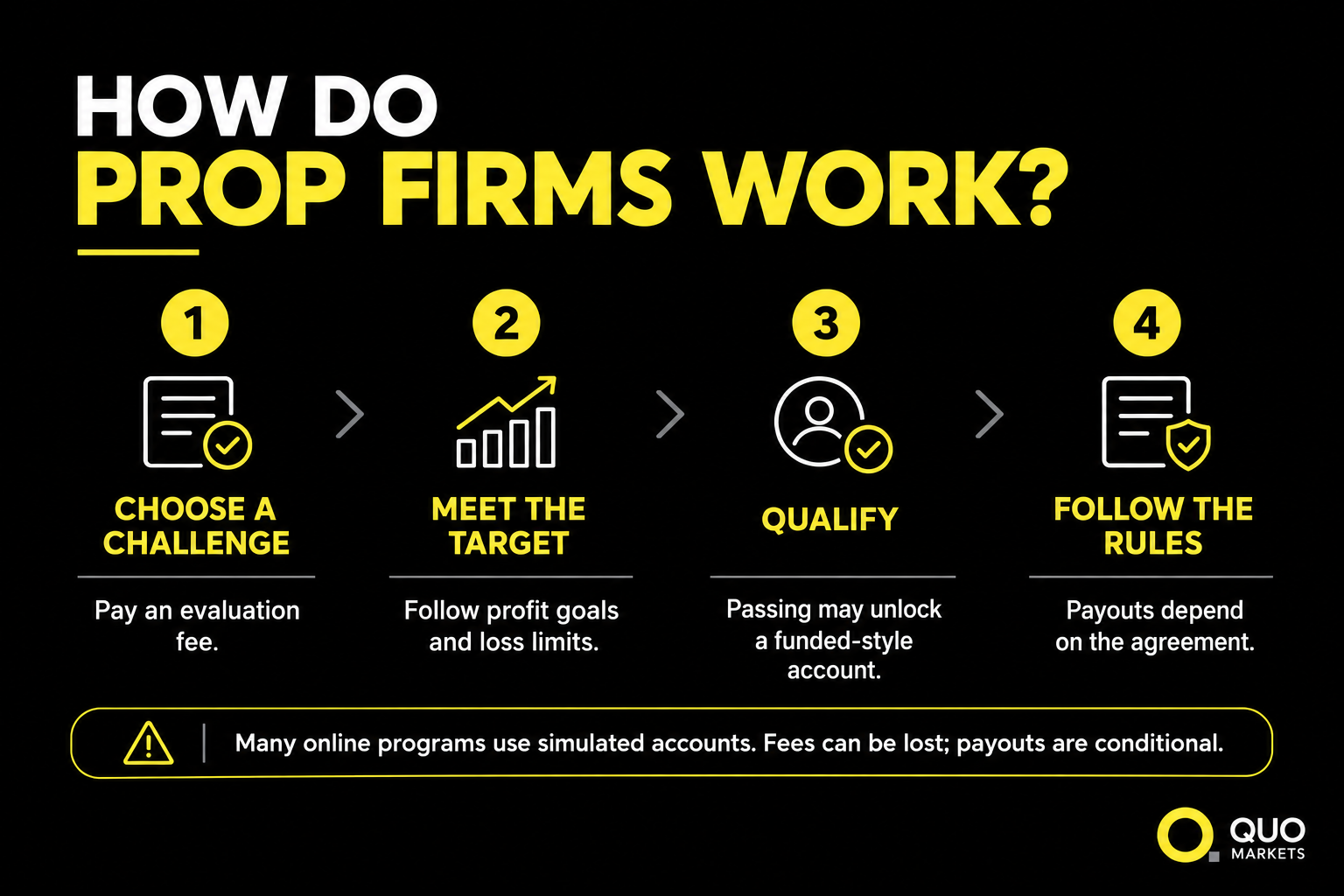
How do prop firms work in practice? The answer depends on the type of firm, but retail funded-account programs commonly follow a structured evaluation process.
1. The Trader Chooses an Evaluation
The process usually begins when a trader selects an evaluation program and agrees to its terms. Depending on the provider, the program may involve a single challenge, multiple stages, or another assessment format.
The trader may pay an upfront fee to participate. This is a real expense, and the applicable refund policy determines whether any of it can be recovered. If the trader fails the assessment, the fee may be lost.
Before committing, it is important to understand the total cost, including any permitted retakes, account resets, or recurring charges.
2. The Trader Demonstrates Their Skills
During the evaluation, traders typically need to meet a profit target while respecting predefined risk limits.
These requirements may include:
- A maximum daily loss.
- An overall drawdown limit.
- Restrictions on trading during certain market events.
- Rules about holding positions overnight or over weekends.
- Minimum trading days or consistency requirements.
- Restrictions on automated strategies, expert advisors, or other trading methods.
The precise conditions vary between programs. A trader who reaches a profit target may still fail if they breach another rule. For that reason, an evaluation tests more than the ability to identify profitable trades. It also assesses discipline, position sizing, and the ability to operate within a prescribed risk framework.
3. The Trader May Receive a Funded Account
After successfully completing the evaluation, a trader may qualify for a funded account or a subsequent stage of the program. This is where careful reading becomes essential. In many online programs, the account is simulated, with prices that reflect market data but orders that do not represent the trader’s own live transactions in the underlying market.
The firm may then pay eligible rewards based on the simulated results, subject to its agreement and payout conditions. Other arrangements may involve selected traders having their strategies copied to live accounts or being offered a different contractual relationship.
Passing an evaluation does not, by itself, prove that the trader has received a live brokerage account containing the advertised capital. The firm’s disclosures and contract determine what is actually being provided.
4. The Trader Must Continue Following the Rules
Qualifying for a funded account does not end the assessment of trading behaviour. A trader may lose access after breaching drawdown limits, violating prohibited-strategy rules, or failing to meet other contractual conditions. Payout eligibility may also depend on verification procedures and compliance reviews.
This makes the ongoing rules just as important as the initial challenge. Traders should understand how losses are calculated, when limits reset, how a breach is handled, and what happens to outstanding reward requests if an account is closed.
How Do Prop Firms Make Money?
Understanding how prop firms make money helps explain why their business models deserve closer examination. The answer depends on whether the firm is a traditional proprietary trading operation or a retail funded-account provider.
Trading Profits in Traditional Proprietary Firms
Traditional proprietary trading firms seek returns from their own trading activity. They may earn from market-making spreads, price discrepancies, relative-value positions, or other trading strategies.
Their results depend on market conditions, execution costs, technology, and risk management. Trading losses can reduce the firm’s capital, and even sophisticated strategies can perform poorly. In this model, trading performance is central to the firm’s business.
Evaluation Fees and Other Charges in Retail Programs
Many retail-funded programs generate revenue from evaluation fees. Some also charge for resets, repeat attempts, subscriptions, or other services, depending on their terms. A trader who pays an evaluation fee is purchasing access to an assessment process. The payment does not guarantee a funded account, a payout, or future profitability.
Some programs also earn revenue from their trading operations or arrangements involving traders who qualify. The relative importance of each revenue source varies, so it would be inaccurate to assume that every firm follows the same model. A key question is whether a provider clearly explains how its simulated accounts work, what qualifies a trader for a payout, and where the money for those payments comes from.
Profit Splits and Performance-Based Rewards
Some funded-account agreements allow eligible traders to receive a percentage of their qualifying profits or performance rewards. The percentage alone tells only part of the story. Traders also need to consider evaluation costs, withdrawal conditions, payout limits, account termination rules, and any additional contractual requirements.
A generous advertised split has limited practical value if the trader cannot meet the program’s conditions or becomes ineligible for payment. Potential rewards must always be considered alongside the possibility of losing fees, failing the evaluation, or losing access to the account.
Do Prop Firms Use Real Money?
The short answer is that some do, while many online funded-account programs use simulated trading. The distinction is one of the most important things to understand before joining a program. Traditional proprietary trading firms generally deploy their own capital in financial markets. Their traders place real orders, and the firm bears the resulting trading gains or losses.
Many retail prop firms operate differently. Their evaluation accounts use simulated balances, and the so-called funded accounts may continue to use simulated trading. The displayed account size represents a program limit or notional balance, rather than money deposited into a personal brokerage account.
In these arrangements, eligible rewards may be paid by the firm under a contractual agreement. The payment is real, but the simulated trading balance itself is not a cash balance that the trader owns or can withdraw.
This distinction also affects how results should be interpreted. Simulated performance does not fully reproduce the conditions of live trading. Liquidity, execution quality, slippage, and other market factors can affect real trades differently.
How to Get a Funded Trading Account
If you are exploring how to get a funded trading account, the first step is to understand the evaluation process and its financial implications. Passing a challenge requires more than reaching a profit target.
Understand the Evaluation Requirements
Read the full program rules before paying an entry fee. Identify the evaluation objectives, permitted instruments, trading hours, drawdown calculations, and any restrictions on trading strategies.
Pay particular attention to whether the maximum loss is calculated using account balance, equity, or a trailing threshold. These methods can produce different results, particularly when open positions fluctuate in value. Also check whether the firm has restrictions on news trading, weekend positions, automated trading bots, or the use of multiple accounts.
Practise Before Paying for an Assessment
A demo account can help you test a trading strategy without committing money to live positions. Use it to practise entries, exits, position sizing, and risk management under different market conditions.
If your goal is to pass an evaluation, practise following the relevant rules as closely as possible. A strategy that produces a profit but regularly breaches a drawdown limit may be unsuitable for that particular assessment.
Prepare a Documented Trading Plan
A written trading plan helps turn decisions into a repeatable process. It should define the conditions under which you enter a trade, where you exit, how much you are prepared to lose, and when you stop trading.
Set limits that you can follow without feeling pressured to recover losses immediately. Avoid increasing position sizes simply because you are behind a target or approaching an evaluation deadline.
Review the Contract Before Starting
Confirm the fee structure, refund conditions, payout eligibility, and account termination procedures. Check the legal entity behind the program, its jurisdiction, and the process for handling disputes.
You should also understand what happens after you pass. Some firms may require further verification or additional stages before providing access to the next account.
What Are the Risks of Prop Trading?
Prop trading programs can appeal to people who want to demonstrate their trading skills under defined rules. However, the structure introduces risks that deserve attention before any payment is made.
Evaluation Fees Can Be Lost
The initial fee is a direct financial commitment. Depending on the agreement, it may be non-refundable if you fail the assessment, breach a rule, or decide not to continue.
Repeat attempts and optional services can increase the overall cost. Calculate the amount you could spend across multiple attempts rather than looking only at the price of the first evaluation.
Strict Rules Can End an Account
Daily loss limits, maximum drawdown thresholds, and other restrictions can result in immediate account closure. Some programs also impose consistency requirements or restrictions on particular trading methods.
These conditions can apply even when a trader believes their overall strategy remains profitable. Understanding how each rule is measured is essential.
Payouts Are Subject to Contractual Conditions
Passing an evaluation does not automatically establish an unconditional right to every advertised reward. Payment may depend on continued compliance, identity verification, account reviews, and other requirements in the agreement.
Read the payout policy carefully and keep copies of the applicable terms. A firm’s stated reward structure should be assessed alongside its payment conditions and dispute procedures.
Firm Stability and Transparency Matter
A funded-account provider is a business, and businesses can change their terms, suspend services, or cease operating. If a firm becomes insolvent or disputes a payment request, recovering money may be difficult.
Look for a clearly identified legal entity, accessible terms, a transparent description of simulated trading, and a documented complaints process. Do not rely solely on social media testimonials or screenshots of payouts.
Simulated Results Do Not Eliminate Trading Risk
Even when a trader is not placing live orders through a simulated account, the evaluation fee remains exposed to loss. If the trader later transitions to a live trading arrangement, actual market losses and execution risks may apply under that arrangement.
The sensible approach is to evaluate the full financial commitment, not simply the headline account size.
Prop Trading vs CFD Trading: What Is the Difference?
Prop trading and contracts for difference (CFDs) offer different ways to participate in financial markets, but they involve different account structures and financial obligations.
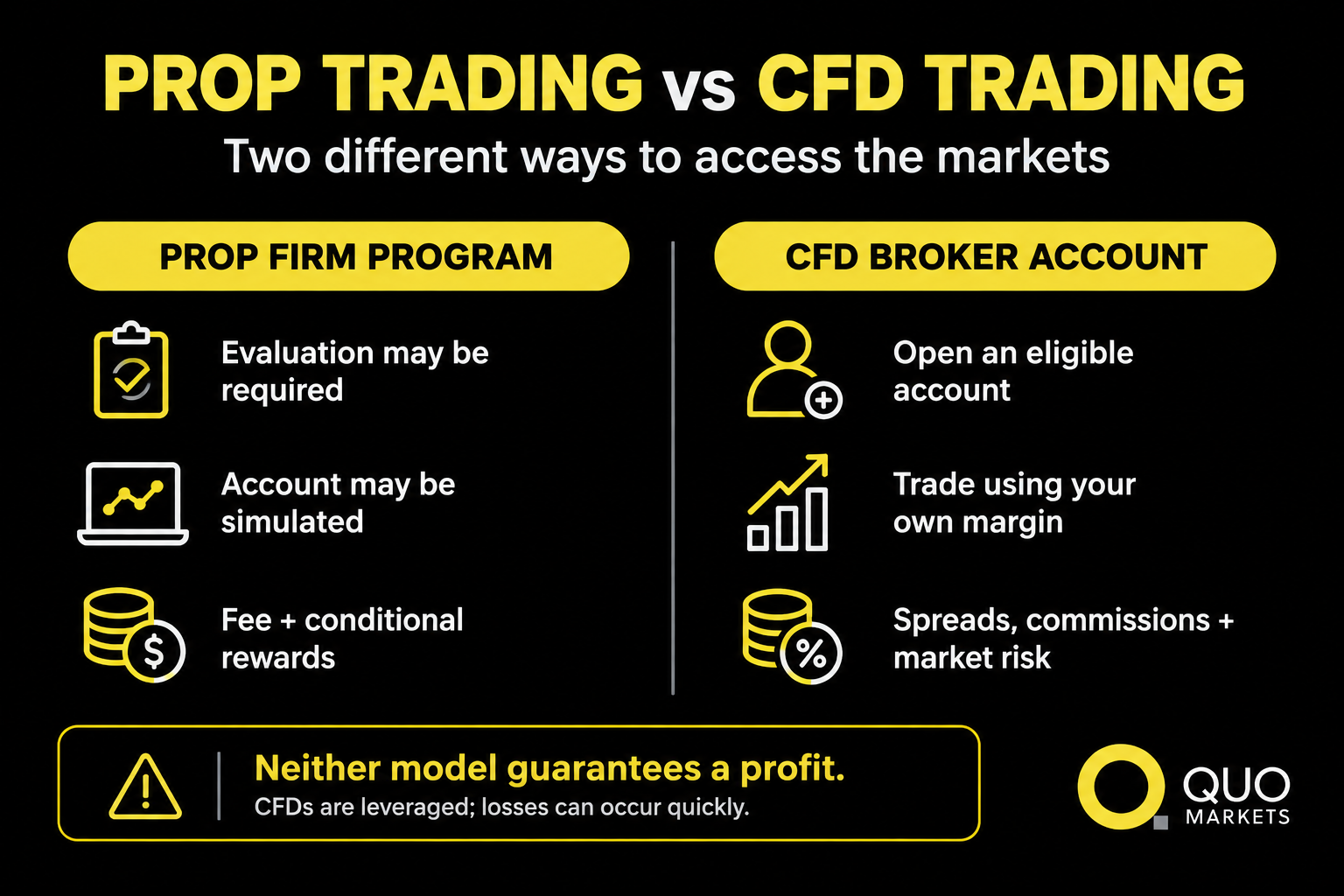
Neither approach guarantees a positive result. The relevant differences are who controls the account, how trades are executed, how costs are charged, and what obligations apply when trading conditions change.
CFDs allow traders to speculate on price movements without owning the underlying asset. However, they are leveraged products, and relatively small market movements can have a substantial effect on account equity. Losses can occur quickly, particularly when markets are volatile.
A broker account also differs from a funded program in terms of ownership and control. With a CFD account, the trader uses their own deposited funds as margin, subject to the broker’s terms. The trader is responsible for the financial consequences of their positions, within the protections and obligations applicable to that account.
An Alternative to Funded Accounts: CFD Trading With QuoMarkets
For readers researching prop trading, another option is to learn and practise through a brokerage account rather than pay for an evaluation. QuoMarkets does not offer proprietary trading challenges or funded trading accounts. Instead, it provides access to CFD trading through brokerage accounts, with demo accounts available for practice.
This is a different model from a retail prop firm. There is no prop-firm evaluation that grants access to a simulated funded account. Traders use the brokerage account they open and are responsible for managing their own trading funds and exposure.
Start With a Demo Account
A demo account allows you to become familiar with trading platforms, practise order placement, and test a trading plan in a simulated environment before committing funds to live trading.
It can also help you understand how different instruments behave and how your chosen approach responds to changing market conditions. Demo trading cannot reproduce every aspect of live execution, and positive demo results do not guarantee live profitability.
Compare the Available Account Types
QuoMarkets offers four account types: Raw, Standard, Zero, and Limitless. Their pricing structures and conditions differ, so review the official account specifications before choosing an option. Negative Balance Protection is listed across all four account types.
Choose a Platform That Fits Your Workflow
QuoMarkets supports both MetaTrader 4 (MT4) & MetaTrader 5 (MT5). These platforms provide tools for chart analysis and trade management, with features varying by platform and instrument. Getting comfortable with your chosen platform before trading live can help reduce avoidable operational mistakes.
The most important consideration is to understand the product, its costs, and the potential downside before opening a live position. Whether you explore a funded-account program or trade CFDs through a broker, discipline and realistic expectations remain essential.
FAQs
What Is a Prop Firm in Trading?
A prop trading firm trades financial instruments using its own capital. In the retail market, the term often refers to companies that assess individual traders through paid evaluations and may offer simulated funded accounts with performance-based rewards. The two business models are not identical.
How Do Prop Firms Make Money?
Traditional proprietary trading firms seek profits from their own trading activity. Retail funded-account providers may earn revenue from evaluation fees, repeat attempts, subscriptions, or other services, and some may also have trading-related revenue. The business model varies by firm.
Do You Need Your Own Money to Get a Funded Trading Account?
Many retail programs require an upfront evaluation fee. You may not need to deposit the advertised trading capital, but you can lose the fee if you fail or breach the rules. Other costs may apply under the agreement, so check the full terms before participating.
Are Funded Trading Accounts Real Money?
Not necessarily. Many retail-funded programs use simulated accounts, including after the evaluation. Eligible payouts may be real payments made under a separate agreement, but the displayed account balance is not necessarily money held in a live trading account.
Does QuoMarkets Offer Prop Trading or Funded Accounts?
No. QuoMarkets offers CFD trading rather than prop trading challenges or funded accounts. Traders can practise with demo accounts, compare its four account types, and access TradingView, MT4, and MT5. CFD trading involves the risk of losing money, so understand the product and its conditions before trading live.