

Your Profit Isn’t Yours Until It Lands: The Trader’s Guide to Withdrawals, Fees and Frozen Funds
The balance on your trading screen is a number in a database. It turns into money only when a bank somewhere agrees to move it. Between those two states sits a process most traders never look at until the day it matters, and by then they are reading terms and conditions with a knot in their stomach.
This article follows a withdrawal request from the click to the credit. On the way, it covers why some payouts take minutes, and others take a week, what a withdrawal fee is actually made of, what a “freeze” really means, and how to choose the fastest withdrawal forex broker on evidence instead of slogans.
Four Desks, One Request
When you press Withdraw, your request does not travel to “the broker.” It passes across four separate desks, and only the first belongs to the broker.
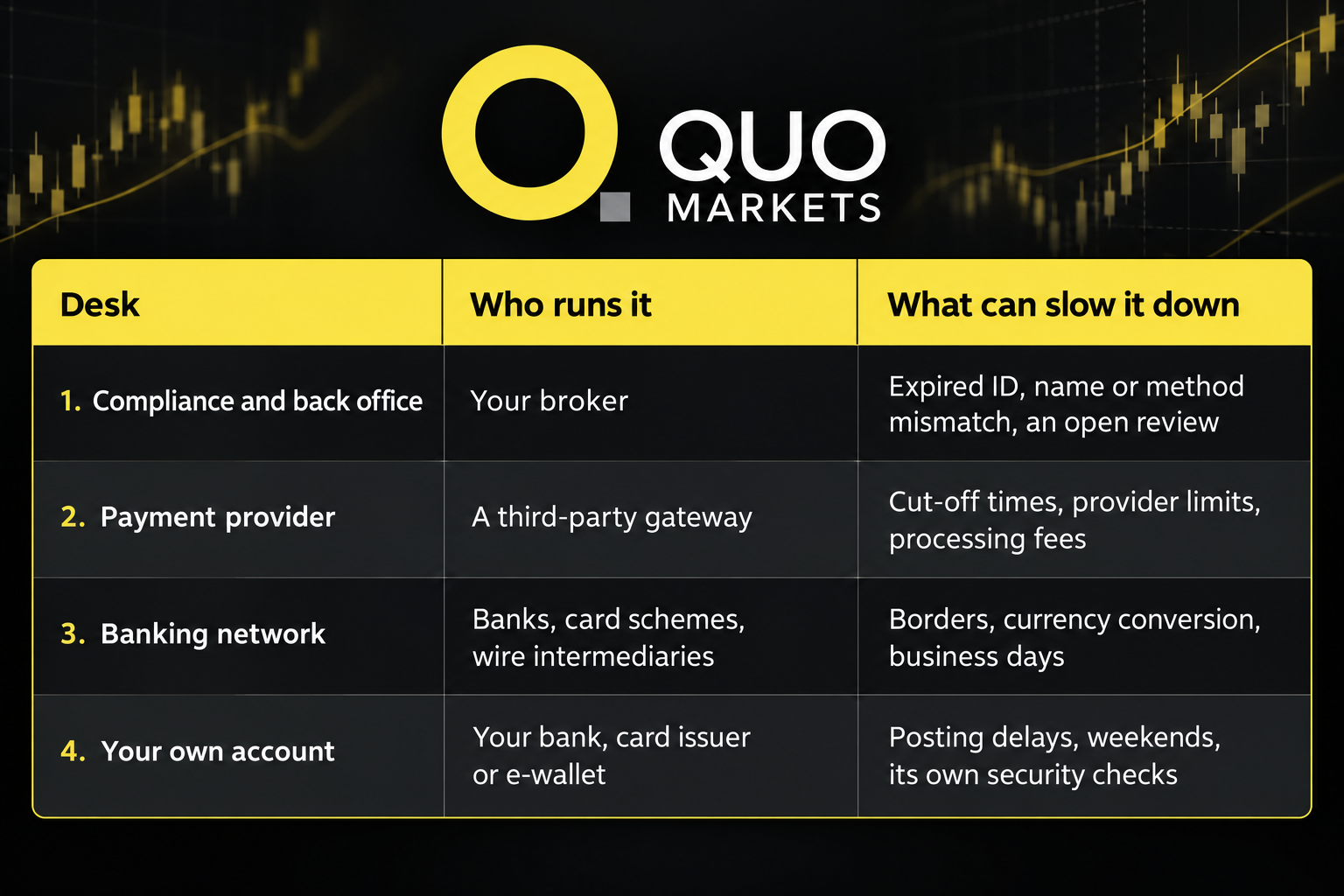
A broker can sprint through desk one and still watch the request crawl through desks three and four. That is why even the best forex broker for withdrawal speed cannot promise an exact arrival time. What it can do is clear its own desk quickly, keep the rules readable, and tell you honestly what happens after.
What “Instant” Is Really Describing
The phrase forex broker instant withdrawal appears on almost every broker homepage. In practice, it usually describes desk one: the request was approved and sent without a human delay. It says very little about when the money shows up.
That part depends on the route you pick.
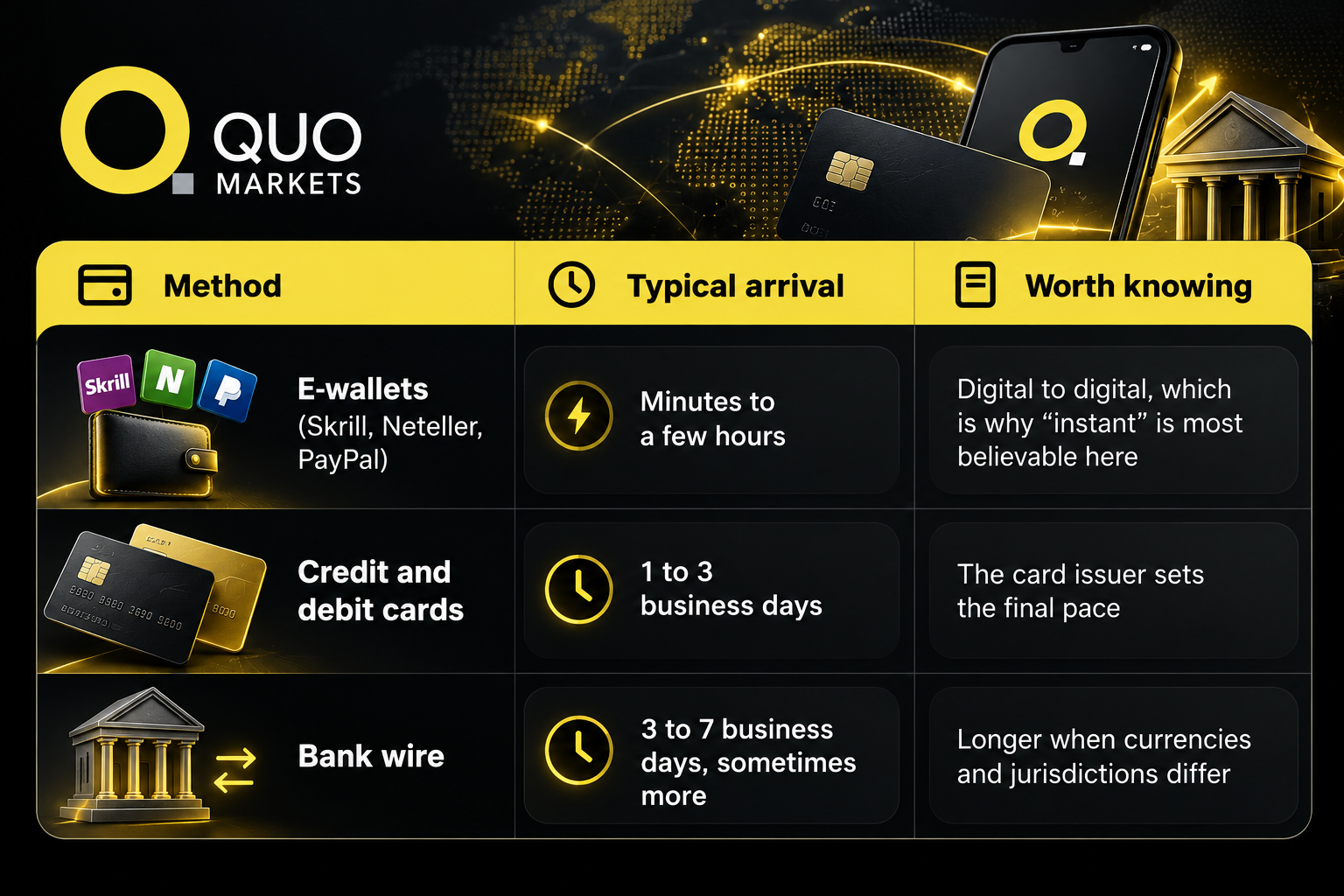
So treat a forex broker fast withdrawal claim as an incomplete sentence and finish it yourself: fast approval or fast arrival, and through which method?
The Fee Line, Itemised
Deposits are often free because brokers want you in. The way out is where costs tend to show up, and they rarely come from one source.
- The broker’s charge: usually a flat amount per request, sometimes free for the first few each month.
- The processor’s or bank’s charge: applied downstream and often visible only after it has been deducted.
- Currency conversion: triggered when you withdraw in a currency other than your account’s base currency.
You can check all of this in five minutes. Open the broker’s “Fees” or “Payments” page before you fund anything and read it line by line. Clear numbers are a good sign. Vague wording is not proof of anything, but it deserves a written question to support.
Money Has A Return Address
Most regulated brokers apply a closed-loop rule: funds leave the way they arrived. Deposit $1,000 by card, and that $1,000 goes back to the same card first. Only the profit above it may be eligible for a different route, such as a bank transfer.
It can feel rigid, but it is one of the plainest anti-fraud and anti-money-laundering tools the industry has. A request that breaks the loop is the most common reason a payout gets held. The practical habit is to choose your deposit method with the exit in mind, on day one.
Why An Analyst Might Stop Your Payout
A frozen balance sounds dramatic. Behind it, there is usually a person or a system following a rule, and the triggers fall into three groups. Details vary by country and regulator.
A pattern that looks unusual. Large deposits followed straight away by a withdrawal request, logins from several unfamiliar locations, or a sudden change in activity can all prompt a review. Brokers are legally required to look into possible laundering or fraud, and the account may be paused while they do.
A legal claim on the money. A court order or a tax authority’s levy can oblige a broker to hold funds. A negative balance or unpaid fees can also suspend withdrawals until they are settled.
A regulator stepping in. If a body such as the FCA, ASIC or CySEC investigates a firm, it can order client funds to be restricted. That sounds alarming, yet it is also the strongest argument for choosing a broker that sits under reputable oversight.
The Ordinary Causes Of Most Delays
Before assuming the worst, rule out the unglamorous list. It catches experienced traders all the time:
- KYC that is incomplete or out of date
- A withdrawal method that does not match the deposit method
- Bonus funds still tied to volume requirements
- A payment provider the broker does not support
- A request filed while a compliance review is already open
- Copy trading allocations that restrict withdrawals until copied positions close
Test The Exit Before You Need It
Reviews and promises only go so far. The most reliable evidence is your own: fund a small amount, complete verification, withdraw a small amount through the method you intend to use, and note the time at each step. Fifteen minutes of tracking tells you more than any comparison table.
Then apply the same test to every platform on your shortlist, QuoMarkets included. A broker that earns the label easy withdrawal forex broker usually shows it before you ask:
- Withdrawal rules written in plain language
- Several payment methods to choose from
- Fees and limits that are easy to find
- Support that answers specific questions with specific answers
- Regulation by a recognised authority
- A payout record you can verify independently
Tight spreads and fast execution matter. They matter less if profits are slow to leave.
When The Clock Runs Out

If a payout stalls, work the problem in order and keep records at every step.
- Check your dashboard. Confirm that all documents are verified and nothing is waiting on you.
- Write to support with specifics. Include the request date, amount, and ticket number; ask for the exact reason, and save the reference of the reply.
- Reread the terms. If a “same-day” promise has passed 48 hours with no valid explanation, you have grounds to escalate.
- File a written complaint with the broker’s compliance department to start a paper trail.
- Go to the regulator. For regulated brokers, that could be the Financial Ombudsman Service (UK), ASIC (Australia) or CySEC (Cyprus).
- Consider a chargeback as a last resort. If you funded by card and suspect fraud, your bank may allow a dispute. It often ends with the trading account being closed.
- Take legal advice for large sums. A lawyer who handles financial disputes can explain the options in your jurisdiction.
Keep your tone even throughout. Documented and persistent gets better results than angry. If you post a review afterwards, stick to dates and facts so it helps the next trader.
Every position you open has an exit plan. Your account deserves one too, and the best time to write it is before the first deposit.
FAQs
Why is my forex withdrawal delayed?
Usually because of verification checks, payment provider processing times, or the length of a bank transfer.
Can a broker legally freeze my funds?
Yes, in specific situations: regulatory requirements, compliance reviews, legal orders, or suspected breaches of the terms. A trustworthy broker will explain the reason.
What does “instant withdrawal” really mean?
Typically, it means the broker approves and sends the request immediately. When the money lands still depends on your payment method.
How do I spot the best forex broker for withdrawal?
Look for clear policies, multiple payment options, responsive support, transparent fees, and regulation by a trusted authority.
Does copy trading affect withdrawals?
It can. Some brokers limit withdrawals until copied positions are closed or allocation rules are met, so read the terms first.
Do withdrawal rules affect how I trade currency pairs?
Indirectly. If you trade high-volume pairs and move money often, withdrawal speed and reliability matter more.
Is fast withdrawal more important than low spreads?
Both matter. Tight pricing lowers your trading costs, while predictable payouts protect the profits you have actually earned.