

Table of Contents
- Crypto CFD Trading Strategies Every Beginner Should Know
- What Every Solid Crypto CFD Strategy Is Actually Built On
- Dollar Cost Averaging
- Swing Trading
- Breakout Trading
- Trend Following
- Risk Management in the Crypto Market
- Final Remarks
- FAQs
Crypto CFD Trading Strategies Every Beginner Should Know
The crypto market hands you something traditional finance never has: round-the-clock trading, every single day of the year, with the kind of volatility that can meaningfully grow a modest position in a relatively short time. The catch? That same volatility works just as hard against you. Without a plan in place, the market has a way of draining a beginner’s account faster than anyone expects.
What separates traders who stick around from those who burn out? – It’s not luck, and it’s not a hot tip. It’s having a clear strategy before a single dollar goes in. If you’re new to crypto CFD trading, the goal isn’t to chase every price spike. It’s to find an approach that suits your schedule, your risk appetite, and your personality; then stick to it.
What Every Solid Crypto CFD Strategy Is Actually Built On

Any trading approach worth using has two pillars underneath it: technical analysis and fundamental analysis. Fundamental analysis helps you assess a project’s real worth – the team behind it, the technology, the actual demand in the market. Technical analysis, on the other hand, is what drives active day trading decisions.
Learning to read candlestick charts and understand price behavior means your decisions come from data, not instinct. Whether you’re looking at Bitcoin or a smaller altcoin, the end goal is a repeatable process that actually fits your life and how much risk you can stomach.
Dollar Cost Averaging
If checking charts every hour sounds like a nightmare, Dollar-Cost Averaging, DCA for short, is often the first strategy seasoned traders recommend to beginners. The concept is straightforward: invest a fixed amount at regular intervals, no matter what the price is doing.
Why It Works in a Volatile Market
The biggest advantage of DCA is that it takes volatility and turns it into something manageable. When prices run high, your fixed investment buys fewer units. When prices fall, you automatically scoop up more. Over time, that smooths out your average entry price. For long-term investors building positions in assets like Bitcoin or Ethereum, both of which have bounced back from brutal corrections, this consistency has historically worked in their favor.
Why Beginners Choose It
DCA removes the psychological pressure of trying to time the market perfectly. Most beginners stumble because they’re either waiting for a bottom that never arrives or they pile in at the top, driven by fear of missing out. By automating purchases through a crypto CFD exchange, you build steadily rather than reactively. The mental relief alone is worth something; it keeps greed and fear from making your decisions for you.
Swing Trading

For anyone who wants more involvement than a buy-and-hold strategy but can’t afford to stare at screens all day, swing trading hits a useful middle ground. The idea is to capture price moves that unfold over several days to a few weeks.
Reading Medium-Term Signals
Swing traders aren’t concerned with what happens minute to minute. They’re looking for the medium-term trend. Moving averages, which track average prices over a set time frame, are a staple tool here, revealing the broader market direction. The Relative Strength Index, or RSI, is another common companion, helping traders gauge momentum and flag whether an asset looks overbought or oversold.
The Trade-Offs Worth Knowing
The upside is real flexibility. You can review charts at the end of your day and set up trades for the week ahead. The downside is overnight risk. Since crypto never sleeps, a news event at 3 a.m. can move the market significantly before you wake up. This is why leaning on support and resistance levels to set entry and exit points matters so much – entering when the trend is in your favor and getting out before a reversal are what keep swing trading profitable.
Breakout Trading
Breakout trading is built around a specific market behavior: prices often compress into a tight range before exploding in one direction. The strategy is about being ready when that compression breaks.
What You’re Actually Looking For
A breakout happens when the price pushes through a defined resistance level or drops below a support level. When that move comes with high volume, it signals that the market has found a new consensus and a trend is forming. Beginners can start by looking for recognizable chart patterns – triangles and rectangles are common. A break above the upper boundary can be a signal to go long; a break below the lower boundary may indicate more downside ahead.
Protecting Yourself From False Moves
The main hazard in breakout trading is the “fakeout” – a brief break beyond a level that quickly reverses. To protect against it, many experienced traders wait for a full candle close above the resistance line or look for the price to retest that level before putting real capital to work. It takes patience, and it takes the ability to move once the move is confirmed.
Trend Following
Trend trading operates on a principle that sounds almost too simple: the trend is your friend. Rather than guessing when a move will end, you follow the path of least resistance until the data tells you it’s time to step aside.
The Indicators That Guide the Approach
Trend followers typically look to the 50-day and 200-day moving averages to get the big-picture view. When price consistently holds above these levels, the trend is read as bullish. The RSI can add confirmation by showing whether momentum is still intact. One honest warning: this strategy thrives in trending markets but can produce choppy, frustrating results when the market is moving sideways.
Knowing When to Exit
In trend following, entry matters far less than exit discipline. The objective is to stay in the trade until the trend genuinely breaks, not to bail early because the price wobbles. You won’t catch the exact bottom or the exact top, but capturing the sustained middle portion of a move is how this approach generates real results.
Risk Management in the Crypto CFD Market
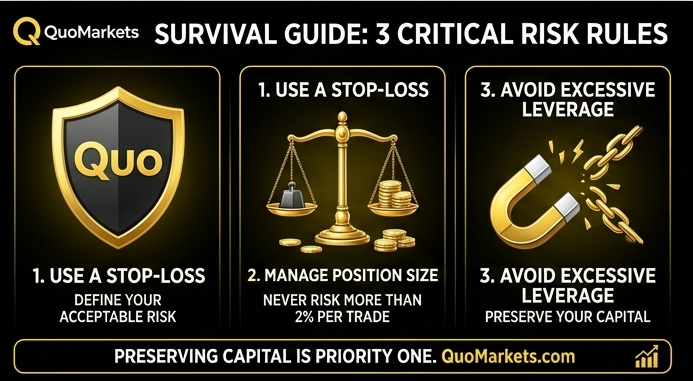
Every strategy above can work. None of them will work without sound risk management beneath them. Experienced traders repeat this constantly: protecting your capital matters more than chasing gains.
Stop-Loss Orders and Position Sizing
A stop-loss order closes a trade automatically once the price hits a level you’ve defined in advance, capping how much you can lose on that position. For beginners, this isn’t optional; it’s the first line of defense against turning a small, recoverable loss into something account-ending. Defining your acceptable loss before you enter removes emotion from the equation when things move against you.
Position sizing deserves equal attention. A widely referenced guideline among disciplined traders is to never risk more than one to two percent of your total capital on a single trade. This means even a losing streak won’t devastate your account; you stay in the game long enough to learn and improve.
Leverage, Diversification, and the Psychology Problem
Leverage magnifies both sides of a trade. For beginners operating in volatile markets, it’s one of the fastest ways to wipe out an account. Margin calls in crypto CFD trading can arrive without warning during sharp price swings, leaving no time to respond. Until you have a solid track record and a real understanding of how leverage interacts with volatility, keep it minimal or avoid it entirely.
Spreading exposure across multiple assets with healthy liquidity also helps. Rather than concentrating everything in one coin, diversifying reduces the damage if a single market moves sharply against you. And then there’s the psychological side, which is every bit as important as the technical side. FOMO drives retail traders to enter positions after prices have already run up, creating setups with terrible risk-to-reward ratios. Recognizing these emotional traps and having a written plan that removes guesswork is what keeps traders in the market long-term.
Final Remarks
The best crypto CFD trading strategies for beginners share a common thread: they’re learnable, repeatable, and built on risk management. Dollar-cost averaging is a low-pressure entry into long-term position building. Swing trading opens the door to active participation without demanding constant screen time. Breakout trading offers high-conviction setups when price action confirms momentum. Trend following keeps you aligned with the dominant market direction instead of working against it.
None of these guarantees consistent profits; anyone who tells you otherwise isn’t being straight with you. What they offer is a framework for making informed, disciplined decisions rather than emotional ones. Before putting real money to work, test your entries, stops, and position sizing on a demo account. Use reputable exchanges that offer the tools you need and take security seriously. Keep learning, because this market evolves fast and so should your understanding of it. Start simple, stay consistent, and let your experience shape how much complexity you take on over time.
FAQs
What’s the best crypto CFD trading strategy for a complete beginner?
Dollar-cost averaging is widely considered the most beginner-friendly approach. It removes the pressure of timing the market and cuts down on the emotional swings that trip most new traders up. As you gain experience, swing trading or trend following can be layered in. High-frequency approaches like scalping are best left alone until you’ve built solid technical analysis skills and can make rapid decisions reliably.
How much money do you actually need to start?
There’s no universal answer; many exchanges let you begin with very small amounts. What matters more than the starting figure is how you manage it. Applying the 1 to 2% risk-per-trade rule means your position sizes should match your actual capital. Starting small while you’re learning is strongly advisable, and using a demo account before committing real funds lets you test your approach without financial consequences.
Is crypto CFD trading like trading stocks?
There are real similarities, particularly around technical analysis and risk management tools. But unlike traditional markets, crypto never closes, operates with significantly higher volatility, and reacts more sharply to sentiment and news cycles. Regulatory frameworks differ, too, and the dynamics of digital assets can shift far more quickly than those of established equities or commodities.
Which technical indicators should beginners learn first?
Start with moving averages and the RSI. Moving averages help you identify overall market direction and potential trend shifts, while the RSI gives you a read on momentum and flags overbought or oversold conditions. Once you’re comfortable with both, support and resistance levels and volume analysis are natural next steps. Combining multiple indicators gives you a fuller picture than relying on any single signal alone.
How do you manage risk when trading crypto CFDs?
Three core practices cover most of it: always use stop-loss orders to define your maximum loss before entering a position, keep individual position sizes in proportion to your total capital using the one-to-two percent rule, and avoid heavy leverage, especially in volatile conditions.