

Table of Contents
- Why the Best Forex Affiliate Program Isn’t Always the Highest-Paying One
- Forex Affiliate vs. Introducing Broker: Understanding the Difference
- Forex IB Commission Models Explained
- How to Evaluate a Forex IB Commission Rate
- Sub-IB Networks: Scaling Beyond Direct Referrals
- Tracking and Reporting: Why Transparency Matters
- Payout Reliability: Questions Every IB Should Ask
- The Importance of Broker Regulation for IB Success
- What QuoMarkets’ 2026 IB Program Offers
- Marketing Support: Tools That Help IBs Grow Faster
- Red Flags to Avoid When Choosing a Forex Partner Program
- Forex Partner Program Checklist Before You Sign
- The Bottom Line: What Matters Most in 2026
- Frequently Asked Questions
The best forex affiliate program rarely matches the one with the flashiest number on its landing page. A 50% revenue share sounds great until you realize it’s calculated on a spread that barely moves, or your payout has been sitting “in review” for three weeks. For an introducing broker working in 2026, the commission rate splashed across the homepage is just the opening line; there’s a lot more to check before you sign anything.
Here’s what actually separates a forex partner program worth your time from one that quietly underdelivers.
Forex Affiliate vs. Introducing Broker: What’s the Real Difference?
Before you start comparing commission tables, it’s worth untangling two terms people throw around as if they mean the same thing.
A forex affiliate usually works at a distance. They drop a banner or share a link, and get paid when someone clicks through and opens an account. Beyond logging into a dashboard now and then, there’s not much contact with the broker.
An introducing broker (IB) relationship goes deeper. The broker formally onboards the IB, often through a verification process that looks a lot like other regulated partnerships. Rather than a one-time transaction, the IB builds a client base over time, and the broker treats them as a long-term partner, not just a traffic source.
This distinction matters more than it sounds. A forex IB program is built around keeping clients and growing their lifetime value, while a plain affiliate program is usually just chasing acquisition numbers. Knowing which one you’re actually dealing with helps you avoid offering something the broker isn’t expecting, or vice versa.
Commission Models: CPA, Revenue Share, Lot Rebates, and Hybrids
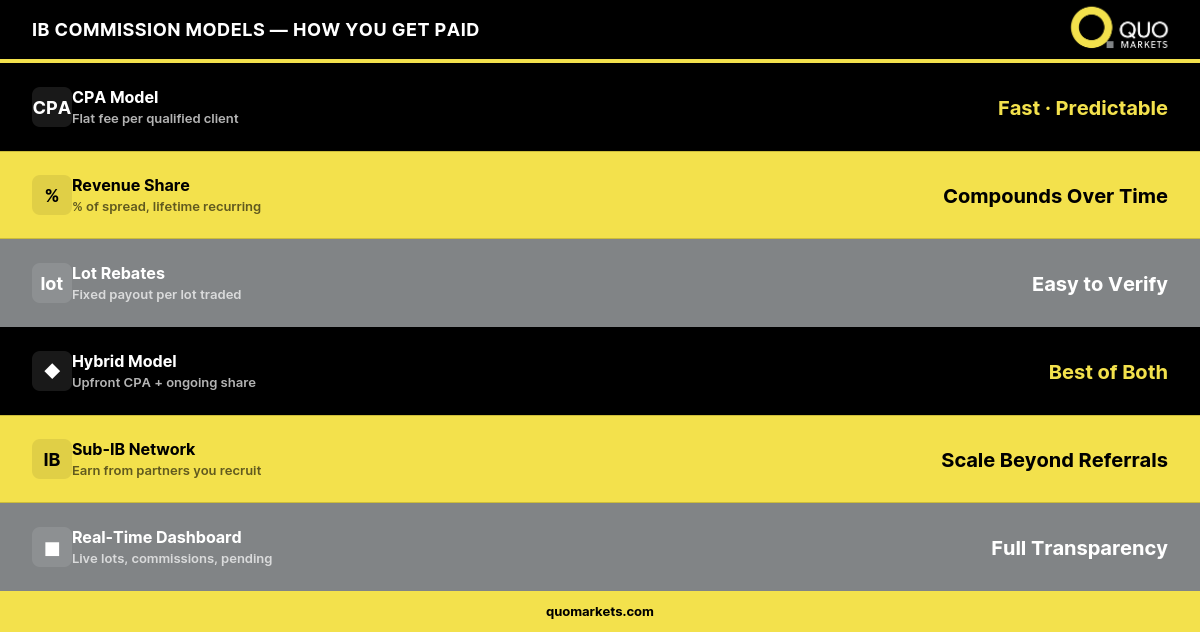
Once you know what kind of partnership you’re looking at, the next question is simple: how do you get paid? Most forex IB commission setups fall into four buckets, and each one suits a different type of partner.
CPA (cost per acquisition) pays a flat fee once a referred client hits a qualifying condition, usually a minimum deposit or their first trade. Say a program pays $200 per qualified client, and you bring in ten clients this month: that’s $2,000, paid out no matter how much those clients trade afterward. This works well for affiliates with heavy traffic who’d rather have fast, predictable payouts than a long-term stake in someone’s trading habits.
Revenue share is a different game. Instead of a flat fee, you earn a cut of the spread or commission the broker pockets from your client’s trades, for as long as that client keeps trading. It pays out more slowly at first, but it compounds over months and years, which is why a lot of seasoned IBs call it the more sustainable option once their client base has had time to mature.
Lot rebates sometimes get lumped into revenue share talk, but they’re really their own thing – a fixed payout per lot traded instead of a percentage of the spread. Easy to calculate, easy to check against trading volume reports.
Hybrid models blend CPA and revenue share: a smaller upfront payment plus an ongoing cut. Good fit for IBs who want some cash up front without giving up the long game entirely.
Payout timing varies a lot between these, too. CPA programs often pay weekly, sometimes even daily, once a client qualifies. Revenue share and lot rebates usually run on a recurring cycle tied to closed trading volume. Whatever model you’re looking at, don’t just ask “how much” – ask “how often.” Payout timing directly affects how much you can reinvest into your own marketing.
What Actually Makes a Forex IB Commission Rate Competitive
A commission rate that looks great in an ad doesn’t automatically mean better earnings in your pocket. A few things shape the real number:
- Spread size
- Trading volume
- Account type
- Range of instruments
- How long clients stick around
Take EUR/USD as an example. If a broker runs a 0.6 pip spread and pays the IB 0.5 pips of that, the partner walks away with roughly $5 per standard lot. But the exact same commission percentage can play out very differently depending on account structure:
RAW account:
- 0.1 pip spread
- Commission charged separately
- Tends to attract more active, professional traders
Standard account:
- 1.0 pip spread
- No separate commission
- Usually preferred by retail traders
The takeaway: judge a commission rate by how real clients actually trade, not by the number on the page. Active, loyal traders will often out-earn a program with a slightly flashier percentage but thinner client activity.
Sub-IB Networks: Building Something Bigger Than a Referral List
What separates a decent partner from a top-tier one often comes down to whether they can build a network. A forex partner program with sub-IB functionality lets a master partner bring other IBs on board underneath them. Instead of earning only from people you refer directly, you also earn from whatever your sub-partners generate.
This setup is especially common in places like Southeast Asia and the MENA region, where relationship-driven growth is still the default way business gets done. A simple example:
- 10 sub-IBs
- Each brings in 100 active traders
- Each trader generates a steady monthly volume
That master partner is now earning from a network far bigger than they could ever manage solo. Multi-tier structures like this let successful traders, educators, fund managers, and community leaders scale far beyond what one person referring clients one at a time could ever achieve.
Tracking and Reporting: The Real Test of Any IB Program
A great commission structure means nothing if you can’t actually verify what you’re owed. This is exactly where a lot of program comparisons fall apart – tracking quality is much harder to advertise than a commission percentage, but it matters just as much day to day.
A solid partner portal should show real-time activity from your referred clients, not a once-a-day or once-a-week batch update. It should clearly break down lots traded, commission earned, and what’s pending versus already paid – clear enough that you can check it against your own records without needing to email support. If you’re running a sub-affiliate network, the portal needs to separate your personal commission from your override commission on sub-IBs. Mix the two together, and you’ve lost the ability to audit anything properly.
Before joining any program, ask for portal access or a live demo specifically to test this. Don’t take the marketing page’s word for it. Transparent, exportable reporting is one of the few things that genuinely protects your income.
Payout Reliability: The Questions Worth Asking Before You Sign
Even the best commission structure is worthless if the payouts don’t show up reliably. Before committing to a program, ask:
- Are payouts daily, weekly, or monthly?
- Is there a minimum withdrawal amount?
- What payment methods are supported?
- Can you download reports to verify everything yourself?
- Are there any hidden fees?
Experienced partners tend to gravitate toward brokers offering automated payouts backed by clear reporting. Common payment options include:
- Bank transfers
- Crypto withdrawals
- E-wallets
Fast, predictable withdrawals make it a lot easier to manage cash flow and reinvest in growing your reach.
Why Your Broker’s Regulatory Status Matters to Your Business Too
A broker’s regulatory standing affects more than their own reputation – it shapes client trust, conversion rates, and how stable your business is long term. Regulation signals that a broker is operating under recognized rules and oversight.
A few examples: the Financial Services Authority in Seychelles, the Financial Sector Conduct Authority in South Africa, and the Securities and Commodities Authority in the UAE. Regulated brokers tend to perform noticeably better in markets like the UAE and South Africa, where traders routinely check licensing before they ever open an account. Strong regulatory standing protects both the broker and the partner from legal and reputational headaches down the line.
What QuoMarkets’ 2026 IB Program Brings to the Table
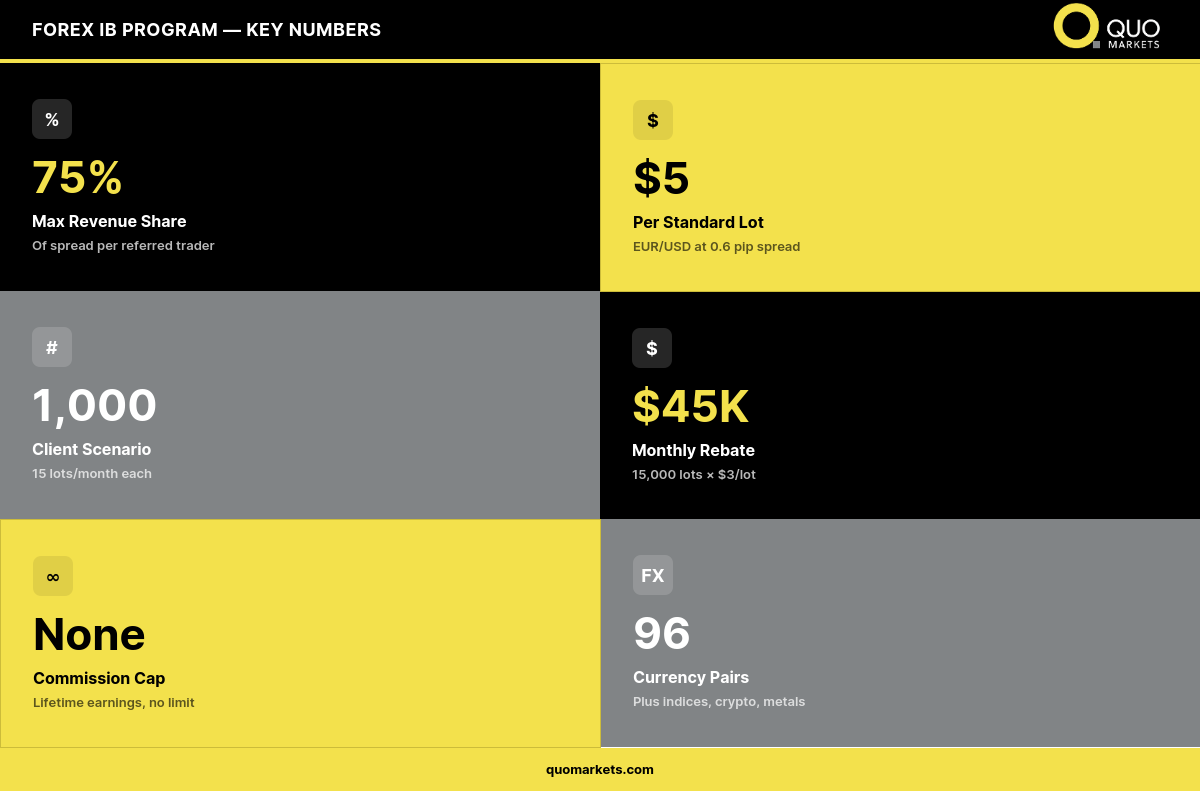
QuoMarkets’ IB Program for 2026 is built around helping partners create steady, long-term income while giving their clients access to a modern trading setup. Partners get a unique referral link, marketing resources, a dedicated account manager, and a real-time dashboard to track referrals and commissions. Clients referred through the program get access to MT4 and MT5, social trading tools, spreads starting from 0 pips, and a wide range of markets – 96 currency pairs, 13 indices, metals, energies, stocks, synthetic indices, NDFs, and over 100 cryptocurrencies.
One of the program’s biggest draws is the revenue model itself. QuoMarkets offers IBs up to 75% of the spread their referred traders generate. On a 0.6-pip EUR/USD spread, for example, a partner earns 0.5 pips, roughly $5 per standard lot. Partners also keep earning for as long as their clients stay active, with no cap on lifetime commissions. The rebate system can add up fast: 1,000 clients trading 15 lots a month works out to 15,000 lots of total volume. At $3 per lot, that’s $45,000 a month, and it keeps repeating as long as trading activity holds steady.
QuoMarkets also runs a multi-level partnership structure, letting partners bring on sub-IBs and earn extra from their networks, scaling well past what direct referrals alone could bring in. Combine that with real-time tracking, no lifetime commission caps, social trading features, a wide instrument selection, and solid customer support, and the program offers more room to grow than a lot of traditional brokerage affiliate setups.
Marketing Support: What Good Programs Actually Provide
The quality of marketing support can make or break how well a partner performs. Strong programs typically offer:
- Co-branded marketing materials
- Ready-made landing pages
- Webinar support
- Social media assets
- Localized promotional content
- Educational resources
Good marketing tools cut down setup time and let partners spend their energy on actually bringing in clients. Dedicated support teams can also help fine-tune marketing, boost conversion rates, and break into new regions. Some programs go further with ready-built websites, banner libraries, video content, and help with business development.
Red Flags: When a Forex Affiliate Program Isn’t Worth Your Time
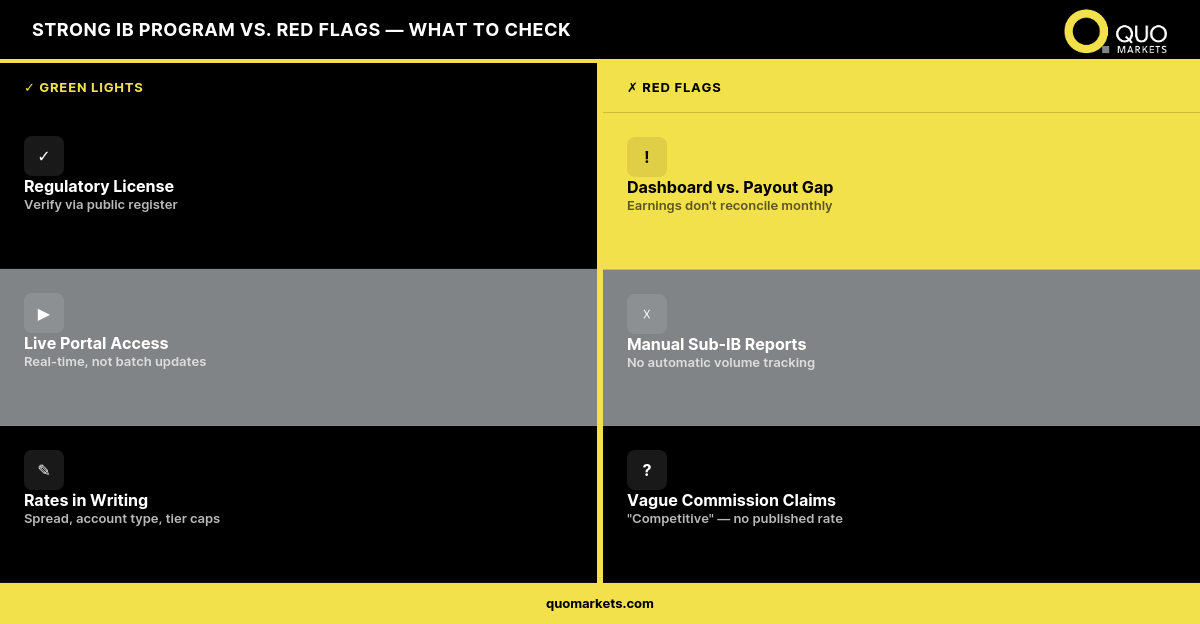
Some warning signs only show up once you’re already in a program, but a few patterns are worth watching for before you ever sign anything.
A persistent gap between what your dashboard says you’ve earned and what actually lands in your account is one of the clearest red flags out there. If the numbers don’t reconcile month after month, it’s a structural problem, not a clerical glitch.
Manual sub-IB reconciliation is another one to watch for. If a broker makes partners manually report or dispute sub-IB volumes instead of tracking everything automatically, disputes stop being the exception and become routine. Programs that only settle payouts once a month, with zero visibility into accrued commission in between, leave you unable to plan your cash flow or catch mistakes early. And vague phrases like “competitive commissions” with no published rates, paired with marketing that overpromises on withdrawal speed or minimum deposits, often point to a program more focused on signing partners up than keeping them.
None of these on their own is necessarily a dealbreaker, but two or more together is a good reason to keep looking elsewhere before committing.
A Quick Checklist Before You Sign With Any Forex Partner Program
- Confirm regulatory licenses and registration directly through the regulator’s public register, not just what the broker claims.
- Request real access to the partner portal before signing anything, and check whether reporting is live or just a batch update.
- Get the exact commission calculation in writing: spread width, account type differences, and whether sub-IB tiers have a cap.
- Confirm payout frequency, minimum withdrawal, and payment methods in writing, not just verbally during onboarding.
- Check what marketing materials and certifications are actually provided once you’re a partner, rather than just assumed.
A program that checks every one of these boxes is far more likely to support real, long-term growth.
The Bottom Line
Picking the right forex affiliate program in 2026 really comes down to four things: a commission structure that holds up under real math, sub-IB infrastructure that lets your network grow beyond your own referral list, regulatory standing that protects both you and the broker, and a payout schedule you can actually plan your business around.
A big headline number means very little without these foundations underneath it. Check the structure first and the number second – that approach will serve your partnership far longer than whatever promotion first caught your eye.
FAQs
What’s the difference between a forex affiliate and an introducing broker (IB)?
A forex affiliate typically earns a one-time fee per referral. An introducing broker earns ongoing commissions from a client’s trading activity and often provides extra support, education, and market guidance along the way.
How much can a forex IB earn per month?
It depends heavily on trading volume and how many active referrals you have. An IB with 100 regularly trading clients can pull in thousands of dollars a month, with sub-IB networks pushing that even higher.
What commission model works best for a new forex IB?
Most new IBs start with CPA for predictable, faster income. Once their client base grows, revenue share or hybrid models tend to produce stronger earnings over time.
What should I check before joining a forex partner program?
Verify licenses, review the payout terms, test the partner portal yourself, confirm sub-IB support, and check the available withdrawal methods before signing up.
Do forex IB commissions expire?
It depends on the broker. Some cap commissions to a set period, while others pay out for the life of the client. Always confirm this policy before joining.
Can I run a sub-IB network under a forex affiliate program?
Yes, as long as the broker supports sub-IB structures. These setups let you earn from both your own referrals and the partners you bring on underneath you.