

Table of Contents
- Margin Trading Explained: What Leverage Actually Does to Your Money
- How a Margin Account Actually Works
- Pros & Cons of Margin Trading
- Margin Calls and Forced Liquidation
- A Real Margin Call Scenario
- Margin Trading Formula
- The Regulatory Side
- How to Keep Leverage From Working Against You
- Final Remarks
- FAQs
Margin Trading Explained: What Leverage Actually Does to Your Money
Margin trading puts more buying power in your hands than your account balance alone would allow. The basic mechanic is simple: you borrow money from your broker to buy financial instruments – stocks, forex pairs, crypto – and your existing funds serve as collateral. The draw is obvious. With a bigger position, even a small price move can turn into a real return. The catch is that this cuts both ways. Gains get magnified, and so do losses. Anyone stepping into leveraged trading for the first time needs to understand exactly how this works before putting real money on the line.
Here’s a clear breakdown of how margin accounts function, what the risks look like when things go sideways, and how to approach the whole thing without learning your lessons the expensive way.
How a Margin Account Actually Works
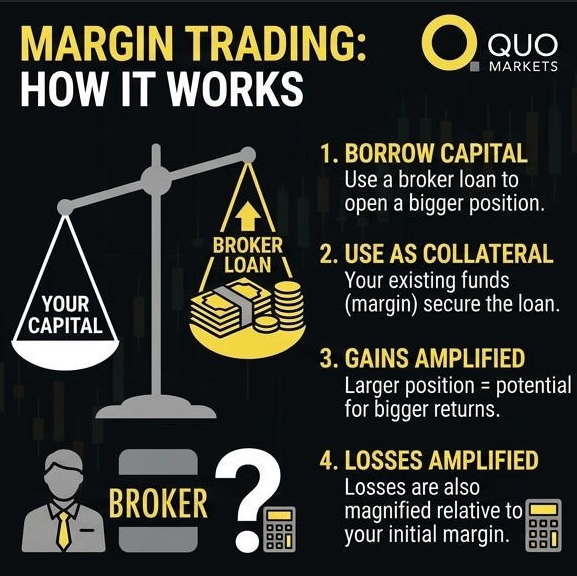
A margin account is not the same as a standard cash account. With a cash account, you can only trade what you deposit, nothing more. A margin account lets your broker lend you additional capital, using your deposited funds and current holdings as security.
What You Put In to Open a Position (Initial Margin)
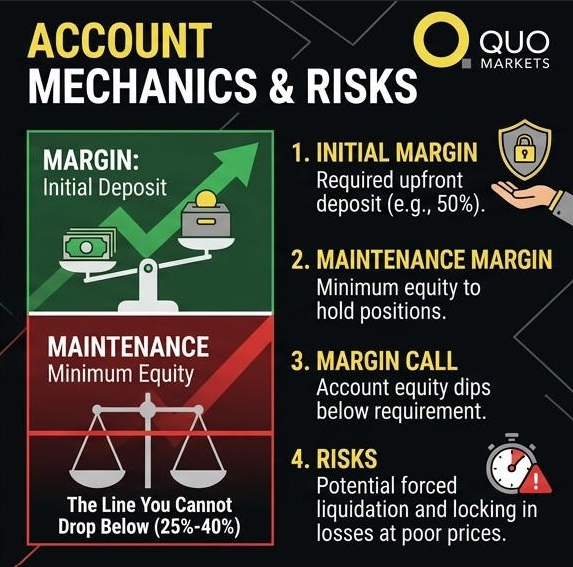
Every time you open a position with borrowed money, your broker requires an upfront deposit called the initial margin. In the U.S., Regulation T, set by the Federal Reserve, caps borrowing at 50% of the purchase price for most securities. Want to buy $10,000 worth of stock? You need at least $5,000 sitting in your account.
The Line You Cannot Drop Below (Maintenance Margin)
Once your position is open, a second threshold comes into play: the maintenance margin. This is the minimum equity your account must hold relative to the total value of your positions. Most brokers set it somewhere between 25% and 40%, though this shifts depending on the asset or the broker’s own rules.
Here’s how that plays out: You deposit $5,000 and borrow another $5,000 to buy $10,000 worth of stock. Your equity is $5,000 – 50% of the position. Now the stock drops to $7,000. Your loan is still $5,000, so your equity is now $2,000, which is about 28.5% of the position value. If your broker’s maintenance margin sits at 30%, you’ve just crossed the line, and a margin call is on its way.
This is what separates margin trading from trading with your own cash. The numbers shift fast, and they don’t always move in your direction.
Pros & Cons of Margin Trading
The Appeal: Your Returns Get Amplified
Leverage is the main reason traders use margin. When you control a position larger than your own capital would allow, a 5% gain on the full position might translate to a 10% or 20% return on what you actually put in, depending on how much you borrowed.
For traders with a high-conviction view on a specific asset, that amplification can make a meaningful difference in absolute returns. Leverage also works well for short-term strategies where profit margins are thin, and position size does the heavy lifting. On top of that, it lets traders spread across more positions at once, rather than tying all their capital to a single trade.
The Flip Side: Losses Scale the Same Way
Everything that works for you on the way up works against you on the way down. With 1:2 leverage, a 10% drop in the asset means a 20% hit to your invested capital, before you even factor in the interest charges on the borrowed funds.
These risks are not abstract. Leveraged positions in volatile markets – crypto, high-beta stocks – can turn against you with almost no warning. And unlike a cash position, where your downside is capped at what you put in, a margin position can, in theory, leave you owing more than your original deposit if the market drops sharply before your broker can act.
Borrowing costs add another layer of pressure. Brokers charge interest on margin loans, and those charges build up every day. A trade that looks profitable can quietly bleed out if you hold it too long.
Margin Calls and Forced Liquidation
What Sets Off a Margin Call
A margin call happens when your account equity dips below the broker’s maintenance margin requirement. At that point, your broker reaches out and tells you to either deposit more funds or close some positions to bring the account back into line.
How long you have to respond depends on the broker. Some give you a day or more. Others, especially during fast-moving markets, may act within the hour. This is worth confirming before you ever open a margin account.
What Happens When You Don’t Act
If you don’t respond in time, or if the account keeps worsening, the broker can start liquidating your positions without asking. They don’t need your approval. The right to do this is written into every margin account agreement, and it exists to protect the broker from losses on the capital they’ve lent you.
This is where it gets genuinely painful. Forced liquidation does not happen at favorable prices. If your broker is selling into a declining market to cover a margin shortfall, they will sell at whatever price the market will take at that moment. You could end up locking in losses at exactly the wrong time.
Holding large leveraged positions through volatile periods is particularly risky for this reason. A sharp intraday move can trigger a margin call and forced liquidation before a trader even has a chance to log in.
A Real Margin Call Scenario
Say a trader puts in $3,000 and borrows another $3,000, giving them $6,000 to invest in a stock at $60 per share – 100 shares. The broker’s maintenance margin is 30%.
The stock drops to $42. The position is now worth $4,200. Subtract the $3,000 loan, and the trader’s equity is $1,200 – about 28.6% of the position value, just under the 30% threshold. Margin call triggered. The trader needs to either add funds or sell shares to get back into compliance.
If the stock keeps falling before they act, the situation compounds quickly.
Margin Trading Formula
Calculating your equity at any point is straightforward:
Equity = Total Position Value − Borrowed Funds
Example:
- Position value: $7,000
- Borrowed funds: $5,000
- Equity: $2,000
To check whether a margin call applies:
Equity Ratio = Equity ÷ Position Value
$2,000 ÷ $7,000 = 28.6%
If the broker requires 30%, the trader is in margin call territory.
The Regulatory Side
Margin trading in the U.S. operates within a structured set of rules designed to protect both individual traders and market stability.
Who Sets the Rules
FINRA and the SEC establish the baseline requirements for margin accounts. The Federal Reserve’s Regulation T governs how much credit brokers can extend for securities purchases. Under FINRA Rule 4210, brokers must enforce minimum margin requirements – 50% initial margin and at least 25% maintenance margin for most equity securities. Many brokers set higher thresholds, particularly for volatile stocks or leveraged ETFs.
Rules Vary by Asset
Margin requirements are not the same across asset classes. Forex margin is typically expressed as a percentage of the notional trade value, not a flat 50% initial requirement. Crypto margin is largely set by the exchange itself, which means standards can vary significantly from one platform to another. Options, futures, and CFDs each follow their own frameworks, with distinct calculation methods, maintenance thresholds, and margin call procedures.
Your Broker’s Specific Policy Matters
Two brokers can follow the same regulatory minimums and still operate very differently in practice. One might give you 24 hours to cover a margin call; another might start liquidating within the hour when the market is moving fast. Reading the terms before you fund a margin account is basic due diligence, and skipping it is how traders get caught off guard.
How to Keep Leverage From Working Against You
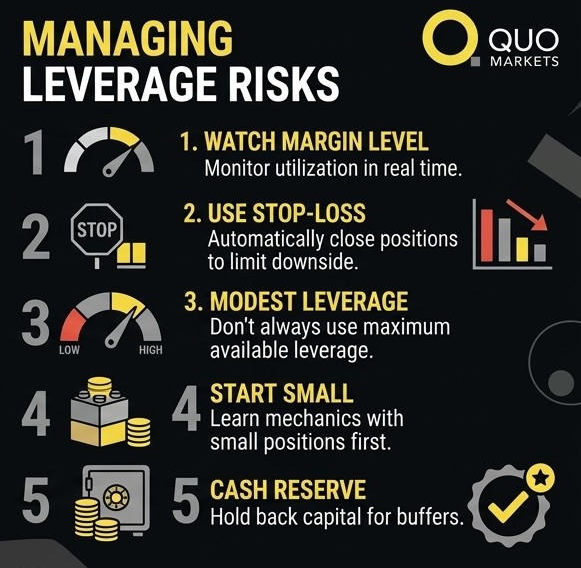
Margin trading can be used responsibly. It takes discipline and a clear set of rules you actually follow.
Watch your margin level. Most platforms display your margin utilization in real time. Keeping an eye on it during volatile stretches gives you room to act before a margin call forces your hand.
Use stop-loss orders. A stop-loss closes a position automatically when it hits a price you’ve set in advance, limiting your downside before losses pile up to the point of triggering a margin call. It’s one of the most practical tools available in leveraged trading.
Leave room between your position size and the maximum leverage available. Your broker offering 1:4 or 1:10 leverage does not mean you should use it. Many seasoned traders treat leverage as a modest amplifier, not a way to take on maximum exposure.
Start with smaller positions. If you’re new to leveraged trading, learning the mechanics with minimal margin is far more practical than discovering the risks through a large, unexpected loss.
Keep a cash reserve. Holding some capital back rather than putting everything into leveraged positions gives you flexibility when equity drops. That buffer can cover a margin requirement without forcing you to sell at the worst moment.
Final Remarks
Margin trading rewards preparation and punishes anyone who goes in without thinking it through. Borrowing to buy means every move, up or down, hits harder than it would with your own cash. Maintenance margins, margin calls, and forced liquidation can all escalate faster than most new traders expect. The regulatory framework provides some structure, but it doesn’t replace personal risk management.
Whether margin trading fits your approach depends on your risk tolerance, your understanding of the instruments you’re using, and your ability to actively watch and manage open positions. Done carefully, it can genuinely improve returns. Done carelessly, the losses arrive quickly and without much warning.
FAQs
What is margin trading in plain terms?
You borrow money from your broker to buy financial instruments beyond what your own balance allows. The borrowed amount is secured against your account holdings, which act as collateral.
What happens during a margin call?
Your broker notifies you that your account equity has dropped below the required threshold. You’ll need to deposit more funds or close positions. If you don’t respond in time, the broker can liquidate your positions automatically.
What is the difference between leverage and margin in trading?
Margin is the deposit you put up to open a leveraged position. Leverage is the ratio showing how large a position you can control relative to that deposit. With 1:2 leverage and $5,000 in margin, you control a $10,000 position. They’re closely related – margin is the capital requirement, leverage is the multiplier on your exposure.
What margin level is generally considered safe?
Many experienced traders aim to keep margin utilization below 50% of their available collateral. That buffer reduces the risk of a margin call during ordinary market swings.
Is margin trading right for beginners?
The risks are significant, and it generally suits traders who already understand leverage and have real risk management habits in place. If you’re starting out and still want to try it, use very low leverage, understand your broker’s policies in detail, and set stop-loss orders from the beginning.
Do margin requirements differ depending on the asset?
Yes, considerably. U.S. equities typically follow Regulation T’s 50% initial margin rule. Forex and crypto margins are calculated differently and often allow much higher leverage. Always confirm the specifics with your broker before trading.