
Imagine your first week with a trading account. A green candle shoots up, your heart jumps, and you click “buy” before you’ve finished a thought. Ten minutes later, the candle turns red. You tell yourself it will come back. It doesn’t, at least not fast enough for you. By Friday, you’re not sure whether you’ve learned something or just paid for a very expensive lesson.
Almost every trader has a version of this story. The markets don’t care how excited you are, and the internet is full of loud voices selling certainty. That’s why one of the best things a beginner can do, before risking a cent, is slow down and open one of the many books about trading for beginners.
Not to memorize a magic strategy. Those don’t exist. The point is to build a mental map: how markets behave, how people behave inside them (you included), and how to stay in the game when things go wrong. Here are the five kinds of trading books for beginners that make that map, in the order I’d read them.
1. Start with your own head
The hardest opponent in trading is usually the person staring back from the screen. Fear makes you close a good trade too early. Greed makes you hold a bad one too long. And after a loss, the urge to “win it back” can do more damage than the original mistake.
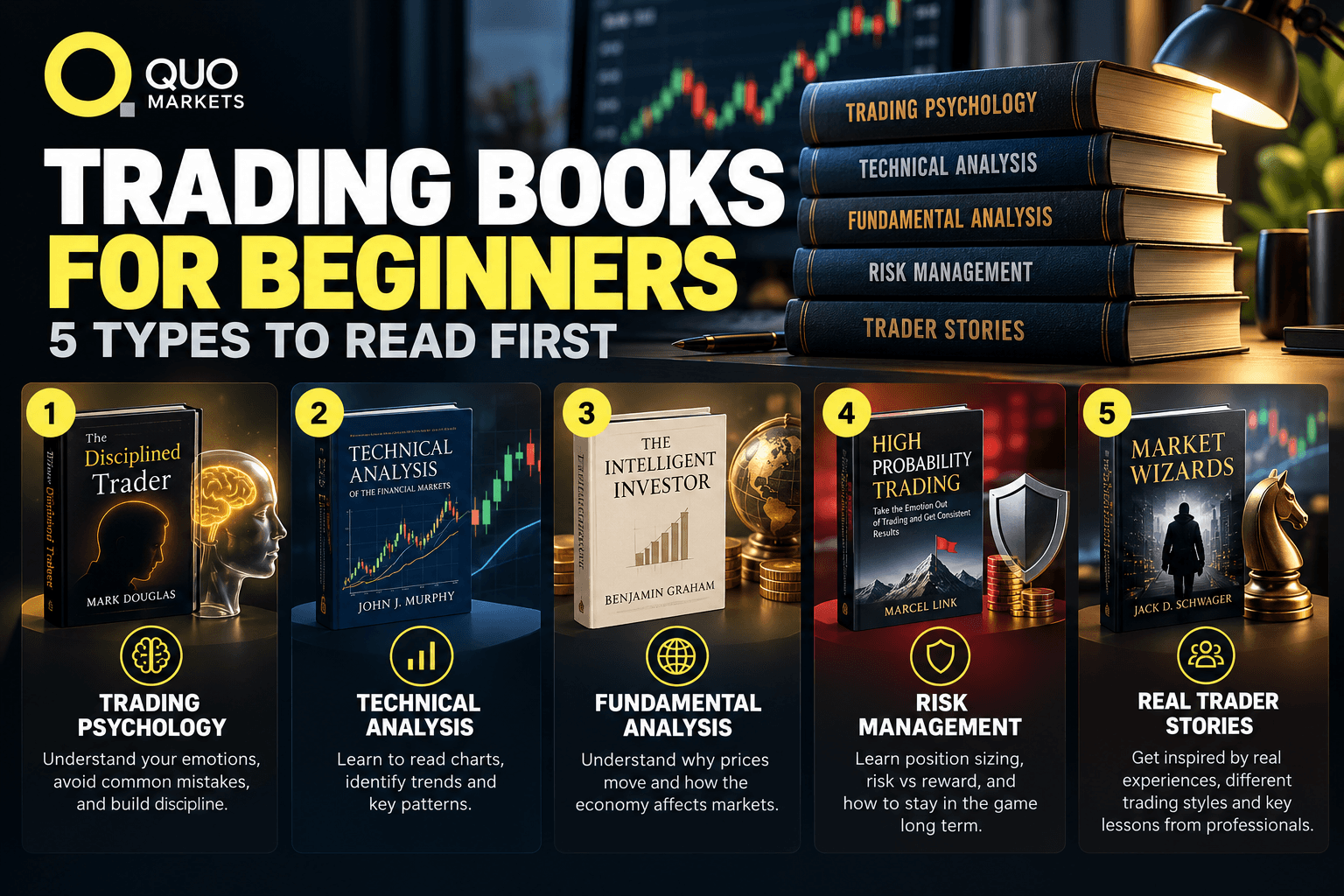
That’s why psychology books deserve the first slot on your shelf. Mark Douglas is the name you’ll hear most often here, and The Disciplined Trader is the one to begin with. Douglas argues that what you believe about the market quietly shapes every decision you make, and that consistency comes from taking full responsibility for your own choices rather than blaming the chart.
The lesson isn’t limited to one style. Whether you end up scalping intraday moves or holding positions for a few weeks, the same mind is making the calls. Learn to watch your reactions without obeying them, and a losing streak becomes something you can get through instead of something that wrecks you.
2. Learn to read the chart like a language
Once you’ve made peace with your emotions, it’s time to learn what the screen is actually telling you. A price chart looks like chaos at first. Then someone shows you support, resistance, trends, and volume, and it starts to read more like a sentence.
The long-standing favorite for this is Technical Analysis of the Financial Markets by John Murphy. It’s thick, and nobody expects you to finish it in a weekend, but it’s a patient walkthrough of chart patterns, indicators, and how different markets move. Think of it as a reference you’ll keep returning to, not a novel you finish once.
This matters most if you’re drawn to short-term trading, which is why so many day trading books for beginners spend their opening chapters on charts: decisions come fast, and there’s little time to hesitate. A trader who understands the chart acts on a plan. A trader who doesn’t acts on a feeling.
3. Ask why prices move at all
Charts show you what happened. They don’t always tell you why. For that, you need to look outside the chart: at companies, economies, interest rates, headlines.
Benjamin Graham’s The Intelligent Investor is the classic starting point, and it earns a place on any list of the best stock trading books for beginners. Its big idea is intrinsic value, the notion that a business is worth something real, and that the market’s daily mood swings are noise around that value. You may never become a value investor, but reading Graham gives you something priceless: a calmer way to think when everyone around you is panicking or celebrating.
This part of your education pays off even if you only trade short-term. A surprise inflation number or an earnings report can send prices flying in minutes, and currency traders feel the same thing whenever major economic data lands. Knowing the story behind the move keeps you from being blindsided.
4. Learn how to survive
If you remember only one section of this article, make it this one.
New traders love to talk about how much they could win. Experienced ones talk about how much they could lose, and what they’ll do about it. Too much leverage, positions that are too big, no exit plan: these are the quiet reasons accounts disappear. Making money in trading is rarely about one spectacular win. It’s about staying in the game long enough for your skills to catch up.
High Probability Trading by Marcel Link is a friendly place to start. It walks through risk versus reward, planning your trades, executing without second-guessing, and growing as a trader over time. The shorter your timeframe, the more every small cost and every swing counts, so these habits matter even more for active traders. Decide how much you’re willing to lose before you enter, and you’ll make far calmer decisions during the inevitable rough patches.
5. Borrow other people’s experience
Theory only goes so far. At some point you want to hear from people who’ve actually lived it, wins, blow-ups and all.
Jack Schwager’s Market Wizards is built from interviews with remarkable traders, and the most striking takeaway is how different they are. Different styles, different philosophies, different temperaments. There’s no single road to success, which is oddly reassuring when you’re trying to find your own.
Then come the practical guides, the day trading for beginners books that explain how things actually work from one session to the next:
- A Beginner’s Guide to Day Trading Online by Toni Turner
- How to Day Trade for a Living by Andrew Aziz
- Day Trading for Dummies by Ann C. Logue
- Start Day Trading Now by Michael Sincere
Between them, you’ll pick up the vocabulary, the platforms, the step-by-step routines and, just as importantly, a realistic sense of what to expect before real money is on the line.
A simple reading order

If a full shelf feels like too much, here’s a gentle path. Begin with psychology so you understand yourself. Add a chart-reading classic so you understand the screen. Layer in some fundamentals so you understand the world behind it. Study risk before you do anything else with money. And read a few trader stories whenever you need perspective or motivation.
The bottom line
No book will stop you from ever losing. Anyone who promises that is selling something. What good books do give you is a foundation: clearer thinking, steadier emotions, and the humility to treat trading as a craft you grow into, not a shortcut.
So before you binge another round of videos or chase the latest “secret” technique, spend a few weeks with the stock trading books for beginners above. Then open a demo account and practice, with nothing at stake but your pride. Trading always carries risk, and a slow, prepared start is the kindest thing you can do for your future self.
FAQs
What should I know before I start day trading online?
How your own emotions affect decisions, the basics of managing money and risk, and how stock and currency markets work. Get comfortable with these before you place a real trade.
Do these books help with swing trading and regular stock trading too?
Yes. Different timeframes, same foundation: you still need to read the market, control your risk, and stick to a plan.
Why does psychology matter so much for day traders?
Because things move quickly. Without a plan and a steady head, it’s easy to react instead of decide.
Should beginners read about short selling and other advanced topics?
Not yet. They’re useful later, but nail the core ideas first.
Can books really make a difference?
They can’t guarantee profit, but they build your knowledge, sharpen your money management, and help you avoid the mistakes most beginners make.