

Bitcoin ETF Explained: How It Differs From Owning Bitcoin
When the US approved the first spot Bitcoin ETFs in January 2024, many traders asked what had changed. Bitcoin was still Bitcoin. What changed was how people could get exposure to its price, and who could do it from an ordinary brokerage account.
Let’s explain how a Bitcoin ETF works, how it compares with owning Bitcoin directly, and what it means for traders who use crypto CFDs.
Key Takeaways
- A Bitcoin ETF gives exposure to Bitcoin’s price through fund shares, without direct ownership of the coins.
- Spot ETFs hold Bitcoin while futures ETFs hold contracts, so the two can behave differently even when Bitcoin moves the same way.
- A crypto CFD is a leveraged contract that gives no ownership of Bitcoin, and leverage magnifies losses as well as gains.
What Is a Bitcoin ETF?
An exchange-traded fund (ETF) is an investment fund whose shares trade on a stock exchange throughout the trading day, like shares of a company. A Bitcoin ETF is built to give investors exposure to Bitcoin’s price through those shares. It does not require them to buy Bitcoin, store it, or manage a crypto wallet.
Buying a share of a Bitcoin ETF does not give you Bitcoin you can send, spend, or move to a wallet. You own a share of a fund. The fund’s structure, custodian, and costs sit between you and the underlying asset.
Crypto ETFs more broadly follow the same logic. Some track a single coin, others a basket of digital assets. The Bitcoin versions are the best known, so they are the focus here.
How Does a Bitcoin ETF Work?
There are two main designs, and they behave differently.
Spot Bitcoin ETFs
A spot Bitcoin ETF holds actual Bitcoin. A custodian stores the coins on the fund’s behalf, and the fund issues shares that represent a portion of that holding. The share price should stay close to the value of the Bitcoin held, minus fees and small tracking differences.
Authorized participants help keep an ETF’s market price close to its underlying value by creating and redeeming shares. When US spot Bitcoin ETPs were approved in January 2024, these transactions were limited to cash. On 29 July 2025, the SEC approved in-kind creations and redemptions, allowing participating firms to exchange eligible Bitcoin or fund shares directly under the applicable procedures. In practice, you buy and sell shares through a broker at the market price during exchange hours.
Bitcoin futures ETFs
A futures ETF does not hold Bitcoin. It holds Bitcoin futures contracts, which are agreements to buy or sell Bitcoin at a set price on a future date. The first US Bitcoin ETF, the ProShares Bitcoin Strategy ETF (BITO), is this type and invests mainly in futures traded on the CME.
Futures expire, so the fund must regularly sell expiring contracts and buy new ones. This “rolling” can create costs, and the fund’s return can drift from Bitcoin’s spot price over time. That is why a futures ETF and a spot ETF can produce different results even when Bitcoin moves the same way.
A Short Timeline: From Futures Funds to Spot Approval
For years, US regulators rejected applications for spot Bitcoin ETFs. In August 2023, a US appeals court found that the Securities and Exchange Commission (SEC) had not adequately explained why it allowed futures-based funds while denying a spot conversion, and ordered it to reconsider.
- May 2015: Sweden’s XBT Provider launched a Bitcoin exchange-traded note on Nasdaq Stockholm, an early listed Bitcoin product in Europe.
- 19 October 2021: BITO began trading on the NYSE and recorded roughly $1 billion in first-day trading volume.
- 10 January 2024: The SEC approved the listing and trading of 11 spot Bitcoin ETF products, with trading starting the next day. The SEC chair said the approval was not an endorsement of Bitcoin.
“First Bitcoin ETF” therefore depends on geography and product type. October 2021 marks the first US Bitcoin ETF, and it was a futures fund. Listed Bitcoin products existed in Europe years earlier.
Bitcoin ETF vs Bitcoin: Key Differences
The comparison depends on what you want to know: ownership, cost, access, or trading hours.
Ownership. Owning Bitcoin directly means holding the asset itself, either in your own wallet or with a crypto platform. That allows you to use it for payments or transfers. An ETF share is a claim on a fund.
Access. An ETF is bought through a standard brokerage account. It requires no crypto wallet and no account with a crypto exchange. Direct ownership requires a wallet or exchange account, plus responsibility for security.
Costs. ETFs charge an annual management fee. Reported fees for US spot Bitcoin ETFs have ranged from about 0.15% to 1.5% a year, depending on the fund and the date, and BITO’s fee was 0.95% at launch. Many broad stock-market index ETFs charge far less, so crypto ETFs generally sit at the higher end of the ETF fee range. Check each fund’s current prospectus. Direct buyers pay exchange or platform fees and network costs instead.
Trading hours. ETF shares trade only when their exchange is open. Bitcoin itself trades around the clock, every day of the year. When a major price move happens on a weekend, an ETF cannot react until the market reopens.
Regulation. An ETF is a regulated product traded on a regulated exchange, with disclosure requirements. Regulation reduces certain operational risks but does not reduce the price risk of the underlying asset.
Volatility. An ETF wrapper does not smooth Bitcoin’s price swings. A fund that tracks Bitcoin is exposed to Bitcoin’s volatility, which has historically been higher than that of traditional ETFs, such as broad equity index funds.
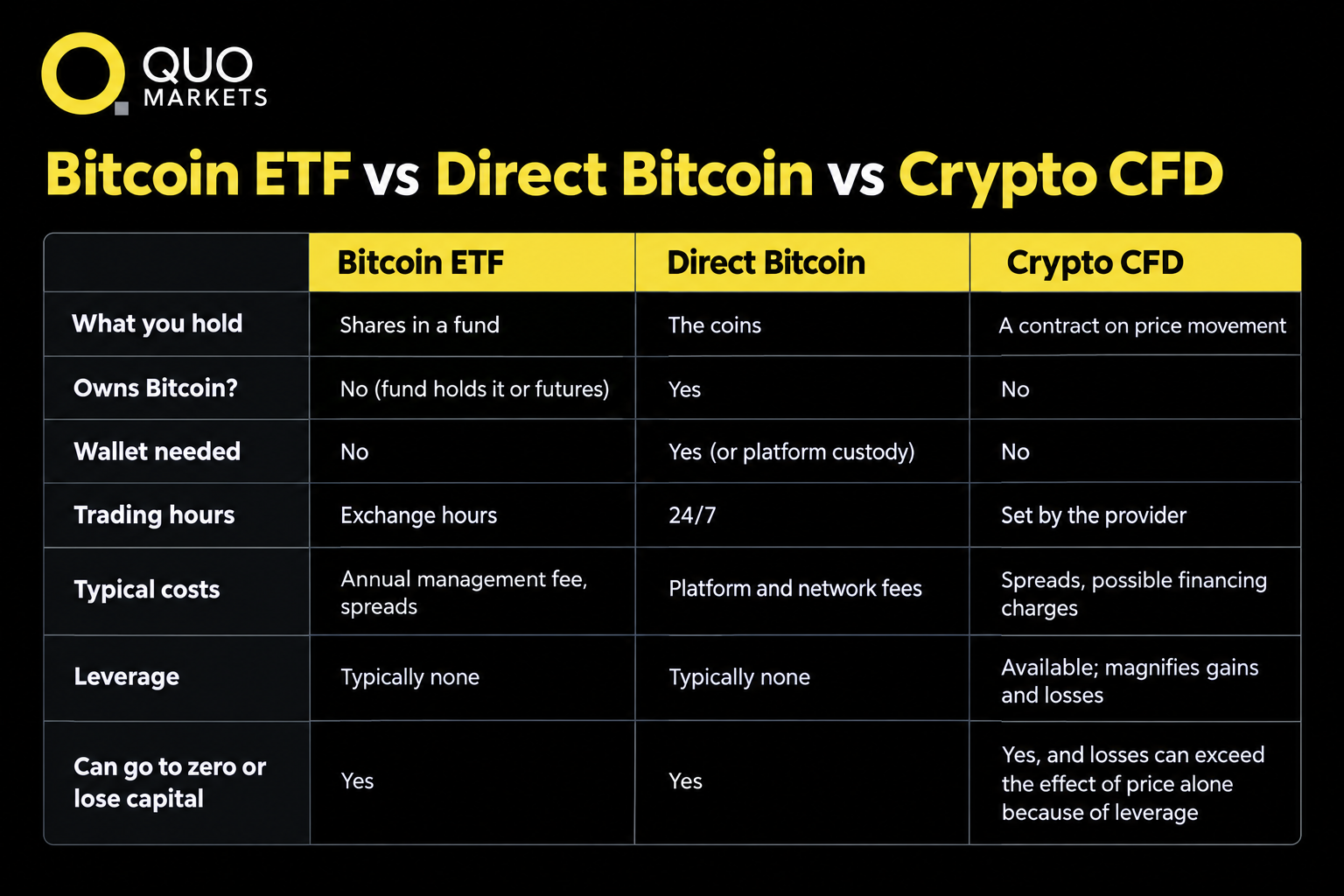
Each column has trade-offs rather than a winner, and the right fit depends on the reader’s goals, risk tolerance, and local rules.
Are Crypto ETFs Available in Europe?
Not in the same way as in the US, and availability varies by country. In the EU, retail investment-fund rules (UCITS) have generally made single-asset crypto ETFs difficult to offer, so access has largely come through exchange-traded products (ETPs) and notes (ETNs) listed on venues such as Deutsche Börse’s Xetra or the SIX Swiss Exchange. Some are physically backed by the underlying coins.
Whether a specific product can be bought by a specific retail client depends on the product’s regulatory status, the broker, and the investor’s country. Rules in the UK, EU member states, and Switzerland differ and have changed over time. Check what your own broker and regulator allow.
How Crypto ETFs Can Influence the Bitcoin Market
ETFs do not just track Bitcoin. Because they hold or trade it at scale, they can affect the market they track.
Liquidity and access. Spot ETFs allow institutional and traditional investors who could not or would not hold crypto directly to gain exposure through familiar accounts. Supporters argue that this brings more participants and deeper liquidity to the market.
Flows as a signal. Daily ETF inflows and outflows are published, and many analysts use them as one input when assessing market demand. Flows describe what investors have already done. They do not predict price, and strong inflows have coincided with falling prices at times.
Volatility is debated. Some argue that ETF-driven demand makes the market more mature. Others point out that concentrated holdings and large flows can add pressure in both directions. There is no settled answer, and anyone claiming one deserves scrutiny.
Regulatory approval is not endorsement. The SEC stated that approving the listing and trading of these products did not mean it endorsed Bitcoin. Approval of an ETF does not guarantee that Bitcoin’s price will rise, and it does not make the underlying asset low-risk.
What Crypto ETFs Mean for CFD Traders
For traders who use CFDs, ETFs matter mostly as information about the market rather than as a product to trade.
Large ETF flows can coincide with price moves in Bitcoin, because the funds buy or sell the underlying asset or futures in response to investor demand. A trader watching Bitcoin may pay attention to published flow data, the timing of US market hours and scheduled regulatory decisions, since these can be associated with changes in volume and volatility.
It is also worth remembering that a Bitcoin CFD and a Bitcoin ETF are different instruments. A CFD tracks a price through a contract with a broker, with no fund structure, no annual management fee, and no ownership. The trade-off is leverage and the financing costs that can accompany it.
Trading Crypto CFDs at QuoMarkets
QuoMarkets does not offer Bitcoin ETFs. It offers crypto CFDs, which allow traders to speculate on price movements of cryptocurrencies without owning the underlying assets.
Traders can choose between four account types and platforms, including MetaTrader 4 (MT4) and MetaTrader 5 (MT5). Demo accounts allow practice with virtual funds before any real money is at risk, and Negative Balance Protection applies to all accounts.
Some points matter before trading any crypto CFD:
- A CFD does not give you ownership of Bitcoin or any other crypto asset.
- Leverage magnifies losses as well as gains. A small adverse price move can lead to a large loss relative to the money in your account, and you can lose your entire deposit.
- Past performance does not indicate future results, and crypto prices can move sharply in either direction.
- CFDs are complex instruments and are not suitable for everyone.
Final Remarks
A Bitcoin ETF packages Bitcoin exposure into a share that trades during exchange hours, with a fund, a custodian, and an annual fee in between. Direct ownership gives control of the asset itself, with the responsibilities that follow. A crypto CFD offers price exposure without ownership, with leverage that can magnify losses as well as gains.
For CFD traders, ETF flows, and approvals are one more input into how Bitcoin behaves, not a signal on their own. Each route carries different costs, hours, risks, and rules, and the details depend on where you live. Whatever the instrument, understanding how it works and what you could lose comes before any trade.
FAQs
What is the difference between a spot Bitcoin ETF and a Bitcoin futures ETF?
A spot ETF holds actual Bitcoin through a custodian. A futures ETF holds futures contracts and has to roll them over, which can create tracking differences from Bitcoin’s spot price.
Does a Bitcoin ETF mean I own Bitcoin?
No. You own shares in a fund. You cannot withdraw coins to a wallet or use them for payments.
Are Bitcoin ETFs available to all investors?
No. Availability depends on the country, the product, the broker, and the investor’s classification. US-listed funds, for example, are generally not offered to European retail clients in the same way.
Can I trade Bitcoin ETFs with CFDs at QuoMarkets?
QuoMarkets does not offer Bitcoin ETFs. It offers crypto CFDs.
Risk warning: CFDs are complex instruments and come with a high risk of losing money rapidly due to leverage. Crypto asset prices are highly volatile. Trading may not be suitable for everyone. Consider whether you understand how CFDs work and whether you can afford the risk of losing your money.