
How to Compare Broker Fees in 2026 Without Getting Fooled by the Headline
Two traders open accounts with two brokers. Both brokers advertise “tight spreads.” Three months later, one trader has paid nearly double what the other did for the same trades.
Nobody lied, and nobody broke a rule. One trader simply compared the number on the banner, and the other compared what actually leaves the account.
In 2026, broker marketing is louder and more polished than ever: “0.0 pips,” “$0 commission,” “lowest costs anywhere.” This guide shows you how to see past those slogans and work out what a broker really costs you, using a method that takes about ten minutes.
Quick Takeaways
- A broker’s advertised price is its best case. Your cost is its average case.
- “Zero spread” and “no commission” are two ways of collecting the same money. Neither is automatically cheaper.
- The only fair comparison is total cost per trade, in dollars, for your style of trading.
- Fees outside the spread (swaps, withdrawals, conversion, inactivity) can quietly outweigh a “cheaper” spread.
- Transparent pricing matters as much as low pricing. If you can’t verify a cost, you can’t compare it.
The Four Ways Brokers Get Paid
Before comparing anything, know where the money comes from. Most forex and CFD brokers earn through some mix of these:
- The spread. The gap between the buy price and the sell price. You pay it the moment you open a trade.
- Commission. A fixed charge per lot or per trade, usually paired with raw spread accounts.
- Markup. An extra layer added on top of the raw market price. It can hide inside a spread that looks small.
- Ancillary fees. Overnight financing (swaps), deposit and withdrawal charges, currency conversion, inactivity fees, and paid data or platform tools.
A good comparison asks which of these a broker uses, and how clearly it discloses each one.
The Spread: Small Number, Big Impact
Here’s a quick sense of scale. On EUR/USD, one pip on a standard lot is roughly $10. A spread of 1.2 pips therefore costs about $12 before the trade has moved at all. Do that twenty times a month, and you’ve spent $240 just for the privilege of participating.
That’s why spreads deserve more attention than almost any other line on a fee page. But not all spreads are built the same:
- Variable spreads move with liquidity. They’re often tighter in calm markets and wider around news and rollover.
- Fixed spreads stay put, which makes budgeting easy, though the fixed number is usually higher.
- Raw (ECN-style) spreads sit very close to the underlying market price, with a separate commission on top.
Minimum vs. Average Spread: The Gap That Costs You
Almost every broker highlights its minimum spread. It’s the lowest reading ever recorded, often in a quiet moment with deep liquidity. It’s real, but it’s not typical.
What you’ll actually pay is closer to the average spread, especially during the sessions you trade. So ask three questions:
- What is the average spread on my pairs, not just the flagship one?
- What does it look like during the London and New York sessions and around major data releases?
- Does the broker publish live or historical spread data, or only a “from” figure?
A broker showing 0.0 pips overnight and 1.5 pips at the New York open isn’t cheap or expensive. It’s simply conditional, and you need to know the conditions.
“Zero Spread” and “No Commission”: Two Prices for the Same Thing
Zero-spread accounts sound like the end of the story, but the cost has to live somewhere. Usually it’s a commission, a markup, or both.
- Raw spread accounts: very tight spreads + a visible commission.
- Wider-spread accounts: no commission, with the cost baked into the spread.
Neither model wins on principle. The better one depends on how often you trade, how big your positions are, and when you trade. Scalpers and high-frequency traders often prefer raw pricing plus commission because the tight spread matters on every entry. Less frequent traders sometimes find a single all-in spread simpler and just as affordable.
Why “No Markup” Deserves a Closer Look
Markups are the hardest cost to spot because they don’t appear as a separate line. They’re added to the price feed itself, so a spread can look competitive while you’re being charged more than the market rate underneath.
That’s why pricing philosophy matters when you choose a broker. A no-markup model means the price you see is meant to reflect the underlying market, and the broker’s charges are stated openly (a spread or a commission) rather than folded invisibly into the quote. It also makes a comparison easier, because you’re weighing disclosed costs against disclosed costs.
QuoMarkets positions itself around this approach, with ultra-tight spreads and a no-markup pricing model. Whichever broker you’re evaluating, the useful test is the same: can you see, in plain terms, what you’re paying and why?
The Costs Outside the Spread
A spread comparison only covers the cost of entering a trade. Look at the rest of the account’s life too:
- Swaps / overnight financing: Matters most if you hold positions for days or weeks, or trade with leverage.
- Withdrawal fees and speed: A “free” account that charges to take your money out, or takes days to do it, isn’t free.
- Deposit and conversion costs: If your account currency differs from your funding currency, conversion margins add up.
- Inactivity fees: Small on paper, annoying in practice if you trade in bursts.
- Platform and data fees: Some brokers charge extra for tools others include.
If you trade infrequently but hold positions for a long time, swaps and withdrawal terms may matter more to you than a fraction of a pip.
Execution Quality: The Cost Nobody Prints
Two brokers can show identical spreads and still deliver different results. Execution quality shows up as:
- Slippage: getting filled at a worse price than you clicked.
- Requotes and rejections: missing the entry entirely.
- Speed under pressure: how the platform behaves when the market is moving fast.
You can’t read this off a fee table. Test it. Open a small live account or use a demo, trade during busy hours, and compare what you clicked with what you got. Fast infrastructure and stable MT4/MT5 connectivity aren’t luxuries for active traders; they’re part of the price.
A Worked Example: The Same Trades, Three Very Different Bills
Here’s an illustrative comparison (hypothetical numbers, for demonstration only). Imagine a trader placing 20 EUR/USD trades a month, 1 standard lot each, with pip value around $10. Overnight financing is left out to keep the math clean.
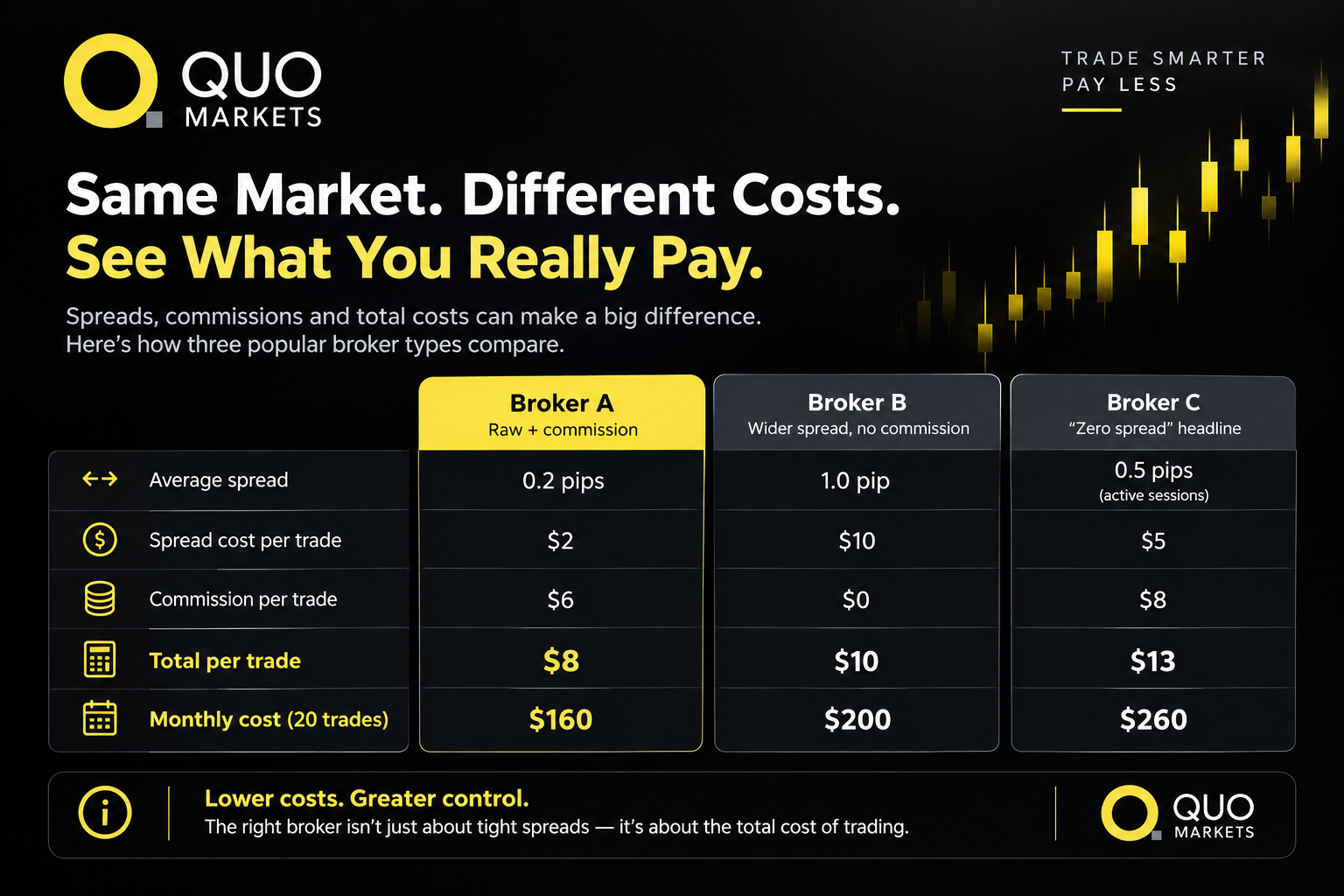
Broker C had the most attractive banner and the highest bill. Broker A wasn’t “zero” on anything, yet it came out cheapest for this trader. Change the trade frequency, lot size, or trading hours and the ranking can shift, which is exactly why you run the numbers on your own profile instead of trusting the headline.
Your 6-Step Comparison Method
- Define your trading profile. How many trades per month? What size? Which pairs? Which sessions? Intraday or multi-day?
- Collect average spreads, not minimums, for your pairs and your busiest hours.
- Add commissions and convert everything to cost per standard lot, round turn.
- Estimate ancillary costs: swaps for your typical holding time, plus withdrawal, conversion, and inactivity terms.
- Check the fine print on the broker’s website or client agreement, and ask support directly if anything is vague. Clear answers are a good sign.
- Test before you commit. Trade small and compare intended prices to filled prices.
Don’t Forget the Trust Layer
The cheapest broker isn’t a bargain if you can’t rely on it. Before funding an account, check:
- Regulation and licensing: which entity you’re contracting with, which authority oversees it, and what protections apply in your region.
- Fund handling: how client money is held, and whether the broker offers independent verification, such as audited proof-of-reserves reporting.
- Withdrawal track record: how fast and how consistently clients get paid.
- Support quality: especially in your language and time zone.
Low fees mean little without dependable withdrawals and honest disclosure.
The Bottom Line
The broker with the loudest “lowest spread” claim isn’t necessarily the cheapest. The cheapest broker is the one whose total, verified cost per trade is lowest for the way you trade, and one that’s upfront about every charge along the way.
So compare average spreads, convert everything to dollars per trade, count the extras, test the execution, and choose the broker that makes its pricing easy to understand.
If transparent pricing, ultra-tight spreads, MT4/MT5 access across forex, commodities, indices, stocks, and crypto, and fast withdrawals are on your checklist, put QuoMarkets through the same six steps and see how the numbers hold up.
FAQs
What fees should I expect from a forex broker?
Mainly spreads, commissions (on raw spread accounts), and overnight swaps, plus possible withdrawal, conversion, inactivity, and platform charges depending on the broker.
Is the lowest-spread broker always the cheapest?
No. A tight advertised spread can be offset by commissions, markups, wider spreads in busy sessions, or poor execution. Compare total cost per trade instead.
Is zero spread trading really free?
No. Brokers offering zero spreads typically recover their revenue through commissions or pricing adjustments.
What’s better: a raw spread account or a no-commission account?
It depends on your trading frequency, lot size, and sessions. Active traders often favor raw spreads plus commission, while occasional traders may prefer one all-in spread.
What does “no markup” mean?
It means the broker doesn’t add a hidden extra layer to the market price. Its charges are stated openly instead, which makes costs easier to verify and compare.
Does the trading platform affect my costs?
Yes. Stable, fast execution reduces slippage and missed entries, which can save more than a small difference in fees.
Risk warning: Trading leveraged products such as forex and CFDs carries a high level of risk and may not be suitable for everyone. You can lose more than your initial deposit. The figures in this article are hypothetical and for illustration only. Always review your broker’s current fee schedule and terms before trading.