

Table of Contents
- Introduction
- Choosing What to Trade and Where to Trade It
- Technical Analysis: The Core of Every Good Day Trade
- Day Trading Strategies Worth Actually Understanding
- Risk Management for Crypto
- The Psychology No One Explains Before You Start Trading
- Final Thoughts
- FAQs
Crypto Day Trading: The Definitive Guide for Traders
Crypto day trading has a grip on traders that’s hard to explain until you’ve felt it yourself. The reason is simple: crypto markets don’t close. While stock exchanges go dark at the end of the business day, crypto runs around the clock, 24 hours a day, every single day of the week. No Monday morning wait. No halted sessions. No forced downtime.
What that creates is a constantly-open arena where prices can shift violently in minutes, producing short-lived opportunities that traditional markets structurally can’t offer. For traders wired to move fast, read short-term price action, and make decisions under pressure, that’s the whole appeal.

Choosing What to Trade and Where to Trade It
Two decisions will shape everything before you place a single order: the assets you trade and the platform you use.
Prioritize Liquidity Over Excitement
Most experienced crypto day traders prefer assets with high liquidity and strong trading volume – Bitcoin and Ethereum being the obvious examples. Liquidity is what allows you to get in and out of positions quickly without your order moving the price against you.
This matters more than most beginners realize. When you’re executing multiple trades in a single session, slippage and poor execution add up fast. High-volume markets also produce cleaner price charts and more reliable technical signals, making analysis significantly more effective.
Platform Choice Is Not a Detail
Your trading platform is your infrastructure. A solid exchange for day trading needs fast order execution, genuine security, and fee structures that are transparent, not buried in the fine print.
When evaluating platforms, the factors that matter most are:
- Track record and reputation in the crypto market
- Tight spreads and competitive commissions
- Quality charting tools with proper technical analysis features
- Access to derivatives like CFDs or futures for more advanced setups
- API access or automated trading tools for anyone building algorithmic systems
One thing to watch: plenty of platforms market themselves as commission-free, but the real costs show up in spread markups and funding fees. For day traders making dozens of trades a week, those hidden costs can quietly carve up profits in ways that only become obvious after the fact.
Technical Analysis: The Core of Every Good Day Trade
Day trading is about using price data well enough and consistently enough to shift the probability in your favor. What matters here is what the chart is telling you right now.
Understanding Candlestick Charts
Everything starts with candlesticks. Each one represents a specific timeframe and shows four things: the open, the close, the high, and the low. Long wicks signal rejection – price tried to move in a direction and got pushed back. Large bullish candles suggest genuine buying pressure. Learning to read these patterns gives you a working language for identifying potential entries and exits in real time.
Moving Averages
Moving averages smooth out the noise in price action and help reveal the underlying trend. The crossover approach is particularly popular: when a short-term moving average crosses above a longer one, it can indicate a bullish shift; when it crosses below, downside pressure may be building. Most experienced traders layer them with other tools to validate signals before acting.
Relative Strength Index
The Relative Strength Index (RSI) measures momentum on a scale from zero to one hundred. When RSI climbs above 70, the market may be overbought. When it falls below 30, oversold conditions may be developing. That doesn’t guarantee a reversal, but it gives you meaningful context when evaluating whether a move has room to continue or is running out of steam.
MACD And Volume
The Moving Average Convergence Divergence (MACD) helps you spot shifts in momentum and potential trend reversals before they fully develop. Volume analysis works alongside it – a sudden spike in trading volume behind a price move often confirms whether a breakout is genuine or a head fake.
Combining multiple indicators improves your ability to identify high-probability setups and time your entries and exits with more precision.
Day Trading Strategies Worth Actually Understanding
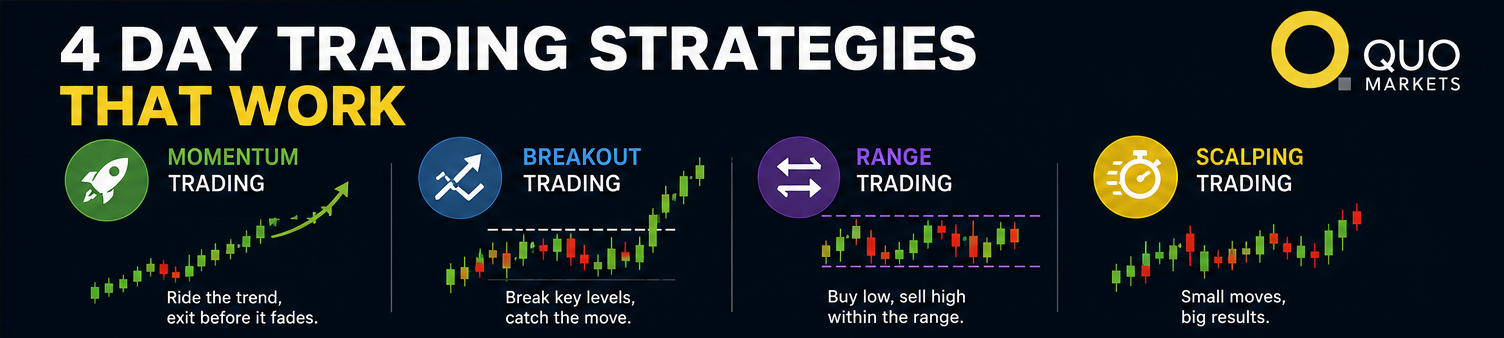
No single strategy works across every market condition or suits every trader’s personality. The goal is understanding the logic behind each one so you can deploy it when conditions actually support it.
Momentum Trading
Momentum trading is about getting on board a move that’s already in progress. A major protocol upgrade, a regulatory decision, a sudden flood of volume – these events can send prices surging or collapsing in minutes. Momentum traders try to enter early in the move and exit before it loses energy. Define your entry triggers and profit targets before the trade, not during it.
Breakout Trading
Breakout trading focuses on entering when the price moves decisively through a key support or resistance level. When price breaks through convincingly, it often signals the start of a new directional run. Traders typically protect themselves with stop-loss orders placed just below the breakout point, because false breaks are common in crypto.
Range Trading
When markets are moving sideways, range trading earns its keep. Identify the upper and lower boundaries of a price channel, buy near support, sell near resistance. It’s methodical and effective during consolidation phases. The main risk is a breakout blowing through your position in either direction, which is why stop-losses on both sides are essential.
Scalping
Scalping involves executing dozens, sometimes hundreds, of trades in a single session, capturing tiny profits from small price movements. Cumulatively, the effect can be meaningful, but frequent trading means constant exposure to spreads, commissions, and fees that compound quickly. Most scalpers focus on highly liquid assets and work with 5- to 15-minute charts to sharpen entry timing.
Risk Management for Crypto

Even a technically sound strategy will eventually fail without proper risk management. In crypto, a market capable of erasing hours of gains in minutes, that failure tends to be decisive.
The foundation is the 1–2% rule: never risk more than 1–2% of your total trading capital on any single trade. On a $10,000 account, that means a maximum loss of $100–$200 per trade. This is what keeps a losing streak from becoming a liquidation event.
The tool that enforces this is the stop-loss order. Set it before you enter, and it automatically closes your position if the price moves against you by a defined amount. It removes the temptation to hold a losing trade while hoping for a reversal, a habit that leads to the kind of catastrophic losses most traders only survive once.
Other non-negotiables include:
- Avoiding high leverage: Leverage amplifies both gains and losses. For beginners, it’s often a direct route to getting wiped out.
- Diversifying positions: Concentrating all your capital in one coin exposes you to single-asset risk. Spreading across assets provides a meaningful buffer.
- Setting a daily loss limit: Pick a maximum daily loss and walk away when you hit it. This is the primary defense against revenge trading, the impulsive decisions that compound losses instead of recovering them.
Keep records of every trade, deposit, and withdrawal. Beyond self-evaluation, it’s a legal requirement in most jurisdictions for accurate tax reporting.
The Psychology No One Explains Before You Start Trading
Technical skill alone isn’t enough. The most sophisticated strategy breaks down when the trader executing it can’t manage their emotional responses.
Two forces drive most mistakes: fear and greed. Greed shows up as FOMO; you see a coin exploding across social media and jump in without analysis, usually right at the top. Fear shows up as panic selling during a minor dip, locking in a loss moments before the market rebounds.
Traders who last treat this like a business. They follow a trading plan with the same discipline a pilot uses a pre-flight checklist, because structure is what separates them from the people who blow up their accounts in month three.
Keep a trading journal. Log every trade: what prompted it, what you were feeling, and what happened. Reviewing it regularly helps you identify the emotional patterns quietly sabotaging your results and correct them before they become ingrained habits.
Missing an opportunity is recoverable. Losing your capital chasing one often isn’t.
Final Thoughts
Crypto day trading is a market that rewards traders who build real skills, understand the mechanics, and take risk management seriously. For those who do, it offers access and opportunity that few other markets match.
Start small. Use a demo account or trade with minimal capital while your strategy develops. Study your past trades harder than you study market news. Set your rules before each session. The market will be there tomorrow. Without discipline, your capital might not be.
Sustainable profits come from consistency. Every experienced trader figured that out the hard way.
FAQs
Is crypto day trading legal?
In most countries, yes, but regulations differ significantly. Many governments require traders to report capital gains from crypto, while others have placed restrictions or bans. Research your local laws and tax obligations before you start.
Can crypto day trading actually be profitable?
Yes. Volatility and frequent price movements create real opportunities. That said, a significant number of traders lose money early on, and the learning curve is real.
Which coins are best for day trading?
Most day traders stick to high-liquidity assets like Bitcoin and Ethereum. These markets offer smoother execution, more reliable price data, and better conditions for short-term strategies.
How much capital do you need to start?
There’s no fixed minimum, but most beginners start small to limit exposure while they learn. The rule that matters most: never risk more than 1–2% of your total capital on a single trade.
What tools do crypto day traders use?
The standard toolkit includes moving averages, RSI, MACD, and volume indicators – tools that help traders read price data, spot trends, and time entries and exits with greater precision.