
Indices Trading: The Complete Beginner’s Guide
Watch any business broadcast, and you’ll see a ticker tape of red and green numbers constantly flickering across the bottom of the screen. Standard & Poor’s. Dow Jones. FTSE. To most casual viewers, they’re just background noise – a quick pulse check on whether Wall Street had a good or bad day. But for traders, those numbers aren’t just report cards. They’re the market itself, bought and sold in seconds.
Let’s explore everything you need to know about indices trading, from how indices are built and what drives their prices to the products you can use, the strategies that work, and the risks you must respect.
What Is Index Trading?
An index is a numerical measure that tracks the performance of a group of assets, most often stocks, bundled together to represent part of or an entire market. The S&P 500, for example, reflects the performance of roughly 500 prominent US stocks ranked by market cap, while the FTSE 100 tracks the 100 largest companies listed on the London Stock Exchange. Index values reflect the prices of their constituent assets, rising or falling as the underlying stocks move.
Indices trading means speculating on these index price movements through derivatives or funds that mirror the underlying index. You do not own individual stocks. Instead, you use products like CFDs, futures, or ETFs whose value is derived from the index price. This means traders can profit by going long or short on indices depending on their market view.
Here are the essentials to keep in mind:
- Indices measure the price performance of a group of shares from a specific market, sector, or theme.
- Beyond equities, indices can cover the bond market (including the investment-grade bond market), the commodity market, and currency indices like the US Dollar Index (DXY).
How Are Indices Built and Calculated?
Index providers such as S&P Dow Jones Indices, FTSE Russell, and STOXX select constituents using criteria including market capitalization, trading volume (liquidity), sector representation, and listing on specific stock exchanges. Once selected, each constituent stock receives a weight, and the combined weighted price changes produce the overall index value through a formula and a “divisor” that ensures continuity when stocks are added, removed, or split.
The three main weighting methods are:
- Market-cap weighted indices assign weight by each company’s market value. The S&P 500 and MSCI World use this approach, meaning larger companies exert more influence on the index’s performance. A single mega-cap stock’s earnings surprise can shift the entire index.
- Price-weighted indices assign weight based on individual share prices. The Dow Jones Industrial Average is the classic example. Higher-priced stocks move the index more, regardless of total company size.
- An equal-weighted index treats all constituent stocks equally. The S&P 500 Equal Weight version gives mid-cap firms more relative exposure than the standard cap-weighted version.
Indices undergo periodic maintenance through rebalancing or reconstitution, typically on quarterly schedules. The S&P 500, for instance, reviews constituents in March, June, September, and December. The FTSE 100 follows a similar quarterly cycle. Off-schedule changes can be triggered by mergers, delistings, or other corporate events.
Types of Indices You Can Trade
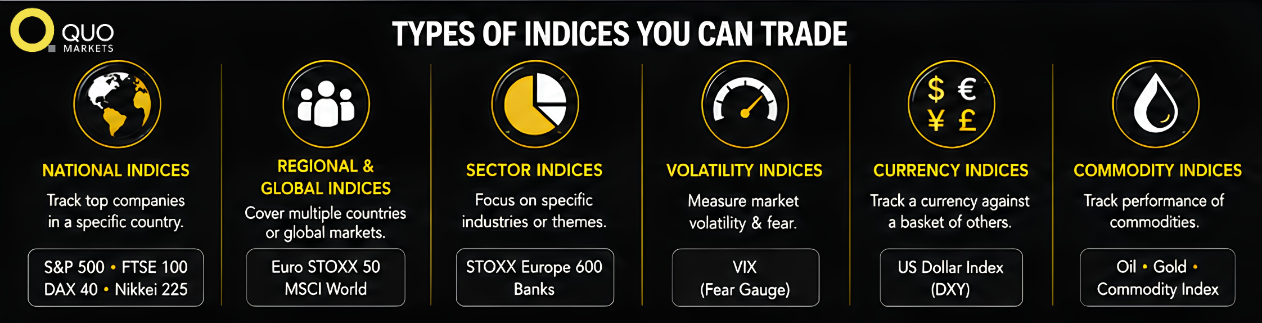
There are many indices available across geography, sector, and asset class, giving traders flexibility in how they gain exposure to global markets. Here are the main categories:
- National indices track companies listed in specific countries. The S&P 500 index covers large-cap US stocks, the FTSE 100 represents top UK firms on the London Stock Exchange, the DAX 40 follows 40 blue chips on the Frankfurt Stock Exchange, and the Nikkei 225 captures 225 large firms on the Tokyo Stock Exchange.
- Regional and global indices span multiple countries. The Euro STOXX 50 covers Eurozone blue-chip stocks, while the MSCI World index tracks large and mid-cap stocks across developed global markets.
- Sector indices focus on specific industries like technology or healthcare. The STOXX Europe 600 Banks index is a popular index in this category.
- Volatility indices measure market volatility. The VIX, known as the “fear gauge,” reflects expected 30-day volatility in the US stock market based on S&P 500 options pricing.
- Currency indices track a currency against a basket of others. The US Dollar Index (DXY) measures the USD relative to six major trading partners.
Broad market indices tend to be less volatile than narrow, niche alternatives. Small-cap indices like the Russell 2000 or thematic indices such as clean-energy trackers carry higher risk and sharper moves.
Why Trade Indices Instead of Individual Stocks?
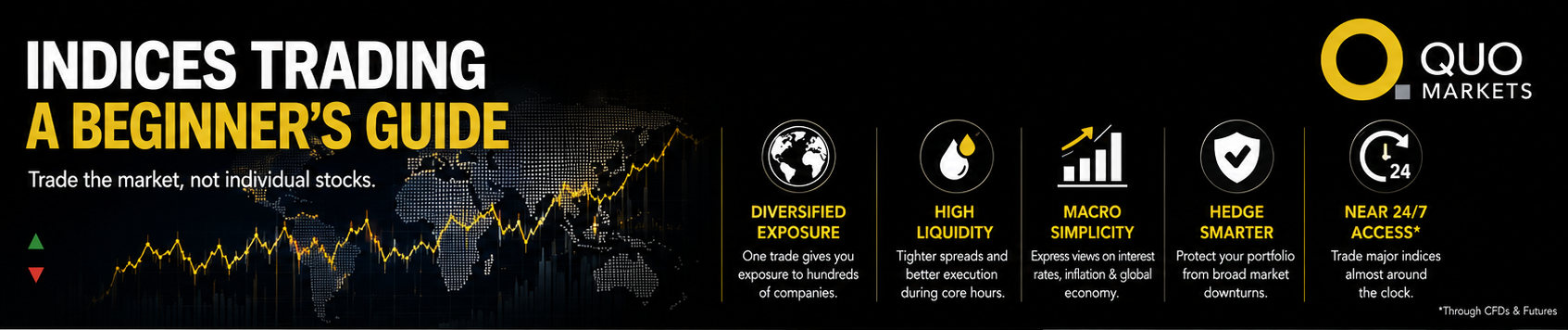
Trading indices enables traders to gain exposure to entire economies, sectors, or investment themes in a single transaction. Rather than analysing and selecting dozens of individual stocks, you can express a view on broader market exposure through one position.
- Diversification: one index position spreads risk across multiple companies. A profit warning from a single firm has far less impact on the S&P 500 than on that company’s share price alone.
- Liquidity: High liquidity in major indices often leads to tighter spreads and better execution, especially during core trading hours (roughly 14:30–21:00 UTC for US indices).
- Macro simplicity: traders can express views on interest rates, inflation, or global growth via indices rather than picking individual winners.
- Hedging: indices can be used to hedge existing stock positions effectively. A portfolio manager holding US stocks, for instance, might short a stock index to protect against broad market declines during falling markets.
What Moves Index Prices?
Index prices ultimately reflect the combined moves of all constituent stocks. In market-cap-weighted indices, larger companies carry disproportionate influence, so a strong earnings report from Apple or Microsoft can move the entire S&P 500 meaningfully on a single day.
Key drivers of index price movements include:
- Central bank decisions from the Fed, ECB, or Bank of England, along with economic data releases such as inflation figures (CPI, PCE), employment data (US Nonfarm Payrolls), and GDP growth reports.
- Company financial results from mega-cap constituents. During earnings season, a handful of reports can set the tone for an entire index compared to the broader market.
- Market sentiment and investor psychology play vital roles in price movements. Geopolitical events like elections, wars, and trade disputes often trigger broad market movements across many indices simultaneously.
- Rebalancing dates and passive fund flows. When indices are rebalanced, passive index-tracking funds must buy or sell stocks to match new weightings, potentially increasing trading volume and affecting prices around rebalance dates as index-tracking funds adjust their holdings around specific calendar dates. Sector rotation between growth and value stocks can also shift which indices outperform.
Traders should track macroeconomic indicators that affect index movements and stay aware of the economic news calendar.
Ways to Gain Exposure to Indices

You cannot buy a stock index directly. Instead, you use financial instruments designed to track the underlying index. Here are the main products:
- Index funds and exchange-traded funds (ETFs) are common long-term options. An S&P 500 ETF like SPY or VOO physically holds the underlying stocks and charges a small expense ratio (SPY’s is roughly 0.09% annually). ETFs trade during regular stock exchange hours and suit long-term index investing strategies.
- Index futures are standardised contracts traded on exchanges like the CME. The E-mini S&P 500 futures contract, for example, represents $50 multiplied by the index level and expires on a quarterly cycle. Futures provide leverage and near-24-hour access, making them popular for shorter-term speculation.
- CFDs on indices are OTC financial derivatives popular with retail traders. CFDs enable trading indices with leverage for larger market exposure, allow flexible position sizing, and let you go long or short on an index with CFDs. Most retail index trading is done using CFDs or spread betting. However, CFDs allow leveraged trading of indices with a margin deposit, and trading costs include spreads, commissions, and overnight financing fees.
Index Trading Hours and Global Sessions
Index trading hours depend on the underlying stock exchange’s hours, though many brokers offer nearly 24-hour access to the most traded indices via CFDs and futures during the trading week.
- The core US cash-equity session runs from 09:30 to 16:00 ET. That corresponds to 14:30–21:00 UTC while US daylight saving time is in effect and 15:30–22:00 UTC during US standard time. This is when the S&P 500 and Nasdaq 100 see the deepest liquidity and tightest spreads.
- The European session covers London (08:00–16:30 UK time for the FTSE 100) and Frankfurt (09:00–17:30 CET for the DAX 40), overlapping with US pre-market hours and delivering high activity for European and global indices.
- The Asian session includes Tokyo (09:00–15:30 JST for the Nikkei 225) and Hong Kong, providing the primary liquidity window for Asian popular indices.
Many brokers run a daily maintenance break where trading pauses briefly. Overnight gaps can occur between the previous close and next open when economic news or geopolitical events break outside regular hours. Beginner traders should start with well-known liquid indices during their most active local session to improve execution reliability and benefit from the current market price reflecting full participation.
Step‑by‑Step: How to Start Trading Indices

Starting your first index trade does not need to be complicated. Here is a straightforward process:
- Choose an index. Pick one or two major indices that fit your time zone and interests, such as the US 500 (S&P 500) or Germany 40 (DAX 40). Avoid spreading attention across too many indices early on.
- Select a trading product. Use an ETF or index fund for longer-term, lower-risk exposure. Choose CFDs or index futures if you want shorter-term, active trading with the ability to trade in falling markets.
- Pick a regulated broker. Check that the broker holds licences in your jurisdiction. Be aware that some providers restrict access in certain regions (USA, Canada, and various sanctioned countries, for example). Also review the broker’s spread, leverage limits, and fee structure.
- Fund your account and practise on a demo account first. Demo trading helps you understand execution, slippage, and how the underlying market behaves without risking real capital.
- Place your first small trade. Use conservative position sizes and modest leverage.
Key order types to know:
- Market order: executes immediately at the best available price.
- Limit order: fills only at your specified price or better.
- Stop-loss order: exits a losing trade automatically at a preset level. Stop-loss and limit orders help manage risk in index trading.
- Take-profit order: locks in gains when price hits your target.
Core Index Trading Strategies for Beginners
Having a trading plan with entry and exit rules along with risk limits is essential, even when trading broad market indices rather than trading individual stocks.
Trend-following is one of the simplest approaches. On daily charts, identify the prevailing direction using moving averages such as the 50-day and 200-day. When price is above both, and they are sloping upward, the trend favours long positions. This trading style suits traders who prefer to align with the dominant direction.
Swing trading targets moves over one to five days. Traders look for support and resistance zones, using tools like RSI, MACD, and candlestick charts, which are commonly used in technical analysis for index trading, to time entries and exits within a broader trend.
Breakout trading involves entering positions when the price decisively moves past resistance or support, often around scheduled economic data releases or earnings dates. This approach requires quick execution and disciplined stop-losses.
Long-term investing via index funds or ETFs is the least active strategy. Buying and holding a broad market index over years benefits from compounding returns and lower fees.
Fundamental views matter too. Expectations for interest-rate cuts, for example, tend to support equity indices, while tightening cycles can weigh on them. Successful trading requires understanding market drivers and risks alongside your chosen technical framework.
Risk Management in Indices Trading
Indices provide broad market exposure through a single position, but they still carry significant market risk and concentration risk, especially when traded with leverage through CFDs, futures, or margin accounts. Leverage allows traders to control larger position sizes with smaller deposits, but it can magnify both gains and losses in indices trading.
- Position sizing: risk management involves not risking more than 1% to 2% of total capital per trade. This limits the damage from any single losing position.
- Stop-loss orders limit potential losses in a trade by automatically closing a position when price moves against you by a predetermined amount.
- Avoid concentration in a single index or direction. During market-wide sell-offs, correlations between assets can increase sharply, meaning diversification across many indices may fail to protect capital. Diversification does not eliminate market risk in index trading.
- Systemic risk is real. During events like the 2020 pandemic shock, nearly all global indices fell together. Indices trading carries significant risk that cannot be diversified away entirely.
Final Remarks
Ultimately, trading indices offers a direct way to capitalize on broad market movements without the headache of stock picking. By starting with highly liquid benchmarks, mastering a single entry strategy, and keeping your risk tight on QuoMarkets, you give yourself room to learn without unnecessary stress. Focus on execution over fast profits, stick to a disciplined plan, manage your leverage, and let consistency build your trading edge over time.
FAQs
Can I trade indices with a small account?
Yes. Many brokers offer fractional index CFDs or low-minimum index ETFs, so you can gain exposure to major indices with as little as a few hundred dollars.
Are index funds and indices trading the same thing?
Not quite. An index fund or ETF is typically a long-term investment vehicle that passively tracks an index, usually without leverage. Indices trading more commonly refers to active, shorter-term speculation using leveraged products like CFDs or futures, where you can go long or short and trade intraday moves. Long-term investors tend to prefer index funds, while active traders lean on financial derivatives.
Which index is best for a complete beginner to trade?
Many beginners start with one or two major indices that have high liquidity and broad news coverage, such as the S&P 500 (US 500) or the Nasdaq 100 (US Tech 100). These are among the most traded indices globally and offer tight spreads during core hours. The “best” index depends on your time zone, risk tolerance, and trading style, so test your approach on a demo account before committing real capital.
Do dividends affect index prices?
They can. Price return indices only reflect stock prices, while total return indices assume dividends are reinvested. Most tradable products like futures and CFDs are priced off the price return version. When large constituent stocks go ex-dividend, the index price typically drops by the dividend amount, and brokers may apply a dividend adjustment to open CFD positions. Staying aware of major ex-dividend dates helps avoid surprises.
Is indices trading suitable for long‑term investing?
Long-term investors usually use low-cost index funds or ETFs to hold positions in major indices over many years, benefiting from compounding and minimal trading fees. Leveraged derivatives like CFDs and futures are generally not suitable for buy-and-hold investing due to ongoing financing costs and margin requirements. If your goal is wealth building over decades, a broad-market ETF is the more appropriate tool. Active indices trading suits shorter-term horizons where you are managing positions daily or weekly.