
Short-Term Moves or Long-Term Trends? Explore Different Types of Trading
What Are the Different Types of Trading?
The main types of trading are scalping, day trading, swing trading and position trading. They are generally classified by how long a trader holds a position, from a few seconds to several months or longer.
Trading involves buying and selling financial instruments to take advantage of price movements. Traders may use technical analysis, economic data, company news, or market sentiment to identify potential opportunities. Their approach depends on their trading strategy, objectives, and the conditions in the market.
There is no universally accepted number of trading styles. The four approaches above are commonly distinguished by holding period, while momentum trading, breakout trading, news trading, and algorithmic trading describe other ways of identifying or executing trades. These methods can overlap with different holding periods.
For CFD traders, understanding these differences helps explain how trading frequency, overnight exposure, transaction costs, and market monitoring can affect a trading plan.
Key Takeaways
- Trading styles differ mainly in how long positions remain open, how frequently trades are placed, and how much time traders spend monitoring market movements.
- Scalping and day trading focus on short-term price changes, swing trading targets moves over several days or weeks, and position trading follows longer-term market trends.
- Each trading style carries different costs and risks, and potential gains depend on market conditions, execution, trading costs, and risk management.
1. Scalping: Trading Small Price Movements
Scalping is a short-term trading style that aims to capture small price movements through positions held for seconds or minutes. Scalpers may place multiple trades during a single session, looking for opportunities in brief changes in supply, demand, and market momentum.
Because individual price movements are often small, execution costs and speed can have a significant effect on results.
How scalping works
A scalper typically monitors short-term charts, price changes, trading volume where available, and the bid-ask spread. The bid is the price at which a buyer is willing to purchase an instrument, while the ask is the price at which a seller is willing to sell it. The difference between them is the spread.
For example, suppose a CFD is quoted at 100.00 bid and 100.02 ask. A trader who opens a long position at the ask and immediately closes it at the bid would face a 0.02 price difference before considering commissions and any other applicable charges.
The scalper’s strategy may look for a small move that exceeds these costs. However, the market can move against the position before the intended exit, and repeated trades can accumulate losses and expenses.
What scalpers monitor
Scalping generally relies on:
- Short-term price charts: Often one-minute or similarly short intervals.
- Liquidity: Sufficient market activity to help orders execute at reasonable prices.
- Spreads and commissions: Costs that can have a substantial cumulative effect when trading frequently.
- Defined exits: Pre-planned conditions for closing a trade if the expected movement does not occur.
Scalping is often described as an intensive form of day trading because positions are normally opened and closed within the same trading session. It requires close attention to price movements and fast decision-making.
What are the risks of scalping?
A small target leaves limited room for trading costs, slippage, and execution delays. Slippage occurs when an order executes at a different price from the one expected. During volatile conditions, the difference can be significant.
Frequent decisions can also lead to overtrading, especially when a trader tries to recover losses by opening additional positions. Leverage can magnify both gains and losses, so position size and predefined loss limits matter.
2. Day Trading: Opening and Closing Positions Within a Day
Day trading involves opening and closing positions within the same trading day. Day traders seek to take advantage of short-term price movements without carrying their positions overnight.
Depending on the market and strategy, a trade might last a few minutes or several hours. Some day traders focus on one or two opportunities, while others trade more frequently.
How day trading works
Day traders often combine technical analysis with market news and scheduled economic releases. They may look for breakouts, changes in momentum, reversals, or reactions to events such as interest-rate decisions and employment reports.
Consider a hypothetical index CFD trading near 5,000 points. A trader identifies a potential breakout above a resistance level and plans an entry, an exit target, and a maximum acceptable loss. If the price moves above the level, the trader may open a position according to the plan. If the breakout fails, the position may close at a loss.
The example illustrates a trading process, not a signal that a breakout will succeed. Prices can reverse, and stop orders may execute at a different price during fast markets.
Which markets do day traders follow?
Day trading takes place across several markets, including foreign exchange (Forex), shares, indices, commodities, and futures. Liquidity and trading hours vary by instrument.
Forex attracts active traders because major currency pairs trade across global sessions, although liquidity and spreads change throughout the day. Share and index traders may focus on the opening hours of their relevant exchanges, when trading activity can increase.
CFD traders can speculate on price movements in these markets without necessarily owning the underlying asset. For example, a shares CFD tracks the price of a company’s shares, but it does not give the trader ownership of those shares.
What does day trading require?
Day trading requires a defined plan, attention to market developments, and disciplined risk management. Traders generally need to monitor positions closely and understand how their chosen instruments behave during different sessions.
Trading costs deserve particular attention. Spreads, commissions, financing where applicable and slippage can reduce the result of frequent trading. A strategy that appears profitable before costs may produce a different outcome after all expenses are included.
Research also highlights the difficulty of day trading. A study of individual day traders in Taiwan’s futures market found that the traders in its sample lost money on average after transaction costs during the period examined.
Before trading live, traders can use a demo account to practise order placement and test how a strategy behaves. Demo results, however, cannot guarantee similar performance with real money.
3. Swing Trading: Capturing Moves Over Days or Weeks
Swing trading aims to capture price movements that develop over several days or weeks. Swing traders try to identify a potential move within a broader market trend or trading range and hold a position while that move develops.
Unlike scalpers and many day traders, swing traders do not normally need to close every position by the end of the trading day. This allows them to work with longer chart intervals, although it introduces overnight and potentially weekend exposure.
How swing trading works
Swing traders often use technical analysis to identify trends, support and resistance levels, breakouts and possible turning points. They may also consider fundamental factors, including company earnings, economic indicators and central-bank decisions.
For example, suppose an index CFD has been moving between 4,900 and 5,000 points. A swing trader may watch for a confirmed move beyond this range, then assess whether the market has room to continue in the same direction. The trader establishes an entry plan, an invalidation level, and an exit strategy before deciding whether to open a position.
The market could continue in the anticipated direction, reverse into the previous range, or remain sideways. A planned setup therefore needs a defined risk limit rather than an assumption that the trend will continue.
What do swing traders use?
Common tools include:
- Daily and four-hour charts: To assess market structure over a longer period.
- Moving averages: To examine the direction and strength of a trend.
- Support and resistance: To identify areas where buying or selling pressure has previously emerged.
- Fundamental analysis: To understand events that may influence prices over several sessions.
These tools provide context rather than certainty. Indicators can lag price, and apparent support or resistance levels can fail.
What are the risks of swing trading?
Holding positions for longer periods means prices can move while the trader is away from the screen. Economic announcements, earnings releases, and geopolitical developments can trigger sharp changes.
For CFD traders, overnight financing may apply when positions remain open beyond the provider’s specified cutoff. Weekend gaps can also matter when markets reopen at a substantially different price. Stop-loss orders can help define an exit plan, but they do not always guarantee execution at the requested level.
Swing trading may require less continuous screen time than scalping or day trading, but it still involves research, monitoring, and regular reviews of open positions.
4. Position Trading: Following Longer-Term Market Trends
Position trading focuses on broader market movements and trends over weeks, months, or, in some cases, years. Position traders generally place fewer trades than short-term traders and allow more time for their market view to develop.
They may examine economic cycles, interest rates, company fundamentals, industry developments, and long-term price patterns. Technical analysis can help identify trend direction, possible entry areas and levels at which the original trading thesis may no longer hold.
How position trading works
A position trader might analyse a major currency pair in the context of changing interest-rate expectations or examine an index during a prolonged market trend. Rather than responding to every intraday fluctuation, the trader focuses on whether the broader conditions supporting the position remain intact.
For instance, a trader expects a currency pair to strengthen over several months because monetary-policy expectations are changing. The trader studies the economic outlook, defines the conditions that would invalidate the view,w and determines an appropriate position size.
If the currency moves in the expected direction, the position may gain value. If the outlook changes or the price moves against the trade, losses can occur. A long holding period does not remove market risk.
What distinguishes position trading?
Position trading generally involves:
- Longer time horizons: Decisions are based on developments over weeks or months rather than individual price ticks.
- Less frequent trading: Traders may hold positions through ordinary market fluctuations.
- Broader analysis: Economic data, interest rates, company results, and longer-term trends can influence decisions.
- Ongoing risk management: Position sizes and exit conditions still need review as the market changes.
What are the risks of position trading?
Longer holding periods can expose traders to sustained adverse trends, unexpected economic changes, and significant price gaps. For leveraged CFD positions, overnight financing can accumulate over time and affect the overall result.
A further consideration is the difference between trading a market and investing in an asset. A position trader holding a shares CFD does not own the company’s shares, even if the position remains open for months. CFD financing, leverage, and contract terms can make the experience very different from buying shares outright and holding them without leverage.
Comparing the Four Main Trading Styles
The key differences between the four types of trading are holding period, trading frequency, monitoring needs, and exposure to costs or overnight market movements.
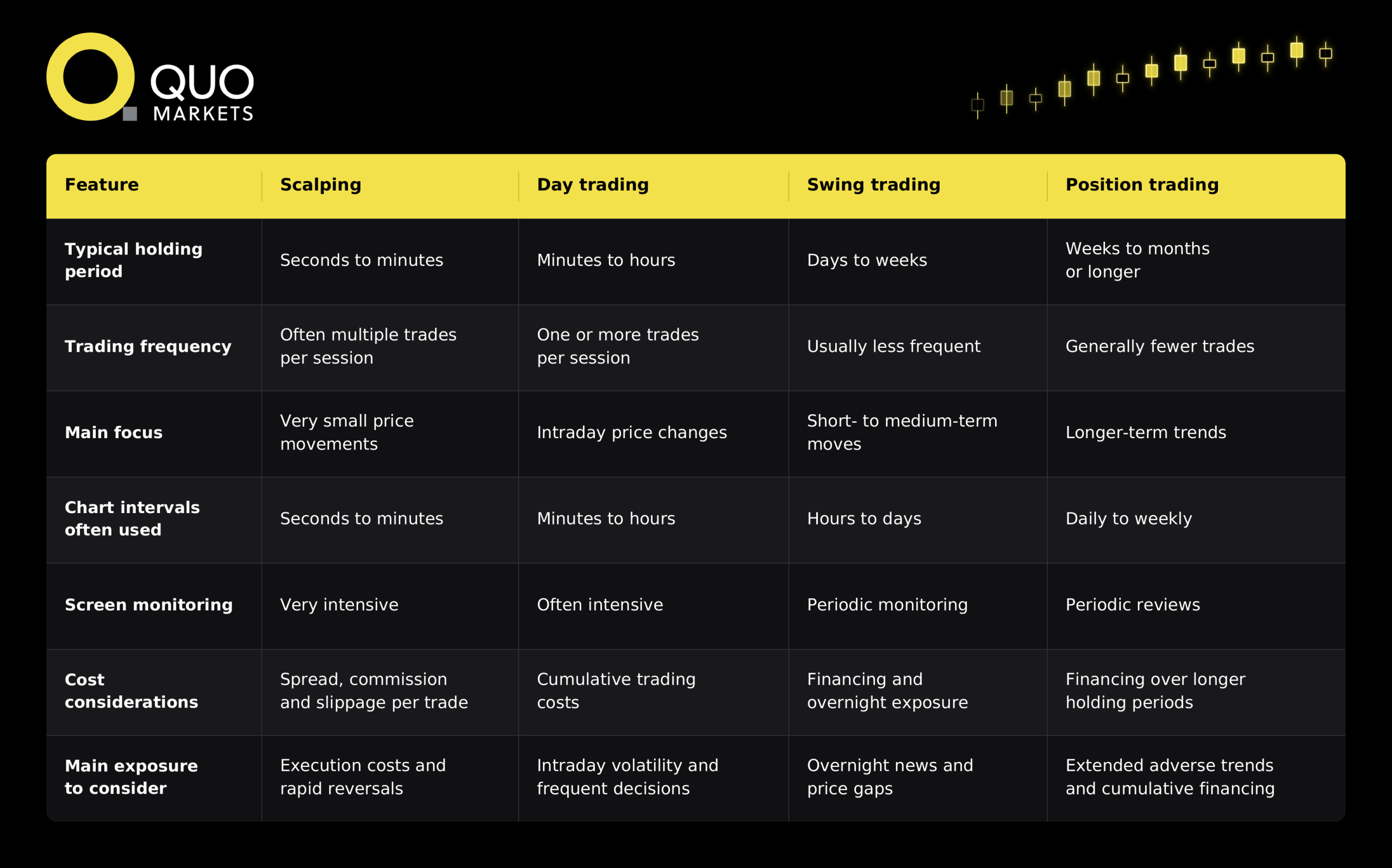
These are general characteristics rather than fixed rules. A trader may combine approaches, and the actual holding period depends on the instrument, strategy, and market conditions.
Other Trading Styles and Strategies
The four main styles are commonly classified by holding period. Other terms describe how traders identify opportunities or automate decisions, rather than how long a position must remain open.
Momentum trading
Momentum trading focuses on price movements that may continue in the same direction. Traders look for evidence of strengthening upward or downward movement, using price action, volume where available, and other indicators. Momentum can fade quickly or reverse, so the approach remains exposed to false signals and changing market conditions.
Breakout trading
Breakout trading seeks to take advantage of a price moving beyond an established range or a level traders have been watching. A breakout can signal a change in market behaviour, but some moves fail and return to the previous range. Traders may use confirmation rules and predefined exit levels to manage that uncertainty.
News and sentiment trading
News traders respond to developments such as inflation reports, central-bank decisions, earnings announcements, or geopolitical events. Sentiment trading focuses more broadly on how market participants appear to interpret available information.
Both approaches require care because markets can move before a news release, and the initial reaction may reverse. A widely anticipated announcement can also produce a different response from the one traders expect.
Algorithmic trading
Algorithmic trading uses computer programs to analyse data, generate orders, or execute trades according to predefined rules. Some systems operate at extremely short intervals, while others follow strategies that hold positions for much longer.
Automation can improve consistency in executing a set of rules, but it does not eliminate risk or guarantee that a strategy will perform as expected. Results depend on the model, data quality, market conditions, execution, and oversight. Algorithms can also respond poorly to unexpected events or technical failures.
These additional approaches can be combined with scalping, day trading, swing trading, or position trading. For example, a momentum strategy may be used for intraday trades or for positions held over several days.
Risk Management Across Different Types of Trading
Regardless of trading style, risk management helps traders define how much they are prepared to lose and how they will respond when a market moves against them. The details vary with holding period, instrument, and trading costs.
Several principles apply across approaches:
- Define the trade before entering: Identify the reason for the trade, the conditions that would invalidate the idea, and the planned exit.
- Set position sizes carefully: Consider the potential loss, account equity, leverage, and distance to the stop level.
- Understand the full cost: Account for spreads, commissions, overnight financing, and possible slippage.
- Recognise event risk: Economic announcements, earnings, and unexpected news can affect prices across every timeframe.
- Review results realistically: Assess performance after costs and over a meaningful sample of trades, rather than judging a strategy by one successful or unsuccessful outcome.
- Practise before trading live: A demo account can help test order execution and build familiarity with a platform, although live conditions can differ.
CFDs are leveraged products. Leverage allows a trader to control a larger position relative to the margin deposited, which magnifies the effect of price movements on account equity. Losses can accumulate quickly, and the applicable protections and terms depend on the provider and jurisdiction.
Trading CFDs With QuoMarkets
QuoMarkets offers CFDs across several markets, including Forex, indices, commodities and shares. Share CFDs provide exposure to changes in share prices without transferring ownership of the underlying company’s shares. Traders therefore need to understand the contract specifications and costs that apply to the instrument they trade.
The holding period can affect the practical costs of a CFD strategy. Scalping and day trading place particular emphasis on spreads, commissions and execution, while swing and position trading require attention to overnight financing and exposure to price gaps.
Before opening a position, review the relevant instrument’s trading conditions, contract specifications, trading hours and applicable charges. Consider practising in a demo environment and understand the risks of leverage before committing real funds.
Final Thoughts
The different types of trading describe distinct ways of approaching market movements. Scalping and day trading focus on short-term price changes, swing trading looks for moves over days or weeks, and position trading follows broader trends over longer periods.
Understanding the differences helps clarify what each approach involves, including the time commitment, trading costs, and risks. Whatever the holding period, a clearly defined strategy, realistic expectations, and disciplined risk management remain central to evaluating trading decisions.
FAQs
What are the four main types of trading?
The four commonly discussed trading styles are scalping, day trading, swing trading, and position trading. They differ mainly in how long positions are held, how frequently traders act, and how closely they monitor markets.
What is the difference between day trading and swing trading?
Day traders generally open and close positions within the same trading day. Swing traders usually hold positions for several days or weeks, aiming to capture a larger price movement over time. Swing trading involves overnight market exposure, while day trading typically avoids it by closing positions before the session ends.
How long do position traders hold trades?
Position traders may hold positions for weeks, months, or occasionally years. The actual holding period depends on the strategy, instrument, and whether the conditions supporting the trade remain in place.
Is scalping a type of day trading?
Scalping is generally considered a form of day trading because positions are typically opened and closed within the same session. Its defining feature is the very short holding period and focus on small price movements.
Can you combine different trading styles?
Yes. Some traders use different styles for different instruments or market conditions. However, each approach has its own entry rules, holding periods, cost considerations and risk limits. Combining styles without a clear plan can make it harder to assess performance and manage exposure.
Disclaimer: Trading CFDs, including oil and other commodities, involves a high level of risk and may not be suitable for all investors. Leverage can work both for and against you, magnifying both profits and losses. Past performance is not a reliable indicator of future results. Please ensure you understand the risks involved and seek independent financial advice if necessary before trading.