

Table of Contents
- What Is a Buffered ETF?
- Why Are Buffered ETFs Called “Boomer Candy”?
- How Do Buffered ETFs Work?
- Buffered ETFs vs. Covered Call ETFs vs. Traditional Index ETFs
- Buffered ETF Pros and Cons
- Understanding the Risks
- Defined Outcome vs. Flexible Market Access
- FAQs
Boomer Candy: The Blunt Wall Street Nickname Behind Buffered ETFs
Somewhere in financial media, someone started calling buffered ETFs boomer candy, and the name never really went away. It sounds playful, maybe even a little dismissive, but it is shorthand for a real product category built around one specific tradeoff: less downside risk in exchange for a ceiling on your gains, over a fixed stretch of time.
If you have seen the term floating around a financial newsletter or a retirement planning article and wondered what it actually means, this is the explainer. Let’s explore what a buffered ETF is, how it works mechanically, where the real risks sit, and why the boomer candy label stuck in the first place.
What Is a Buffered ETF?
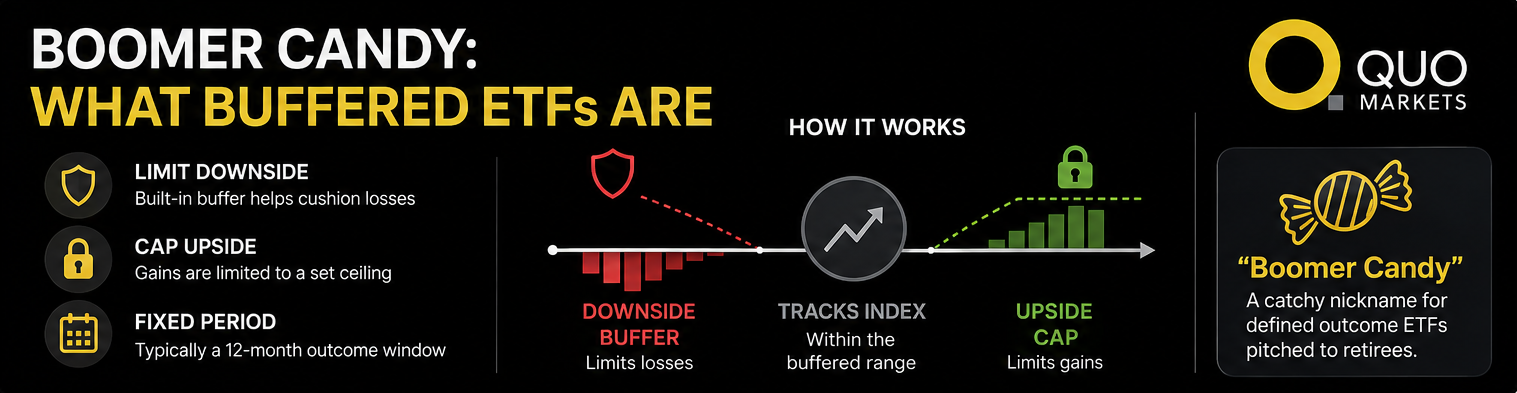
A buffered ETF is an exchange-traded fund built to limit an investor’s losses within a defined range, in exchange for capping how much that investor can gain over a set period, typically around twelve months. Financial media and asset managers also refer to these funds as defined outcome funds or structured outcome ETFs, and all three names describe the same underlying idea: the fund is engineered, using options contracts, to produce a return that falls somewhere between the full upside and the full downside of an underlying index.
The word “buffered” refers to that protective range. Instead of simply tracking an index like a traditional ETF, a buffered ETF layers options positions on top of the index to cushion a portion of any decline. In return for that cushion, the fund gives up part of the gain it would otherwise capture if the market rallies. Every buffered ETF operates on a fixed outcome period, and the stated buffer and cap only apply to investors who hold the fund from the start of that period straight through to the end.
Why Are Buffered ETFs Called “Boomer Candy”?
The nickname traces back to Bloomberg Intelligence analyst Eric Balchunas, who used it to describe buffered ETFs and similar defined outcome products. The Wall Street Journal picked it up soon after, and the phrase spread through financial commentary from there. It is reported terminology, not a formal industry classification, and it is worth treating as commentary on how these funds are marketed rather than a judgment on the products themselves.
The demographic angle is the point of the joke. Buffered ETFs are frequently pitched to retirees and conservative investors, people who want to stay invested in equities but who are understandably nervous about a sharp drawdown eating into savings they no longer have decades to rebuild. That audience skews older, hence “boomer.”
The “candy” part is where the nickname gets a bit sharper. It suggests something that looks appealingly sweet and simple on the surface, protection from losses, while the actual tradeoff, a hard cap on your gains and valuation quirks tied to the outcome period, is easy to gloss over in a short pitch. The name stuck because it captures that tension in two words, even if it oversimplifies a product that, mechanically, is more nuanced than a piece of candy.
How Do Buffered ETFs Work?
The mechanics come down to two options positions layered on top of an underlying index, most commonly the S&P 500.
First, the fund buys protective put options. A put option gives the fund the right to sell the index at a set price, which is what creates the downside buffer. If the index falls, the put options gain value and offset a portion of that loss, up to the stated buffer amount.
Second, the fund sells call options against the same index. Selling those calls generates the premium income used to help pay for the protective puts, and it is also what creates the cap. Because the fund has sold away the right to the index’s gains above a certain level, any rally past that point does not flow through to the investor.
Both positions run on a fixed outcome period, usually about twelve months, starting on a specific date and ending on a specific date. This is the detail that trips people up most often: the buffer and the cap are only guaranteed in full if you buy in at the start of the period and hold through to the end. Buy in partway through, or sell before the period closes, and your actual experience of the buffer or the cap can look different from what was advertised.
Buffered ETFs vs. Covered Call ETFs vs. Traditional Index ETFs

All three fall under the broader universe of equity index investing, but the way each one uses options, or does not use them at all, changes the outcome an investor should expect.
A traditional index ETF simply tracks its benchmark. There is no buffer and no cap; an investor captures the full upside and the full downside of the index, minus the fund’s expense ratio.
A covered call ETF holds the underlying index and sells call options against it to generate additional income. That income can boost returns in flat or modestly rising markets, but it does not offer explicit downside protection, and it caps upside in a strong rally in a similar way to a buffered ETF, just for a different reason: income generation rather than loss limitation.
A buffered ETF combines a protective put position with a call sale, using the call premium to help fund the put. The result is a defined range of outcomes rather than either full market exposure or an income overlay. It limits losses within a set buffer and caps gains within a set ceiling, for the length of one outcome period at a time.
Buffered ETF Pros and Cons

Buffered ETFs offer a real benefit for the right investor: a defined level of downside limitation and generally lower realized volatility compared with holding the uncushioned index outright. For someone who wants equity exposure but loses sleep over sharp corrections, that structure can be genuinely useful.
The tradeoffs sit right alongside those benefits, not in some separate list. The cap limits gains in a strong market year, sometimes significantly, which means a buffered ETF can lag a traditional index fund by a wide margin when the underlying benchmark has an exceptional run.
These funds also tend to carry higher expense ratios than a plain index ETF, since the options overlay adds management complexity. And because the stated buffer and cap are tied to a specific outcome period, an investor who enters or exits at the wrong time within that window may not receive the protection or the ceiling they expected.
None of this makes a buffered ETF good or bad on its own; it makes it a tool with a specific shape, and that shape needs to match what an investor is actually trying to accomplish.
Understanding the Risks
The risk that deserves the most attention is point-to-point valuation. A buffered ETF’s buffer and cap are calculated using the fund’s value on a single start date and a single end date within its outcome period. If an investor buys in after the period has already started, or sells before it ends, the buffer they experience and the cap they are subject to can differ from the numbers advertised for that fund. This is not a flaw hidden in the fine print; it is a structural feature of how these products are built, and it is the reason financial commentators keep circling back to it when they cover defined outcome funds.
Beyond that core mechanic, two other risks are worth naming plainly. Fees on buffered ETFs generally run higher than those on a comparable traditional index fund, which eats into returns over time regardless of market performance. And the capped upside itself is a real cost during strong years, not a hypothetical one. An investor who holds a buffered ETF through a year when the underlying index posts an unusually large gain will simply not receive all of that gain, by design. Weighing these risks against the stated downside protection is the entire exercise of evaluating whether a buffered ETF fits a given portfolio.
Defined Outcome vs. Flexible Market Access
It is worth stepping back and looking at buffered ETFs next to other market instruments purely in structural terms. A buffered ETF locks an investor into a fixed outcome period, generally around a year, with a single entry valuation date and a single exit valuation date that determine whether the stated buffer and cap actually apply. Other instruments used to gain market exposure, CFDs among them, work differently: they offer daily liquidity and carry no fixed holding period, meaning a position can be opened and closed on any trading day without waiting for an outcome window to complete.
Defined outcome structures and instruments with daily liquidity serve different purposes and carry different risk profiles, and neither is inherently better than the other. Understanding how each one actually functions, rather than reacting to a nickname or a marketing pitch, is what allows an investor to judge whether a given structure fits their own timeline and risk tolerance.
Conclusion
Buffered ETFs trade a portion of potential upside for a defined level of downside protection, and that tradeoff only applies as advertised across a fixed outcome period. Boomer candy is media shorthand for that arrangement, not a formal product category, and it says more about how these funds are marketed than about how they actually work. Understanding the mechanics, the buffer, the cap, and the valuation dates matters far more than the nickname when evaluating any defined outcome product against your own goals.
FAQs
What is a buffered ETF?
An exchange-traded fund that uses options to limit losses within a defined range, in exchange for capping gains over a set period, typically twelve months. Also called a defined outcome or structured outcome ETF.
How do buffered ETFs work?
The fund buys protective puts on an index, commonly the S&P 500, to limit downside, and sells call options to help fund that protection, which caps the upside. The stated buffer and cap apply in full only if held for the entire outcome period, usually one year.
Why are buffered ETFs called “boomer candy”?
Bloomberg Intelligence analyst Eric Balchunas coined the term, and the Wall Street Journal popularized it, to describe how these funds are pitched to retirees as a simple way to stay invested while limiting downside. Critics say the sweet pitch can obscure the capped returns, fees, and valuation risk underneath.
What’s the difference between a buffered ETF and a covered call ETF?
A buffered ETF buys puts to limit downside and caps upside to help pay for that protection. A covered call ETF sells calls for income, without offering explicit downside protection. Both fall under the defined outcome category, but one prioritizes loss limitation, and the other prioritizes income.
What are the risks of buffered ETFs?
The main one is point-to-point valuation: returns are set by the fund’s value on a single start and end date, so entering or exiting mid-cycle can mean a different buffer or cap than advertised. Higher fees, capped upside in strong years, and losses beyond the buffer are also risks.
Are buffered ETFs a good investment?
That depends on the investor. They trade unlimited upside for reduced volatility and partial downside protection, which is not guaranteed or risk-free. Whether that tradeoff pays off depends on how the buffer, cap, and holding period line up with actual market performance.
Risk disclaimer: CFDs are complex instruments and come with a high risk of losing money rapidly due to leverage. You should consider whether you understand how CFDs work before investing.